




OEM Poultry Shears: Precision in Kitchen Scissors
OEM poultry shears are a practical category for kitchenware brands, importers, wholesalers, and retailers that want to offer a durable cutting tool for everyday food preparation. Unlike general-purpose scissors, poultry shears are expected to handle slippery ingredients, thicker cuts, and repetitive kitchen tasks with control. For buyers sourcing from a kitchen scissors manufacturer or poultry shears factory, the goal is not only to find an attractive product, but to confirm that the design, materials, finishing, packaging, and quality process fit the target market.
The original product description highlights several useful features: premium stainless steel blades, micro-serrated edges for grip, an ergonomic black and grey soft-grip handle, a built-in bottle opener, a compact riveted pivot, and curved handles intended to improve leverage. These are relevant features for a poultry shears program, but B2B buyers should still verify the details directly with the supplier before placing an OEM or wholesale order.
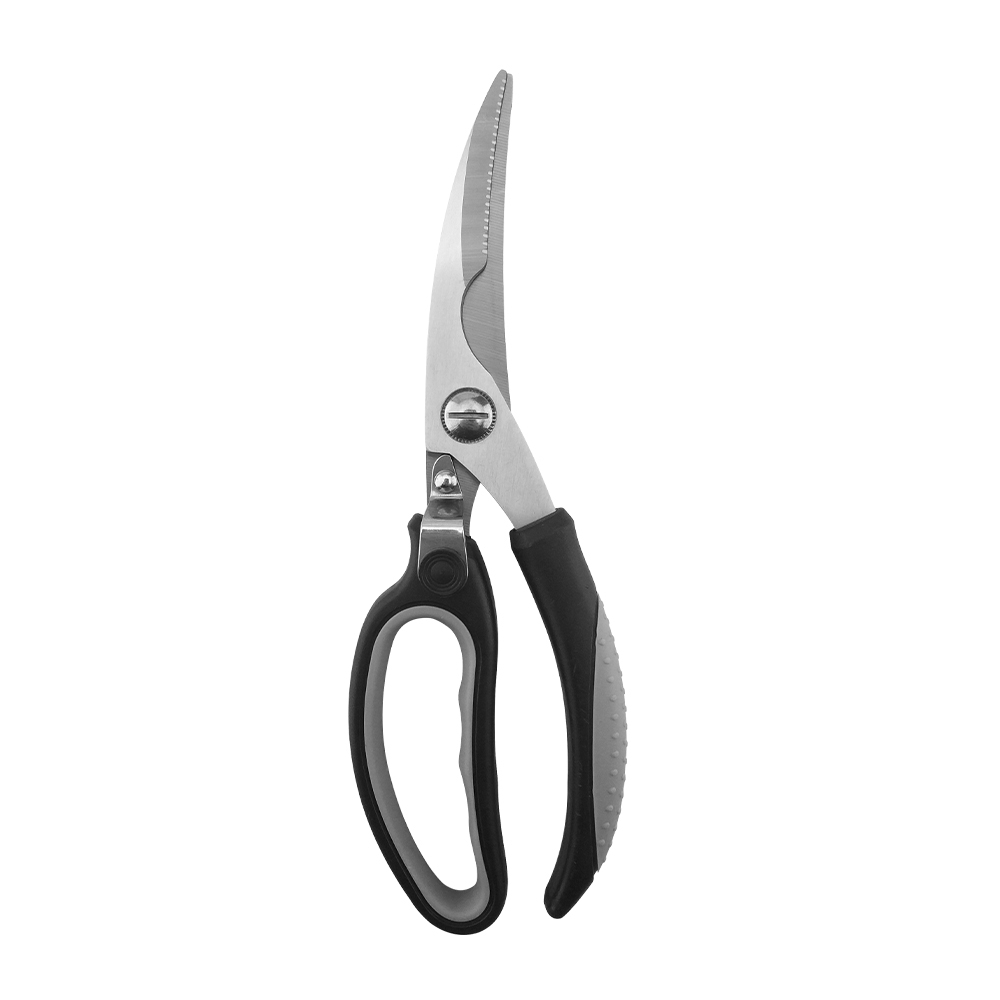
What Makes Poultry Shears Different from Standard Kitchen Scissors?
Poultry shears are designed for heavier kitchen cutting tasks than ordinary household scissors. They are often used to cut poultry joints, trim meat, portion vegetables, and prepare ingredients where a knife may be less convenient. The key difference is not only blade sharpness. A good pair of poultry shears should provide stable grip, controlled leverage, and a handle shape that remains comfortable when pressure is applied.
For OEM buyers, this distinction matters because customers judge poultry shears by performance under stress. If the product is positioned for meat and poultry preparation, the blade geometry, pivot strength, and handle comfort must support that claim. When reviewing samples, buyers should test the shears on realistic tasks instead of only checking appearance on a desk or showroom table.
Key Product Features to Evaluate
The source article describes stainless steel blades and micro-serrated edges. Stainless steel is commonly chosen for kitchen cutting tools because it is suitable for food-preparation environments and can support a clean, polished appearance. However, buyers should ask the supplier what stainless steel type is used, how the blades are heat treated, and what hardness range is targeted. These details affect edge retention, corrosion resistance, and long-term user satisfaction.
Micro-serrated edges are especially useful on slippery surfaces. They help hold poultry skin, meat, herbs, and vegetables during cutting, reducing the chance that the ingredient slides away from the blade. The built-in bottle opener adds secondary utility, although buyers should consider whether that function is suitable for their retail positioning. Some buyers prefer a simple food-prep tool, while others value multifunctional kitchen scissors.
- Blade material: confirm the stainless steel type and finishing process.
- Edge design: test whether the micro-serration grips without tearing food excessively.
- Pivot construction: check smooth opening, closing, and long-term stability.
- Handle comfort: evaluate grip when hands are dry, wet, or lightly oily.
- Extra functions: decide whether the bottle opener supports your target market.
OEM Sourcing Checklist for Buyers
When sourcing OEM poultry shears, buyers should move beyond catalog photos and request a structured evaluation. A supplier may be able to provide existing models, private-label packaging, color adjustments, or other customization options, but these commercial details must be confirmed. Do not assume MOQ, pricing, lead time, or certification status without written confirmation from the supplier.
| Evaluation Area | What to Check | Questions to Ask the Supplier |
|---|---|---|
| Blade and cutting performance | Sharpness, micro-serration, cutting control on poultry, meat, and vegetables | What stainless steel is used? Is there a documented blade treatment process? |
| Handle design | Comfort, grip stability, black and grey soft-grip finish, leverage | Can the handle color, texture, or logo placement be customized? |
| Pivot and assembly | Compact riveted pivot, smooth movement, resistance to wobble | How is pivot consistency checked during production? |
| Packaging | Retail presentation, instruction space, barcode area, multilingual needs | What packaging formats are available for OEM or wholesale orders? |
| Quality control | Inspection criteria, sample approval, defect handling | Can the supplier share inspection standards before mass production? |
| Compliance documents | Market-specific requirements for food-contact kitchen tools | Which documents are available, and which must be arranged for the destination market? |
How to Assess Samples Before Placing an OEM Order
Sample testing is one of the most important steps in poultry shears sourcing. A product can look strong in photos but feel unstable in use. Buyers should request pre-production or reference samples and test several units, not just one. Consistency across samples is often a better indicator of manufacturing control than a single perfect unit.
Start with a visual inspection. Check whether the blade edges are even, whether the handles are cleanly finished, and whether the riveted pivot sits securely. Open and close the shears repeatedly to feel for roughness, looseness, or uneven resistance. Then perform practical cutting tests with ingredients similar to the target user’s actual tasks. If the product is marketed for poultry preparation, include poultry-related cutting in the test plan.
- Inspect the blades for alignment, burrs, stains, or inconsistent finishing.
- Open and close the shears at least 30 to 50 times to check smoothness.
- Cut thin and thick food items to evaluate grip and blade control.
- Test the handle with wet hands to assess slip resistance and comfort.
- Wash and dry the shears according to the supplier’s care guidance, then inspect for changes.
- Record comments with photos so the supplier can make clear adjustments.
Handle Comfort, Safety, and User Experience
The original description mentions an ergonomic handle with black and grey soft-grip material and a subtle curvature that improves leverage. For end users, handle comfort can determine whether poultry shears are used frequently or left in a drawer. For buyers, it is important to evaluate the handle with different hand sizes and cutting angles.
A handle that feels comfortable during a light paper cut may still create pressure points when cutting thicker foods. Buyers should check the inside handle edges, the amount of finger space, and the grip texture. If the shears are intended for a wide consumer audience, avoid overly narrow handle openings. If the product is intended for professional or heavy home use, leverage and control become even more important.
Safety communication should also be considered. Sharp poultry shears need suitable packaging and clear handling guidance. If the shears include a bottle opener, packaging should explain the function without confusing customers about food-use care. For private-label programs, ask whether the supplier can support warning labels, care instructions, and packaging artwork based on your market requirements.
Packaging and Private-Label Considerations
OEM sourcing is not only about the tool itself. Packaging affects shelf appeal, shipping protection, customer education, and return rates. Buyers should decide whether the poultry shears will be sold through supermarkets, kitchenware stores, online marketplaces, food-service channels, or promotional programs. Each channel may require a different packaging approach.
For retail, a clear visual of the blade and handle may help customers understand the product quickly. For e-commerce, protective packaging and accurate product information are more important than shelf display. For wholesale or food-service supply, simple and durable packaging may be preferred. Ask the supplier which packaging options are available, what information can be printed, and whether packaging samples can be reviewed before production.
Quality Control Questions for a Poultry Shears Factory
Before confirming an order with a poultry shears factory or kitchen scissors manufacturer, buyers should define acceptable quality criteria. Vague instructions such as “good quality” are not enough. Provide measurable expectations where possible and ask the supplier how they inspect production.
Important quality points include blade alignment, pivot tightness, handle bonding or fitting, surface finish, edge consistency, packaging accuracy, and carton condition. If your market requires specific food-contact documentation or product labeling, raise this early. The supplier may have documents available, or you may need third-party testing based on your destination market and distribution channel.
Useful questions include: What is the normal inspection process? Are cutting tests performed during production? How are defective units handled? Can approved samples be sealed for comparison? What changes are possible before mass production? These questions help prevent misunderstandings and support a more reliable OEM program.
Use and Care Guidance to Include for End Users
Even a well-made pair of poultry shears performs better when customers use and care for it correctly. Buyers developing private-label packaging should consider adding concise care guidance. Recommend washing after use, drying before storage, and keeping the cutting edge away from children. If the supplier provides specific care instructions, follow those instructions rather than creating unsupported claims.
Because poultry shears are often used with raw meat, hygiene matters. Customers should clean the blades and handle areas thoroughly after food preparation. If the shears are not confirmed by the supplier as dishwasher-safe, do not print dishwasher-safe claims. Instead, ask the supplier for the correct cleaning recommendation and supporting information.
Key Takeaways
- OEM poultry shears should be evaluated for real cutting performance, not only appearance.
- The described features include stainless steel blades, micro-serrated edges, soft-grip handles, a bottle opener, and a riveted pivot.
- Buyers should confirm material details, customization options, packaging choices, MOQ, lead time, and compliance documents directly with the supplier.
- Sample testing should include blade alignment, pivot smoothness, handle comfort, and realistic kitchen cutting tasks.
- Clear care instructions and accurate packaging claims help reduce customer confusion and product complaints.
FAQ: OEM Poultry Shears Sourcing
What should I ask a supplier before ordering OEM poultry shears?
Ask about blade material, edge treatment, pivot construction, handle customization, packaging options, sample availability, inspection standards, lead time, MOQ, and any documents required for your target market.
Are micro-serrated edges useful on poultry shears?
Yes. Micro-serrated edges can help grip slippery foods such as poultry skin or meat, giving users more control while cutting. Buyers should still test samples to confirm the serration feels smooth and effective.
Can I claim the shears are dishwasher-safe?
Only make that claim if the supplier confirms it and provides appropriate support. If dishwasher suitability is not confirmed, use conservative care guidance such as washing and drying after use.
How many samples should be tested?
Testing several samples is better than relying on one unit. Multiple samples help buyers evaluate consistency in blade alignment, pivot movement, handle finish, and cutting performance.
Is a built-in bottle opener necessary?
It depends on the sales channel and target customer. A bottle opener adds utility, but some buyers may prefer a simpler poultry-preparation tool. Evaluate whether the feature supports your product positioning.
