




OEM Scissors Manufacturing: How to Source Coated Household Scissors
For retailers, importers, promotional product buyers, and private-label brands, scissors may look like a simple category. In practice, a good sourcing decision depends on blade material, edge retention, handle comfort, finishing quality, packaging, and repeatable production. The original article introduced a new generation of household scissors with advanced blade treatments and colorful styling. This rewritten guide expands that idea into practical B2B sourcing advice for buyers evaluating OEM scissors manufacturing, especially when considering titanium-coated or decorative household scissors.

Key Takeaways
- Define the target use first: household, craft, kitchen prep, office, or promotional gifting.
- Advanced coatings, including titanium-style finishes, can add wear resistance and visual appeal, but buyers should verify performance with samples.
- Comfort, blade alignment, opening-and-closing feel, and packaging quality are as important as the blade finish.
- Ask suppliers clear questions about materials, coating process, inspection standards, customization options, lead time, MOQ, and compliance documentation.
Why OEM Scissors Require More Than a Catalog Choice
OEM scissors sourcing is not only about choosing an existing shape and adding a logo. Scissors are hand tools that customers judge immediately. If the blades drag, the pivot is loose, the handle feels sharp at the edges, or the coating scratches too easily, the product can create returns and poor reviews. A reliable OEM project should begin with a written product brief that defines the intended user, expected retail price range, sales channel, packaging format, and preferred appearance.
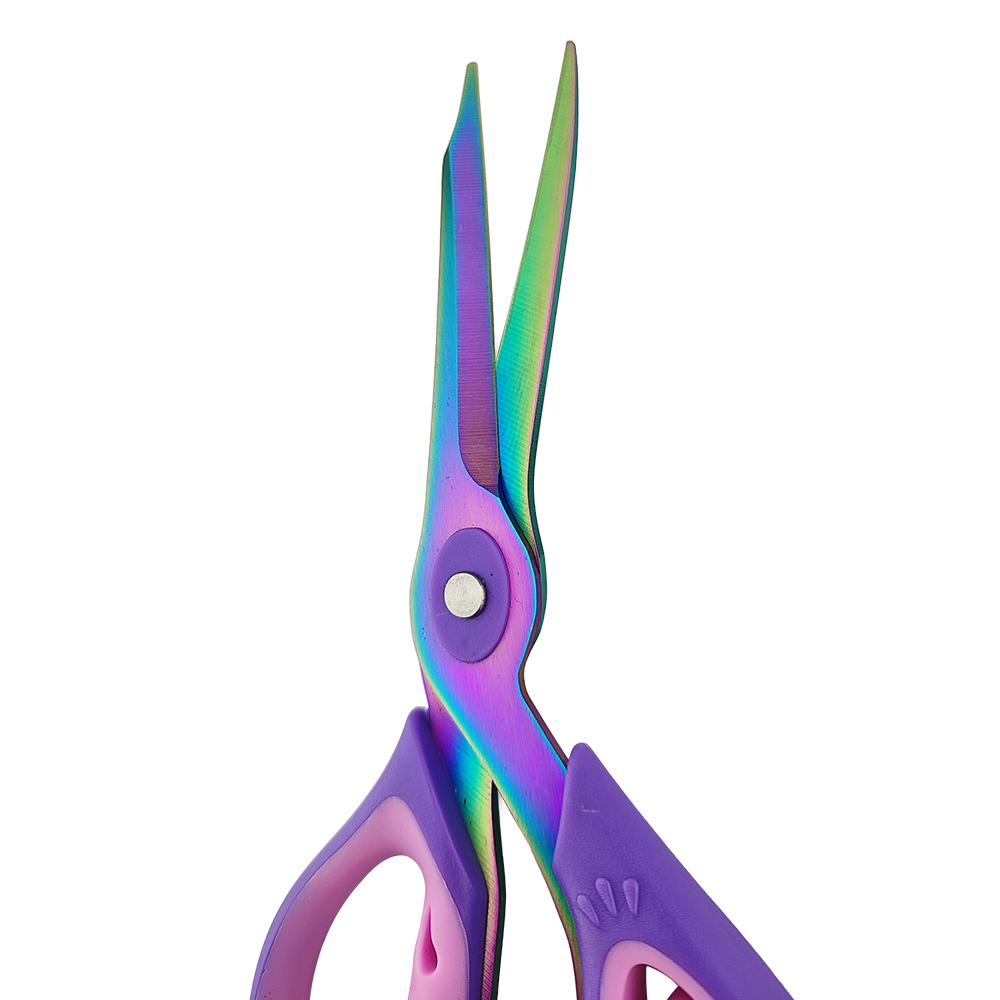
For household scissors, buyers often want a balance of sharpness, durability, comfort, and visual differentiation. A decorative iridescent or rainbow-hued blade can help a product stand out, while an ergonomic colorful handle may improve shelf appeal and daily usability. However, appearance should not replace basic function. Request physical samples and test them on the materials your customers are likely to cut, such as paper, light cardboard, packaging film, fabric scraps, thread, or food packaging.
Understanding Titanium-Coated Scissors
The original article highlighted titanium coating scissors as an upgrade over uncoated alternatives. In many scissors designs, stainless steel provides the base for the blade, while an added coating or finish may improve surface hardness, wear resistance, corrosion resistance, and long-term appearance. A titanium-style coating can also create the colorful gradient effect often associated with iridescent scissors.
Buyers should still avoid assuming that every coated product performs the same. Coating quality depends on the substrate, preparation, application method, thickness, adhesion, and post-production handling. When sourcing titanium-coated household scissors, ask the supplier to explain what the coating is, what benefits it is intended to provide, and how the factory checks adhesion, edge sharpness, and surface consistency. If your market requires specific chemical or safety documentation, request the relevant records before placing a bulk order.
Comparison Checklist for Buyer Evaluation
| Evaluation Area | What to Check | Questions to Ask the Supplier |
|---|---|---|
| Blade base material | Cutting feel, rust resistance, edge consistency | What blade material is used, and can it be confirmed in the specification sheet? |
| Coating or finish | Color uniformity, scratch resistance, adhesion, edge condition | What coating process is used, and how is coating durability inspected? |
| Pivot and alignment | Smooth opening, no wobble, clean full-length cutting | What tolerance or inspection method is used for blade alignment? |
| Handle design | Grip comfort, finger-hole size, burr-free edges | Can handle color, material, or logo placement be customized? |
| Packaging | Retail presentation, barcode area, shipping protection | What packaging options are available for retail, e-commerce, or wholesale packs? |
| Quality control | Sample approval, batch inspection, defect criteria | Can you provide an inspection checklist before production? |
Product Design Choices That Affect Market Fit
Scissors used at home may need to handle several tasks: opening stubborn packaging, cutting paper for school projects, trimming craft materials, or assisting with light kitchen prep. This wide use case makes design decisions important. A longer blade may be useful for straight cuts, while a shorter blade may provide control. A bright handle color can help users find the tool quickly in a drawer, while a softer grip may be more comfortable for repeated cutting.
If the product is intended for gift sets, back-to-school programs, office supply retailers, or homeware collections, the finish and packaging may matter more. If it is intended for utility use, blade performance and durability should take priority. In either case, an OEM supplier should help translate the buyer’s requirements into a practical specification rather than simply offering a generic model.
Sample Testing Before Bulk Production
Before confirming an OEM scissors order, build a small but realistic test plan. The goal is not to duplicate a laboratory unless required by your market; it is to catch obvious performance and consistency issues before they become expensive. Compare coated and uncoated samples if both are under consideration. Cut the same materials repeatedly and observe whether the blades remain aligned, whether the pivot loosens, and whether the coating shows visible wear during normal handling.
- Check appearance under good lighting for scratches, uneven color, stains, or burrs.
- Open and close each sample several times to assess smoothness and tension.
- Cut paper from heel to tip to identify gaps or dull areas.
- Test representative materials such as packaging, light fabric, or craft paper.
- Inspect the handle for comfort, molding marks, and sharp edges.
- Review packaging fit to prevent movement and surface damage in transit.
Customization, Branding, and Packaging Questions
OEM buyers often request private-label packaging, handle color matching, printed logos, barcode placement, or display-ready cartons. These details should be confirmed early because they affect artwork preparation, sample lead time, cost, and inspection. Do not assume every factory can support the same branding method on every handle material or coating finish. Ask for examples, artwork templates, and a pre-production sample that includes the final packaging.
Commercial details such as MOQ, unit pricing, production lead time, payment terms, and shipping method should be requested directly from the supplier. If your sales channel has packaging, labeling, or compliance requirements, include them in the RFQ rather than raising them after production begins. Clear documentation reduces misunderstandings and helps both sides evaluate whether the project is suitable.
How to Choose an OEM Scissors Supplier
A capable scissors supplier should communicate clearly, provide consistent samples, and answer technical questions without overpromising. Look for a partner that can discuss blade material, coating finish, handle construction, inspection steps, and packaging options in detail. Ask how defects are categorized, how many samples can be provided for approval, and whether the supplier can keep a sealed reference sample for production comparison.
For international sourcing, also ask about export experience, document preparation, and carton marking. If certifications or testing reports are necessary for your market, request current documents and confirm that they apply to the exact product being purchased. Avoid relying on broad claims that are not connected to your model, finish, or packaging.
FAQ
Are titanium-coated scissors always better than uncoated scissors?
Not always. A coating may improve wear resistance and appearance, but overall quality also depends on blade material, edge grinding, alignment, pivot construction, and quality control. Test samples before deciding.
What materials should household scissors be tested on?
Use materials that match the intended customer use, such as paper, light cardboard, packaging film, fabric scraps, thread, or craft materials. Avoid promising performance on heavy materials unless the design is made for that purpose.
Can OEM scissors be customized with colors and logos?
Often, yes, but the options depend on the supplier’s models, handle material, coating finish, printing method, and order quantity. Request artwork guidelines and a branded pre-production sample.
What should buyers ask before placing a bulk order?
Ask about blade material, coating process, inspection standards, sample approval, packaging options, MOQ, lead time, pricing, compliance documents, and how the supplier handles defects or production changes.
How can buyers reduce quality risk?
Create a written specification, approve physical samples, define inspection criteria, keep a reference sample, and check packaging protection. For larger orders, consider independent pre-shipment inspection if appropriate.
