




Quick answer: A dependable plastic cutting board manufacturer should be able to identify the approved material, explain the product's manufacturing and inspection controls, provide market-relevant food-contact evidence, and reproduce the approved sample across successive production lots. For a retailer or importer, the strongest supplier evaluation connects four records: the finished-product specification, the material and colorant documentation, the pre-shipment inspection results, and the packaging revision that will reach the customer.
That is a more useful test than a catalog photograph or a statement that a board is “premium quality.” A plastic board may look simple, but small changes in resin formulation, thickness, surface texture, handling features, or packaging can affect the way it feels, cleans, travels, and performs after repeat orders. This guide is written for procurement teams building a verifiable PP cutting-board supply program—not for shoppers choosing a single board for home use.
BONET HOUSEWARE CO., LTD., based in Yangjiang, China, lists a PP chopping board under product reference C101, measuring 24.8 × 14.8 × 0.8 cm, and describes OEM/ODM kitchenware services covering design discussions, sampling, material and packaging customization, inspection, and export coordination. These published facts offer a starting point, not a substitute for an approved production specification or a current commercial quotation.
The buyer's decision in one sentence: select the board that can be documented, inspected, and reordered consistently for your intended market—not simply the board with the lowest opening quote.
1. What Should a Plastic Cutting Board Manufacturer Actually Prove?
When a buyer searches for a plastic cutting board manufacturer, the real question is whether a supplier can translate a product description into repeatable, inspectable output. Marketing images cannot show how a factory manages resin changes, cosmetic defects, label versions, or an unexpected variation between the first and third shipments. A structured supplier audit asks for evidence at each of these handoffs.
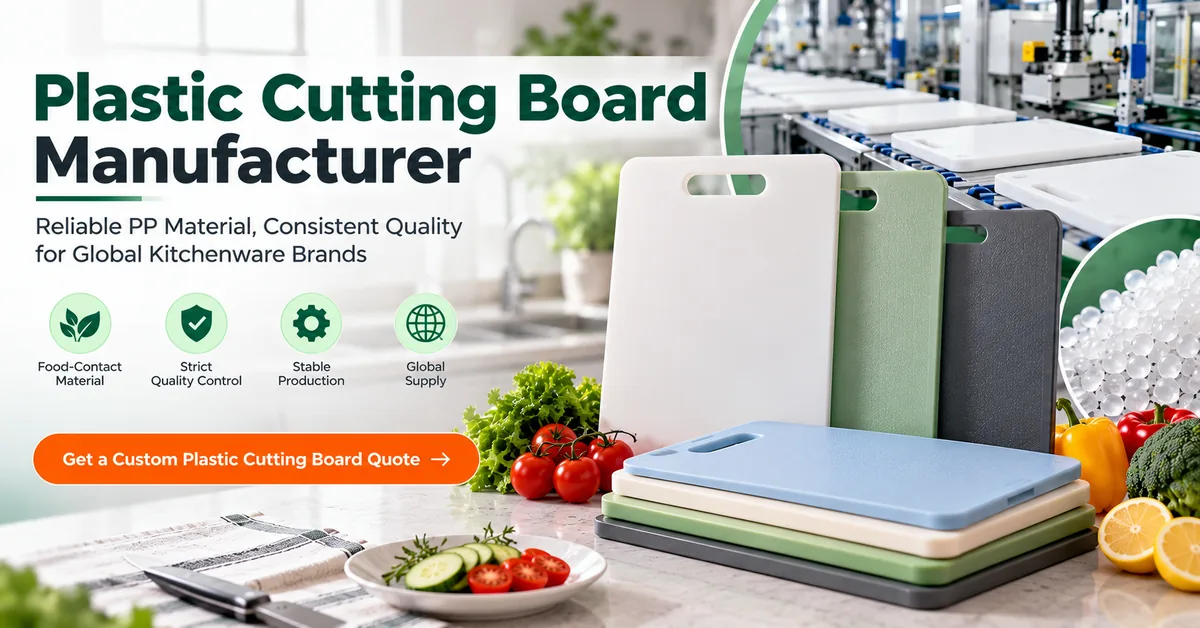
Start with product identity. Does the supplier have a traceable model number, a current drawing, a defined material, and a clear distinction between standard options and proposed custom work? Next assess production control: how is an approved sample used on the line, who can authorize changes, and what inspection records are available? Then assess commercial reliability: can the supplier explain how quantity, packaging, testing, and lead time affect a quotation without promising a universal MOQ or delivery date?
An importer should also determine which activities are performed directly by the supplier and which are outsourced. “Manufacturer” does not by itself prove that resin compounding, tooling, molding, printing, laboratory testing, or every packaging step takes place under one roof. Ask for the actual process map and responsible party. Outsourcing is not automatically a problem; undocumented responsibility is.
A strong evaluation ends with a practical deliverable: a supplier-approved control plan naming the product revision, material requirements, critical dimensions, inspection methods, reporting schedule, and procedure for handling nonconforming goods. This turns an attractive sample into a procurement asset that can be used again when staff, production shifts, or order quantities change.
2. Which Buyers Benefit—and When Is This Not the Right Product?
The framework is especially relevant to kitchenware importers managing repeat containers or mixed-SKU shipments, private-label brands placing their name on consumer packaging, supermarket and homeware chains needing consistent barcode and shelf presentation, and e-commerce sellers exposed to parcel damage and return costs. Food-service distributors may also find it useful, provided the exact board is assessed for their operating conditions rather than assumed suitable for intensive professional use.
A compact PP board can be positioned as an everyday food-preparation accessory, a kitchenware assortment component, or a potential bundle with other kitchen tools. However, it should not automatically be presented as an industrial butcher's block, a heavy-duty restaurant board, a certified antimicrobial product, or a heatproof worktop protector. Those uses require different performance requirements and supporting evidence.
Buyers planning unusual dimensions, thick commercial slabs, special antimicrobial additives, recycled-content claims, or specific high-temperature cleaning processes should request a feasibility and documentation review first. The fact that a supplier offers broad OEM/ODM services does not mean every requested feature is already a standard product or has completed testing.
3. BONET's Verified PP Reference: Model C101
A useful manufacturer assessment begins with an actual product, not a hypothetical specification. BONET's publicly listed cutting-board detail page identifies item C101, plastic material PP, and dimensions 24.8 × 14.8 × 0.8 cm. Its category page positions the board for everyday kitchen preparation and suitable serving applications. Buyers can review the C101 product page and the Chopping Board category before preparing a request for quotation.
| Product attribute | Public BONET information | Procurement verification needed |
|---|---|---|
| Reference | C101 | Confirm current SKU, drawing revision and sample availability |
| Product type | Cutting / chopping board | Define intended foods, user group and operating conditions |
| Listed plastic | PP (polypropylene) | Confirm resin grade, additives, colorants and material records |
| Published dimensions | 24.8 × 14.8 × 0.8 cm | Agree tolerances, measuring points and weight target |
| Metal material field | Not specified as a metal component | Do not infer metal construction from generic descriptions |
| Color, surface and edge | Final production options not established by this table | Obtain photographs, finish standard and approved sample |
| MOQ, price, production time | No universal figures verified | Request project-specific quotation and schedule |
| Food-contact testing | No model-specific report verified in this review | Request evidence matching the actual article and market |
| Packaging | To be agreed | Confirm individual pack, label, carton and shipment protection |
This is an important distinction: PP is the publicly identified plastic material, but the published product record is not a complete bill of materials or compliance dossier. A responsible importer should request the exact formulation and supporting documents relevant to its sales market, particularly if colors, additives, surface treatments, or other components will change.
4. Specify the PP Resin, Not Just the Word “Plastic”
For a plastic cutting board manufacturer, polypropylene is a broad polymer family. A purchasing specification that says only “PP cutting board” leaves too many variables open. Different resin grades and formulations can behave differently during forming, handling, cleaning, and use. The approved specification should identify the resin or controlled material designation and any permitted alternatives, without demanding proprietary information that the supplier cannot legally disclose.
Ask for a material declaration or relevant supplier documentation that distinguishes base polymer, color masterbatch, additives, and any other food-contact components. Clarify whether reprocessed material is used, whether any regrind is allowed, and what controls prevent unapproved mixing or contamination. If the answer is “food-grade plastic,” follow up: what does that claim mean for the finished article and the specific intended use?
Incoming-material records can include supplier identity, batch or lot number, receipt date, material code, inspection status, and a reference to the applicable specification or certificate of analysis. A certificate of analysis is useful only if its information is relevant to the accepted material and can be linked to the material actually used in production. It should not be treated as a universal certificate of food-contact compliance.
Color deserves the same discipline. A green board and a white board may use different pigments or masterbatches, and an importer should not automatically extend one color's documentation to another. If a private-label program needs multiple colors, request confirmation of each color's material status and agree on a master color reference under controlled viewing conditions.
For a repeat order, the critical question is simple: what prevents an unapproved resin or colorant substitution? The answer should involve documented change approval, traceable production records, and an escalation route—not merely a promise that the factory will be careful.
5. PP Versus HDPE: A Manufacturing Procurement Decision
Both polypropylene (PP) and high-density polyethylene (HDPE) are used in plastic cutting boards. But for a B2B buyer, the more important issue is not which polymer wins a general consumer comparison. It is which specific finished-board construction can meet the channel's handling, cleaning, surface, and documentation requirements at an acceptable total cost.
| Procurement consideration | PP board program | HDPE board program |
|---|---|---|
| Material identity | Require controlled PP grade and colorant records | Require controlled HDPE grade and colorant records |
| Product feel | Often comparatively firm, depending on grade and design | Often more yielding under a knife, depending on grade and design |
| Temperature-related claims | Validate with the finished product and intended wash cycle | Validate with the finished product and intended wash cycle |
| Thickness and stability | Determine through sample tests, not polymer name alone | Determine through sample tests, not polymer name alone |
| Manufacturing route | Confirm actual molding or machining method | Confirm actual molding or machining method |
| Regulatory review | Assess complete article, formulation and use conditions | Assess complete article, formulation and use conditions |
| BONET published reference | C101 is listed as PP | No specific HDPE board model confirmed here |
A retailer might choose PP for a compact household assortment, while a professional kitchenware channel may request a thicker or differently finished format. Neither choice automatically provides better sanitation or longer life. Surface wear, cleaning instructions, board stability, and replacement guidance still matter.
The correct comparison uses matched sample conditions: similar board size, agreed thickness, intended use, and a documented cleaning procedure. If the buyer changes from PP to HDPE after sampling, the material and performance approval should be revisited rather than assuming the new version is interchangeable.
6. Understand the Manufacturing Route Before Setting Acceptance Criteria
A plastic cutting board manufacturer may use different production routes, including forming processes and machining from suitable stock. The route influences possible geometry, tooling economics, edge details, surface finish, and the controls needed for consistency. BONET's public C101 listing does not establish the exact production route for that SKU, so the following is a buyer's verification checklist, not a claim about a specific BONET machine.
If a board is injection molded, ask how the manufacturer controls filling, cooling, dimensional change, gate or parting-line appearance, and removal of excess material. The buyer need not prescribe confidential machine settings, but should define the visible and functional outcome. If a board is machined or cut from sheet, review stock material identification, cut accuracy, edge treatment, surface quality, and any marks introduced during handling. Other routes may require different checks.
The handhold deserves attention. A comfortable slot in a sample can become a complaint source if edges vary or burrs remain. Likewise, a smooth-looking surface can show uneven texture, sink marks, flash, or visible scratches under retail lighting. Define the allowed finish through a signed sample and written criteria rather than an adjective such as “perfect.”
Ask the manufacturer to show how a product moves through material receipt, forming or machining, finishing, cleaning where applicable, inspection, and packing. The supplier should also explain how it segregates rejected pieces and how it prevents those pieces from being mixed back into accepted stock. This manufacturing-flow review is particularly useful when the importer plans more than one SKU or color.
7. Create a Finished-Board Specification That Inspectors Can Use
A drawing becomes useful when its requirements are measurable. For model C101, the published nominal dimensions are a starting point, but the website does not publish the allowable dimensional tolerances. Buyers should not invent a factory tolerance and present it as an existing BONET standard. Instead, agree on tolerances that match product function, process capability, inspection method, and commercial requirements.
A complete finished-board specification should define the following items before a production release:
| Control item | What the buyer should define | Evidence at approval |
|---|---|---|
| Overall length and width | Nominal dimensions, datum points, allowed variation | Dimensioned drawing and sample measurement |
| Thickness | Where and how thickness is measured; allowable variation | Approved measurement plan |
| Flatness / rocking | Test surface, method and pass/fail rule | Recorded test on representative samples |
| Edge and handhold finish | No hazardous sharp edges, burrs or unacceptable flash | Approved finish sample and inspection photos |
| Surface appearance | Texture, scratches, discoloration and cosmetic limits | Golden sample and defect examples |
| Weight | Target or reference range, if commercially important | Verified packed and unpacked weights |
| Color | Master reference, lighting and acceptable variation | Signed color standard |
| Cleaning instructions | Validated care method and limitations | Final label copy and supporting evidence |
| Packaging | Pack count, artwork version, barcode and carton details | Physical packed sample and carton specification |
For an e-commerce program, a board that passes dimensional checks can still fail commercially if the retail sleeve tears or the carton allows rubbing between units. For a supermarket, a product may be functionally sound but rejected because of the wrong barcode, a poorly positioned hang tab, or inconsistent product labeling. Include those conditions in the acceptance plan.
8. Material Traceability: The Link Between Samples and Production Lots
Traceability is the ability to connect a delivered board to the approved inputs and production records that produced it. It does not require every retail buyer to receive a factory's complete internal database. It does require enough information to investigate a complaint, identify affected goods, and verify that approved material controls were followed.
For each production lot, request a practical record chain: purchase order and product revision; incoming resin and colorant references; manufacturing date or lot; relevant inspection results; packaging artwork version; and master-carton or shipment identification. The exact structure can be proportionate to order size and risk. For some projects, a simple lot code linked to controlled factory records is more useful than an elaborate spreadsheet that nobody maintains.
The buyer should also define how a material or process change is handled. A resin grade change, new masterbatch supplier, revised tool, modified texture, or packaging substitute can affect performance or claims. Agree on which changes require notification, re-sampling, testing, or written approval before production. If a manufacturer proposes an alternative material to control costs, request a comparison and assess whether the original compliance evidence still applies.
A lot-traceability review becomes particularly valuable when an importer operates in several countries. A product with the same appearance may require different packaging languages or market documentation. A shipment code should allow the team to identify which label and technical revision reached each destination without guessing.
9. Food-Contact Evidence for EU and US Buyers
When evaluating a plastic cutting board manufacturer, remember that its products contact food directly, so material suitability is not an optional marketing detail. A buyer must verify requirements for the finished article, actual composition, intended food types, contact conditions, and destination market. Statements such as “FDA approved,” “EU certified,” “BPA-free,” or “antibacterial” should never be added automatically because the board is made of PP.
European Union: The European Commission identifies Regulation (EC) No 1935/2004 as the general framework for food-contact materials and Commission Regulation (EU) No 10/2011 as the specific plastics measure. The plastics rules have been amended, including changes concerning manufacturing quality control and substance authorizations. A buyer should assess the applicable current requirements and amendments, request the relevant Declaration of Compliance where required, and review supporting evidence for the intended use. Migration testing, traceability, and manufacturing controls may be relevant, depending on the article and regulatory obligations. A resin certificate alone does not establish that a finished colored board meets every requirement.
United States: The U.S. Food and Drug Administration explains that the regulatory status of a food-contact material depends on its constituent substances and their intended conditions of use. Certain olefin polymers are addressed in 21 CFR 177.1520, but the existence of that provision does not make every PP formulation automatically compliant. Buyers should check the applicable authorizations, limitations, colorants, processing aids, and any manufacturer-specific notification conditions where relevant. The phrase “FDA-approved cutting board” is usually too broad to be useful without a precisely documented basis.
Documentation request: identify the finished SKU and color; material and additive references; applicable regulatory basis; intended contact conditions; declaration or compliance statement as appropriate; relevant test report dates, methods, and scope; and any restrictions that should appear in instructions. A qualified regulatory or laboratory specialist should review the package for the target market. This article describes buyer due diligence and does not state that BONET C101 has passed any particular test.
The European Commission's public food-contact legislation guidance and the FDA's guidance on determining the regulatory status of food-contact components are useful third-party reference points. These are named for verification rather than presented as certifications held by BONET.
10. Performance Tests That Protect the Retail Experience
Compliance documentation and practical performance are related but different questions. A board might use an appropriately documented material yet still wobble on a countertop, develop unacceptable cosmetic marks during shipment, or carry care instructions that do not match actual performance. The buyer should define a fit-for-purpose test plan before approving packaging claims.
Flatness and stability: place representative boards on a defined flat test surface and record whether they rock or slip under an agreed method. Define acceptable behavior for the intended household use. Edge and handhold: inspect for sharp flash, rough transitions, and discomfort when lifting. Surface wear: agree on a practical knife-use simulation if the product positioning requires it; do not advertise a universal “scratch-proof” result. Cleaning: validate the instructions actually printed on the package, including water temperature and dishwasher conditions only if substantiated.
If a retailer wants a dishwasher-safe statement, ask what wash cycle, temperature, placement, and number of repetitions support that statement for the finished board. If a brand wants a heat-resistant claim, define the exact condition and failure criterion. The polymer name alone is not a temperature rating, and a single good-looking sample is not a statistically valid lifetime test.
Also check the interaction between the board and its packaging. A board that is flat after production may arrive warped or marked if stacked, compressed, or exposed to unfavorable conditions in transit. Packaging trials should therefore evaluate the finished, packed article—not just the unpacked board.
11. Build a Risk-Based Inspection Plan, Not a Generic Checklist
A plastic cutting board manufacturer should be evaluated on the ability to implement a mutually agreed inspection plan. The buyer and supplier should decide which defects are critical, major, or minor, how samples are selected, what records are retained, and what happens if a shipment fails. The use of an AQL-based sampling method, if appropriate, requires an agreed sampling standard, inspection level, defect definitions, and acceptance numbers. “AQL passed” without these details is not enough.
| Inspection area | Example issue | Suggested buyer treatment |
|---|---|---|
| Material / identity | Wrong resin or unapproved formulation | Hold shipment pending investigation and evidence |
| Product safety | Sharp edge or detached component presenting a hazard | Treat as a critical concern under the agreed plan |
| Geometry | Thickness, length or flatness outside agreed tolerance | Record as defined functional defect |
| Surface | Visible scratches, bubbles, discoloration or flash | Judge against approved cosmetic standard |
| Hygiene / cleanliness | Foreign matter or unacceptable residues | Investigate cleaning and packing controls |
| Label and claims | Wrong barcode, material statement or market language | Segregate affected packs; approve corrective action |
| Carton / packing | Incorrect quantity or inadequate protection | Correct before shipment or agree remedy |
| Traceability | Missing lot link or unauthorized material change | Pause release until records are reconciled |
The above classifications are planning examples, not published BONET defect standards. Buyers should formalize actual criteria in the purchase agreement. For first orders, consider pre-production approval, a check of early production units, and pre-shipment inspection. For stable repeat orders, adjust oversight according to evidence, defect history, and the consequences of failure—not merely to reduce inspection cost.
When a defect is found, request more than a replacement promise. Ask for the affected quantity, containment action, probable root cause, correction, prevention measure, and method for confirming effectiveness. A supplier that documents corrective action can help the importer reduce repeat claims and protect customer trust.
12. A Practical Lot-Release Matrix for Procurement Teams
To make a plastic cutting board manufacturer inspection program usable across purchasing, quality, and logistics departments, define the record required before each shipment is released. The table below can be adapted into a purchase-order appendix or supplier scorecard.
| Release gate | Evidence to request | Buyer decision |
|---|---|---|
| Product revision | Approved drawing, SKU and signed reference sample | Is this the version we ordered? |
| Material | Controlled PP material and colorant records | Are the inputs consistent with approval? |
| Food-contact dossier | Market-relevant statements and supporting evidence | Are claims and intended uses supported? |
| Dimensional checks | Lot inspection measurements | Are agreed tolerances met? |
| Visual / functional checks | Inspection photos and pass/fail results | Are appearance and handling acceptable? |
| Packing artwork | Final print file, barcode and language version | Is the correct retail version being shipped? |
| Carton control | Pack count, carton dimensions and marks | Does shipment configuration match the PO? |
| Traceability | Lot identifier linked to production records | Can affected units be located if needed? |
| Nonconformities | Deviation log and approved corrective actions | Are outstanding risks resolved? |
| Shipping authorization | Final packing list and release confirmation | May the goods be dispatched? |
The matrix makes responsibility visible. It also prevents a common failure: the sourcing team approves the physical board while marketing changes the package and logistics changes the carton without a shared final sign-off. A compact release checklist is often more effective than a long supplier manual that is not connected to actual shipment decisions.
13. How BONET's OEM/ODM Process Fits a PP Board Project
BONET's published OEM/ODM service page describes six collaboration stages: requirement communication, design and sampling, quotation and confirmation, mass production, quality inspection, and packaging and delivery. It also lists material, color, logo, and packaging customization support for kitchenware. For a plastic board project, these stages can be translated into clear procurement deliverables.

- Requirement communication: identify the sales market, intended user, baseline model C101 or a proposed design, estimated volume, material expectations, colors, packaging, and required documentation.
- Design and sampling: approve the board's geometry, appearance, handling features, material reference, color, and packed sample. Record what is a standard option versus a custom development request.
- Quotation and confirmation: review quantity breaks, sample or tooling charges where applicable, MOQ, production lead time, Incoterms, testing responsibility, and the approved technical revision.
- Mass production: require confirmation that the approved product and material records are being used, with a defined escalation process for substitutions or deviations.
- Quality inspection: assess dimensions, flatness, edges, surface finish, packaging, traceability, and other criteria specified for the order.
- Packaging and delivery: verify carton count, artwork version, shipping marks, documentation, and dispatch arrangements.
These steps are supported as a service process, not as evidence of a specific machine, guaranteed daily output, or universal sample turnaround. A buyer should ask the BONET team which technical checks and customization methods are available for the exact PP board configuration under consideration.
Review BONET OEM/ODM Services Discuss Your PP Board Specification
14. MOQ, Lead Time and Cost: Compare the Whole Approved Unit
The price of a plastic cutting board is influenced by more than the resin alone. Product dimensions and weight, process route, color, surface finish, order quantity, tooling or setup, inspection, testing, labeling, and packing can all affect the commercial offer. Freight efficiency and shipment protection can change the landed cost as well. None of these factors proves that a specific manufacturer is the lowest-cost supplier.
Ask for a quote against a single frozen specification. Compare the product cost, individual packaging, master cartons, one-time charges, sample charges, inspection and documentation responsibilities, trade term and named location, and production schedule. If comparing suppliers, do not compare an unpacked EXW price with a retail-packed FOB price as if they were identical offers.
A new color or logo may seem like a small change, but it can affect material documentation, printing approval, setup economics, and minimum quantities. A new mold or structural revision can have larger consequences. Clarify what the quotation includes, who owns any customer-funded tooling, and whether unused packaging or tooling has storage charges. For a repeat order, ask whether pricing assumes the same approved resin and artwork revisions.
Lead time should be separated into phases: technical review, sample development, sample approval, material and packaging procurement, production, inspection, and shipping. A promised factory production time is not the same as end-to-end replenishment time. BONET's public pages do not establish a fixed MOQ, price, capacity, or lead time for C101; request these details in a current quotation rather than copying numbers from another product.
15. Packaging, Retail Claims and the Cost of a Return
For a private-label or wholesale plastic cutting board, packaging has three jobs: protect the article, identify it accurately, and help the end user understand appropriate use and care. It is therefore part of the technical specification, not a decorative task completed after production.
A retail package should identify the product, material as appropriate, brand, barcode, origin labeling where required, intended use and care instructions, and any substantiated claims. Avoid adding “dishwasher safe,” “antimicrobial,” “recycled,” “BPA-free,” or temperature ratings without checking the applicable evidence and legal wording. If the same board is sold in several markets, control the language and regulatory versions separately.
For e-commerce, review the packed unit's dimensions and weight, abrasion protection, and resistance to the normal fulfillment route. For supermarkets, inspect barcode readability, hanging or stacking presentation, pack count, and master-carton markings. For distributors, prioritize accurate carton quantities and traceability. A damaged package can create a return even when the board itself remains functional.
Calculate the cost of a saleable delivered unit rather than the cheapest factory piece. Include attributable packaging, freight, inspection, duties and clearance as applicable, and expected handling losses. Use actual data from trial shipments to refine the estimate; do not present hypothetical prices as BONET quotations.
16. Applications and Buyer-Specific Specification Priorities
The same board shape can serve different channels, but the purchase specification should reflect the real use case. Household kitchenware retailers usually need a practical size, comfortable handling, clear care instructions, and reliable shelf presentation. Private-label brands also need color, logo and packaging consistency. E-commerce sellers pay close attention to packed dimensions, transit marks, and customer expectations created by product images.
Food-service suppliers should define the expected cleaning routine, workload, and replacement criteria before approving a board. A compact household PP reference is not automatically appropriate for intensive restaurant cutting or high-temperature sanitation. Gift and promotional buyers may prioritize presentation and branding, but should still verify that the finished article's claims and materials are appropriate for food contact.
For kitchenware assortment buyers, a cutting board may be cross-merchandised with BONET kitchen knives or kitchen utensils. Such a bundle is a commercial concept that requires component-level approval and a packaging quotation; it is not proof that a particular prepacked BONET bundle is available.
A practical way to choose specifications is to start with the channel's failure modes. What complaint would be most costly: rocking on the counter, difficult cleaning, an uncomfortable handle, color mismatch, wrong labeling, or shipping damage? Prioritize the tests and documents that prevent those failures rather than requiring every conceivable test regardless of relevance.
17. Compare a Catalog Reference With Proposed Custom Programs
Many sourcing teams ask for several quotes at once, but a comparison is only useful if everyone understands which configurations actually exist. BONET's C101 is the verified reference in this article. The other two columns below describe possible buyer requests, not confirmed BONET stock products or production commitments.
| Buying path | Verified C101 reference | Proposed private-label C101 project | Proposed new-format plastic board |
|---|---|---|---|
| Product status | Published PP model | Feasibility and approval required | New project; feasibility required |
| Baseline geometry | 24.8 × 14.8 × 0.8 cm | May retain reference geometry | Buyer-defined dimensions and features |
| Material | PP listed | PP formulation and color to confirm | PP or another requested material to evaluate |
| Branding | Current product listing | Logo, artwork and packing to quote | Branding and product design to develop |
| Technical work | Confirm current drawing and samples | Review branding method and any material change | Drawing, tooling/process review and prototypes |
| Food-contact review | Request model-specific evidence | Reassess changed colors or components | Full assessment for the approved new article |
| Commercial questions | Current MOQ, price and lead time | Setup, packaging MOQ and sample timing | Development cost, tooling and production schedule |
| Best starting point | Buyer evaluating existing reference | Brand launching a controlled variation | Buyer with a distinct functional requirement |
This comparison prevents a frequent purchasing mistake: assuming that a new size, recycled resin content, textured surface, or dishwasher claim can be priced and approved as a minor cosmetic change. Even if a requested variation is commercially attractive, it should enter the quote only after technical feasibility and documentary scope are clarified.
18. Send a Manufacturer-Ready RFQ, Not Just “Best Price?”
A good RFQ is short enough for a sales engineer to use and detailed enough to prevent quotation gaps. For a plastic cutting board manufacturer, the most useful inputs are the intended product, target market, annual or trial quantity, technical reference, required documentation, packaging plan, and delivery expectations.
Copy this RFQ structure into your inquiry:
- Company and destination: company name, country of sale, importer or brand role, and preferred contact method.
- Product reference: BONET C101, or your drawing and reference photos if requesting a different design.
- Intended use: household preparation, retail assortment, gift, food-service distribution, or another clearly defined application.
- Material and dimensions: PP reference or requested alternative, nominal size, thickness, color and any surface or handhold requirements.
- Volume: trial quantity, expected reorder quantity, annual forecast, and number of color or packaging versions.
- Documentation: target-market food-contact requirements, desired declarations or test evidence, and exact claims planned for the label.
- Branding and packing: logo artwork, barcode, care language, individual packaging, inner pack, master carton and distribution route.
- Quality approval: sample requirements, critical dimensions, appearance standard, inspection plan and traceability expectations.
- Commercial terms: requested Incoterms rule and named place, currency, delivery window, payment discussion and quotation validity.
- Open questions: standard versus custom options, MOQ, tooling or setup charges, sample lead time, production schedule, and any unsupported requirements.
Ask the supplier to mark each requirement as standard / customizable / subject to validation / unavailable. This prevents a quotation from being interpreted as approval of every technical or regulatory claim. For BONET, begin with the published chopping-board range and then submit your specifications through Contact Us.
Frequently Asked Questions About Plastic Cutting Board Manufacturing
1. What should I ask a plastic cutting board manufacturer before ordering?
Ask for the exact SKU or drawing, PP or other resin specification, finished dimensions, colorant and additive documentation, intended use, sample process, inspection criteria, packing details, and market-relevant food-contact evidence. Also confirm MOQ, quotation basis, lead time, change control, and how production lots can be traced. A detailed answer is more valuable than a generic quality guarantee.
2. Does BONET have a publicly listed PP plastic cutting board?
Yes. BONET's product page lists C101 with PP as the plastic material and 24.8 × 14.8 × 0.8 cm as the dimensions. The listing is a starting reference. Current availability, final configuration, MOQ, price, lead time, and applicable test documentation should be requested directly before purchase.
3. Is a PP material declaration enough to prove food-contact compliance?
No. The buyer should consider the finished article's composition, additives and colorants, intended food-contact conditions, and the destination market's applicable requirements. A resin statement may support the evidence package, but it is not automatically a complete finished-product compliance assessment. Seek the relevant declaration and supporting documentation where required.
4. Can a plastic chopping board be customized with a logo or color?
BONET describes color, logo, and packaging customization among its OEM/ODM services. However, the method and availability for a specific board must be confirmed. Printing, marking, colorants, and packaging can each affect sample approval, pricing, minimum quantities, and sometimes the scope of supporting material documents.
5. Is PP always better than HDPE for cutting boards?
No. PP and HDPE have different characteristics, but the finished design, thickness, surface, care instructions, and intended workload determine suitability. Compare approved samples under the same use conditions and request documentation for the exact formulation. BONET's C101 is listed as PP; an HDPE alternative should not be assumed to be in stock without confirmation.
6. What manufacturing defects should an importer inspect?
Typical inspection areas include incorrect dimensions, rocking or warping, rough or sharp edges, unwanted flash, surface blemishes, color mismatch, contamination, wrong labeling, carton damage, and inconsistent pack counts. Agree on defect definitions, measurement methods, sample selection, and release rules in advance; the categories are not a substitute for a project-specific acceptance standard.
7. Can I advertise a PP cutting board as dishwasher safe or antibacterial?
Only when the exact finished product has adequate evidence for the specific claim and the wording is appropriate for the destination market. PP as a material name does not establish dishwasher-cycle performance or antibacterial activity. Ask for the test conditions, scope, and applicable instructions before placing such claims on packaging or product listings.
8. What MOQ and production lead time does BONET offer for C101?
A universal MOQ or production lead time for C101 was not verified from the public product listing. These values may depend on quantity, customization, materials, packaging, testing, and the production schedule. Request a current quotation that separates sample approval, production, inspection, and transport timing.
9. How do I keep repeat orders consistent with the approved sample?
Use a controlled drawing and golden sample, specify approved resin and colorant references, record packaging artwork revisions, require lot traceability, and define which changes need written approval. Review production and pre-shipment inspection evidence for each relevant order. This is especially important when multiple colors, private labels, or destination markets are involved.
10. How can I request a quotation from BONET HOUSEWARE?
Visit the BONET contact page and provide C101 or your proposed board drawing, target country, order volume, intended use, PP or other material requirements, color and branding details, packaging plan, and documentation expectations. Ask which features are standard, which require development, and what sample, MOQ, price, inspection, and delivery terms can be offered.
Conclusion
Choosing a plastic cutting board manufacturer is ultimately an exercise in reducing uncertainty before the goods enter your sales channel. A reliable buying program links the approved board specification to the actual PP resin and colorants, food-contact evidence, manufacturing and inspection controls, packaging revision, and traceable shipment records. Those connections protect more than product quality: they make supplier comparisons clearer, reduce preventable returns, and give importers a better basis for repeat orders.
BONET HOUSEWARE offers a verified starting point through its C101 PP cutting board, publicly listed at 24.8 × 14.8 × 0.8 cm, together with described OEM/ODM collaboration and packaging support. The next step is to confirm the precise project requirements rather than assume that all custom features or certifications are already available. Review the BONET C101 product, explore its OEM/ODM services, and request a project-specific quotation with your material, quantity, destination market, testing, and packaging requirements.
Request a Plastic Cutting Board Manufacturing Quote Explore BONET Chopping Boards
