




Private Label Kitchen Tools: How to Build a Cohesive Product Line
Sourcing private label kitchen tools is rarely about finding a single spoon, spatula, or measuring cup. The harder task is building an assortment that looks coordinated, functions well in everyday cooking, and can be explained clearly on a shelf, in a wholesale catalog, or on an ecommerce product page.
For retailers, distributors, importers, and brand owners, private label kitchen accessories work best when they are treated as a product system. A coherent line may include slotted spoons, solid serving spoons, turners, ladles, scissors, graters, measuring pieces, boxed knife sets, or nested prep items. The goal is not to add more items for the sake of volume. The goal is to create a range that feels intentional and is easy for buyers and end customers to understand.
Key Takeaways
- Private label kitchen tools should be planned as a line, not as unrelated individual SKUs.
- Set composition, color consistency, packaging, and display format affect perceived value.
- Mixed-material kitchen tools require careful sample inspection at joints, edges, coatings, and handles.
- Buyers should ask suppliers clear questions about materials, packaging, production consistency, and customization options before committing.
What a Private Label Kitchen Tools Program Should Solve
The kitchen tools category is crowded. Generic utensil sets, measuring cups, boxed knives, and serving tools are widely available, so differentiation comes from assortment planning and presentation. A private label program allows a buyer to control the color palette, package structure, item mix, and branding, making the range feel like a planned collection rather than a group of commodity goods.
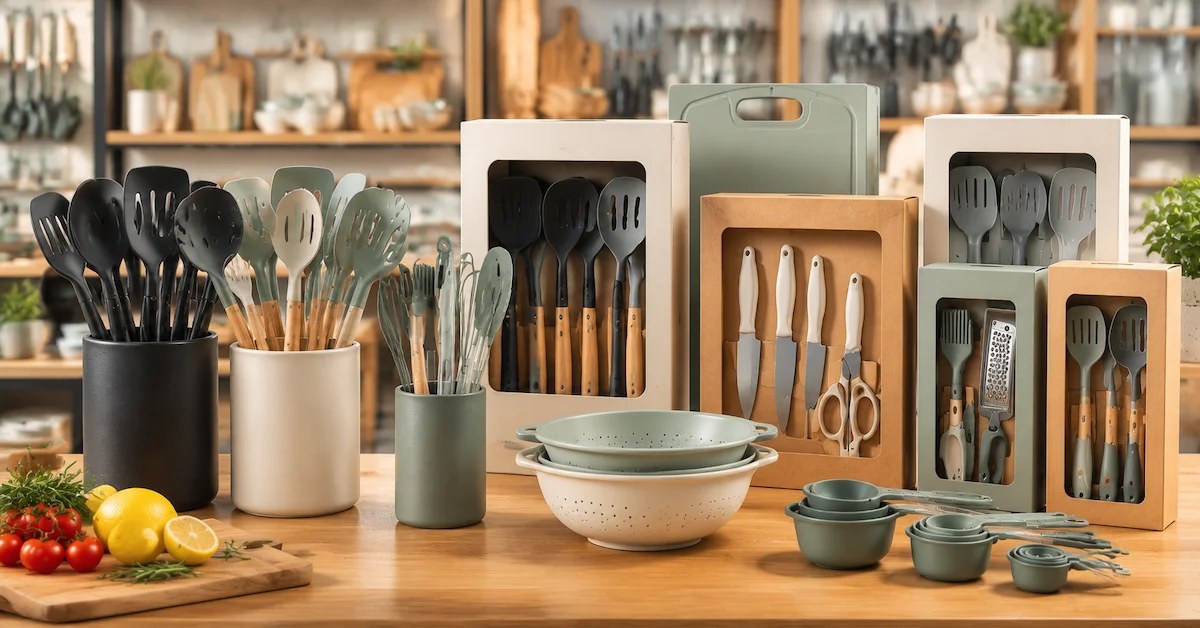
The visible product mix in the source article shows a broad kitchenware direction: cooking utensils, measuring items, scissors, a handheld grater, boxed tools, and coordinated color options. Several pieces appear to use wood or wood-look handles combined with matte working ends in colors such as black, sage green, gray, and beige. Those visual details can help a line look consistent, but buyers should still verify actual material descriptions with the supplier instead of relying on photos.
Choosing the Right Set Format for Your Channel
Different sales channels need different product structures. A home goods retailer may prefer display-ready boxed sets, while an ecommerce seller may care more about clear product photos, compact shipping, and easy-to-understand bundle names. A distributor serving multiple customers may need flexible SKUs that can be sold separately or combined.
| Set Format | Best Fit | Buyer Checkpoints |
|---|---|---|
| Assorted utensil set | Retail shelves, starter kitchens, giftable bundles | Confirm included tools, handle consistency, hanging or holder options |
| Boxed knife or prep set | Gift channels, department stores, online listings | Ask about packaging protection, item labeling, and sheath or box details |
| Measuring and mixing set | Ecommerce, cross-sell programs, compact retail displays | Check nesting, stackability, measurement markings, and carton efficiency |
| Coordinated multi-SKU line | Private label ranges, wholesale catalogs, seasonal resets | Review color matching, packaging family, and replenishment planning |
How to Build a Coherent Assortment
A strong assortment starts with the customer’s cooking routine. Most home users expect tools for stirring, serving, flipping, ladling, cutting, grating, mixing, and measuring. If a set looks attractive but misses common tasks, it may be harder to sell as a complete kitchen solution.
For B2B buyers, the following checklist can help when planning a private label range:
- Define the target channel: retail, ecommerce, wholesale, gifting, or promotional sales.
- Choose an anchor format, such as a utensil set, prep set, or boxed accessory set.
- Decide whether items should be bundled, sold separately, or offered in both formats.
- Confirm the expected color palette and whether colors must match across product families.
- Plan the packaging style before finalizing the assortment, not after samples arrive.
- Prepare product naming and contents lists early to avoid confusion in catalogs and listings.
Quality Review for Mixed-Material Kitchen Tools
Kitchen tools often combine multiple components. A handle may be wood, wood-look, plastic, or another material. A working end may be metal, coated metal, silicone-like, nylon-like, or another composite. Because the original visuals do not confirm exact grades or specifications, buyers should ask the supplier to identify each material clearly and in writing.
Sample review should go beyond appearance. Check whether handles feel secure, whether the head is aligned with the handle, whether edges are smooth, and whether coatings or surfaces look even. Inspect the junction where two materials meet, because gaps, rough seams, or adhesive marks can make an otherwise attractive item feel low quality.
Buyers should also compare multiple samples when possible. One sample can look acceptable, but the real question is whether finish, color, and assembly remain consistent across a production run. If consistency matters to the brand position, ask the supplier how they control color matching and component consistency between lots.
Packaging and Merchandising Considerations
Packaging is not just a shipping requirement in this category. It is part of how the product communicates value. Window-box packaging, as shown in the original article, can help customers see the tools clearly before purchase. It can also support cleaner ecommerce images when the set is photographed in its retail format.
However, display packaging should be judged practically. Ask whether the box protects the product during transit, whether it can stand or hang as required, and whether the contents are easy to identify at a glance. For online sales, consider whether the package creates excess dimensional weight or makes returns more likely due to damage.
Private label buyers should also prepare questions about artwork files, barcode placement, inner carton packing, master carton labeling, and whether packaging can be adapted for different channels. Do not assume customization details, costs, or minimum quantities; request current supplier terms for the specific project.
Supplier Questions Before You Commit
When comparing OEM or wholesale kitchenware suppliers, avoid making the decision on the first attractive sample. Use a structured review so that design, function, packaging, and commercial feasibility are all covered.
- What exact pieces are included in each set?
- What materials are used for the handle, working end, bowl, cup, sheath, or box?
- Can the supplier provide the same color direction across utensils, measuring items, and boxed accessories?
- Which parts of the product or packaging can be customized for private label?
- What are the current MOQ, lead time, sample process, and packaging options?
- How are samples approved before mass production?
- What inspection points should be agreed before shipment?
These questions do not replace a formal purchasing process, but they help prevent common misunderstandings. The earlier a buyer clarifies set contents, material descriptions, color expectations, and packaging structure, the easier it is to compare suppliers fairly.
Common Mistakes in Private Label Kitchen Tool Sourcing
One frequent mistake is choosing products only because they look attractive in a photo. Visual appeal matters, especially for home goods, but the assortment still needs a practical reason to exist. A utensil set should include tools customers expect to use. A measuring set should store neatly and be easy to understand. A boxed set should look organized and protected.
Another mistake is treating every channel the same. Restaurant-oriented buyers may prioritize durability and repeated use. Gift buyers may focus on presentation. Ecommerce sellers need strong images, clear titles, and accurate contents lists. A private label line should be built around the channel that will sell it, not around a generic idea of what a kitchen set should be.
FAQ
Are private label kitchen tools always sold as complete sets?
No. They can be sold as complete bundles, coordinated single SKUs, boxed sets, or a broader family of related accessories. The best format depends on the channel and price position.
Do matching colors matter for B2B kitchenware programs?
They often matter, especially in retail and ecommerce. Matching or coordinated colors help the range look intentional and make it easier to merchandise as a private label collection.
What should buyers verify before approving a sample?
Verify set contents, material descriptions, finish consistency, handle security, edge quality, packaging format, labeling, and whether the approved sample will match mass production expectations.
Can suppliers customize packaging for private label kitchen tools?
Many suppliers may offer packaging or branding options, but buyers should ask for specific current details, including artwork requirements, MOQ, lead time, and any additional costs.
A Practical Next Step
Before requesting quotes, define the role of the line: utility-first, giftable, ecommerce-focused, or retail display-driven. Then compare private label kitchen tools as a complete system, including assortment, materials, color direction, packaging, and supplier communication. A good individual spatula or spoon is useful; a coherent, clearly packaged product line is easier to sell, replenish, and build into a recognizable private label program.
