




Private Label Kitchen Tools: How to Source a Cohesive Utensil Line
Private label kitchen tools look simple until a buyer has to build a full, coordinated range. A spatula, ladle, whisk, skimmer, pair of tongs, and serving spoon may each be easy to understand on their own. The sourcing challenge is making them work together as one product family, with consistent visual language, suitable function, and repeatable production logic.
For retailers, importers, distributors, hospitality buyers, and brands developing OEM kitchenware, the goal is not just to find attractive utensils. The goal is to specify a line that fits the channel, feels coherent on a shelf or product page, and can be sampled, packaged, and reordered without avoidable confusion.
Key Takeaways
- A strong private label utensil line should solve design, function, and sourcing requirements together.
- Assortment planning matters: not every tool needs to be included, but the core cooking and serving tasks should be covered.
- Buyers should verify material, finish, handle construction, and joining methods instead of relying on appearance alone.
- Sampling should review the complete line side by side, not only individual items.
- Commercial details such as MOQ, packaging options, lead time, and testing requirements should be confirmed directly with the supplier.
Why Private Label Kitchen Tools Need a System
A private label kitchen tool program is different from purchasing one generic utensil. A coordinated set has to look intentional across different shapes and functions. The handle style, color palette, finish, storage method, packaging format, and product naming should all support the same brand position.
This is where many projects become difficult. A matte black tool with a light wood or wood-look handle may appear clean and modern in a concept image, but the buyer still needs to ask whether the same finish can be repeated across multiple utensils. A whisk, tong, ladle, and spatula use different forms and may require different construction methods. The sourcing plan must allow for those differences without making the line look mismatched.
Define the Assortment Before Choosing Details
Start with the cooking tasks your target customer actually performs. Common utensil families include spatulas, turners, spoons, ladles, whisks, tongs, skimmers, and serving pieces. A starter range may focus on high-frequency tools, while a broader retail program may include prep, cooking, baking, and serving items.
The assortment should feel complete without becoming crowded. Too few items can make the line look underdeveloped. Too many variations can create cost, packaging, and inventory complexity. Buyers should decide whether the program is intended to be a compact set, an open-stock range, a promotional bundle, or a platform that can expand over time.
Compare Design, Function, and Sourcing Fit
A useful way to evaluate private label kitchen accessories is to separate the decision into three layers. First is design: do the tools look like they belong together? Second is function: do the utensils feel suitable for their intended tasks? Third is sourcing fit: can the supplier explain how the line will be produced consistently?
| Evaluation Area | What to Check | Questions to Ask the Supplier |
|---|---|---|
| Assortment | Coverage of stirring, flipping, lifting, whisking, skimming, and serving | Which items are standard, and which require new development? |
| Visual consistency | Handle shape, finish, color tone, and shelf presentation | Can the same appearance be repeated across different tool types? |
| Construction | Working end, handle, joint, balance, and grip comfort | How is the handle attached, sealed, or finished? |
| Production fit | Shared components, finish repeatability, packaging compatibility | What details affect MOQ, sampling time, and batch consistency? |
| Channel suitability | Retail, hospitality, promotional, or bundled use | What specification changes are recommended for the intended channel? |
Material and Finish Questions Buyers Should Not Skip
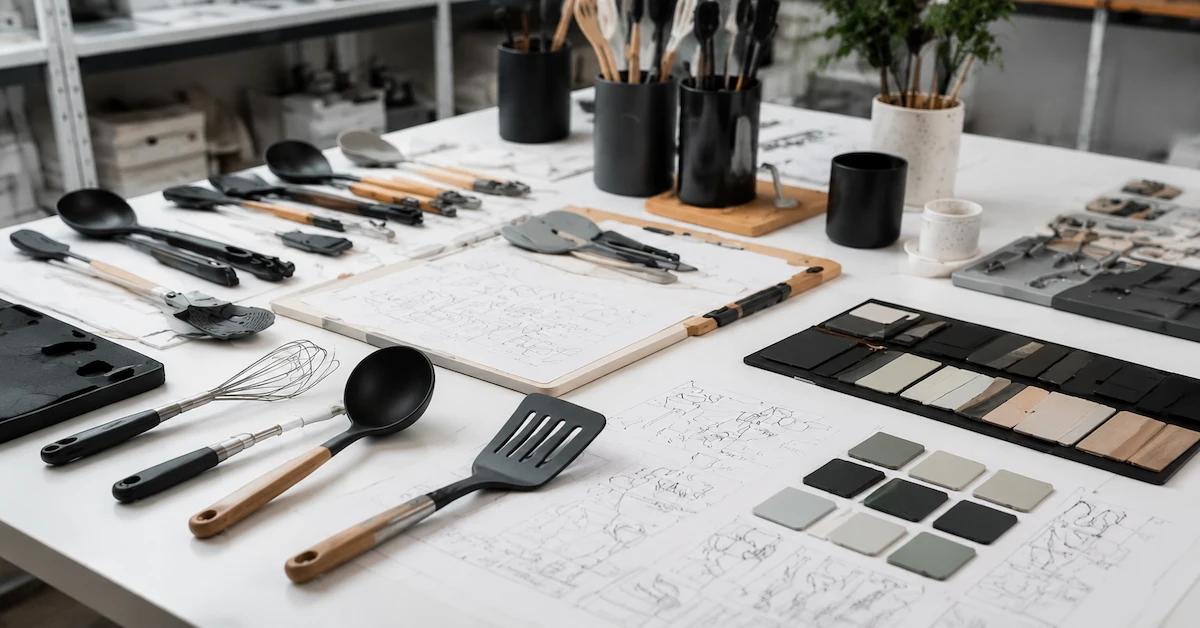
The original sample concept shows a coordinated utensil range with dark tool sections and light wood or wood-look handle accents. It also suggests the kind of mixed-material approach often seen in private label kitchen tools. However, buyers should avoid assuming material grades, coating performance, or durability from an image alone.
Instead, ask for clear component descriptions. Which parts are metal? Which parts are molded, coated, plated, painted, or assembled separately? If a handle has a wood or wood-look appearance, what is the actual material and how should it be cleaned? If a dark finish is used, how does the supplier control surface consistency across different utensil shapes?
These questions are especially important when the line is intended for repeat orders. A single attractive sample is not enough. Buyers need to understand whether the look can be maintained across production batches and whether finish variation is acceptable for the retail or hospitality channel.
Sampling the Whole Line, Not Just One Tool
For custom kitchen utensils, the sample stage should test the family concept. Request a sample board or complete group presentation when possible. Viewing one spoon alone will not reveal whether the handle tone matches the tongs, whether the whisk looks out of place, or whether the overall palette feels coherent.
During review, handle the tools as a user would. Check balance, grip comfort, edge shape, tong spring action, whisk stiffness, ladle depth, and whether similar items are easy to distinguish. Also review packaging implications: a long-handled ladle and a compact whisk may not fit the same carton or display format unless the range was planned carefully.
Common Sourcing Mistakes to Avoid
- Approving only the appearance. A clean visual concept can still fail if the grip, balance, or assembly is weak.
- Forcing every tool to use identical construction. A whisk, skimmer, and spatula may need different forms while still sharing a coordinated look.
- Ignoring finish repeatability. Small color or surface differences become obvious when utensils are displayed as a set.
- Adding too many SKUs too early. A focused launch is often easier to control than a broad, unfocused range.
- Leaving packaging until the end. Packaging format can affect assortment size, shipping efficiency, and shelf presentation.
Supplier Questions for OEM and Wholesale Buyers
Before committing to a private label kitchen tool program, sourcing teams should prepare direct commercial and technical questions. Ask which items are existing styles and which require custom development. Confirm what branding methods are available, what packaging formats can be supported, and what information is needed for artwork approval.
Buyers should also ask about sample timing, production lead time, minimum order quantity, carton packing, replacement sample policy, and how quality checks are handled. If the products must meet specific market requirements, do not assume compliance. Ask what documents, test reports, or third-party testing arrangements are available for the target market and product type.
Good supplier communication should reduce uncertainty. If a line depends on several materials, finishes, or assembled parts, the supplier should be able to explain the risks and control points clearly.
Where Coordinated Utensil Lines Fit Best
Private label kitchen tools are suitable for home kitchen retail, distributor assortments, cookware add-on programs, promotional bundles, and some hospitality-related uses. The right specification depends on the channel. A retail gift set may prioritize visual coordination and packaging. A hospitality buyer may focus more on cleaning, durability, and reorder consistency.
For many brands, the most practical approach is to start with a core range of high-use items and expand after sample approval and market feedback. This keeps the program manageable while still creating a clear product identity.
FAQ
Are private label kitchen tools only for retail brands?
No. They can also be used by importers, distributors, hospitality suppliers, cookware brands, and promotional product programs. The specification should match the sales channel.
Should every utensil use the same material?
Not always. A coordinated look is important, but different tools may need different construction to perform well. Ask the supplier to explain material choices by item.
What should buyers request before placing an order?
Request full-line samples when possible, component descriptions, packaging details, branding options, commercial terms, and any required compliance documentation for the destination market.
How can buyers reduce risk in a new utensil program?
Start with a focused assortment, confirm the finish and handle construction, review samples side by side, and clarify MOQ, lead time, and quality expectations before production.
Practical Next Step
If you are sourcing private label kitchen tools, build a checklist before reviewing samples. Define the core assortment, preferred visual direction, target channel, packaging needs, and supplier questions. Then compare the complete utensil line as one system. The best program is not simply the one with the most pieces; it is the one that looks consistent, works for the user, and can be supplied reliably over time.
