




Private Label Kitchen Tools: What Buyers Should Look For
Private label kitchen tools can be a practical category for retailers, e-commerce sellers, gift programs, and wholesale buyers. A coordinated assortment lets a brand offer prep, cooking, serving, and storage pieces under one visual identity. But a set that looks complete in a product photo still needs to pass a more important test: will customers use it comfortably, understand its materials, and feel that the bundle was worth buying?
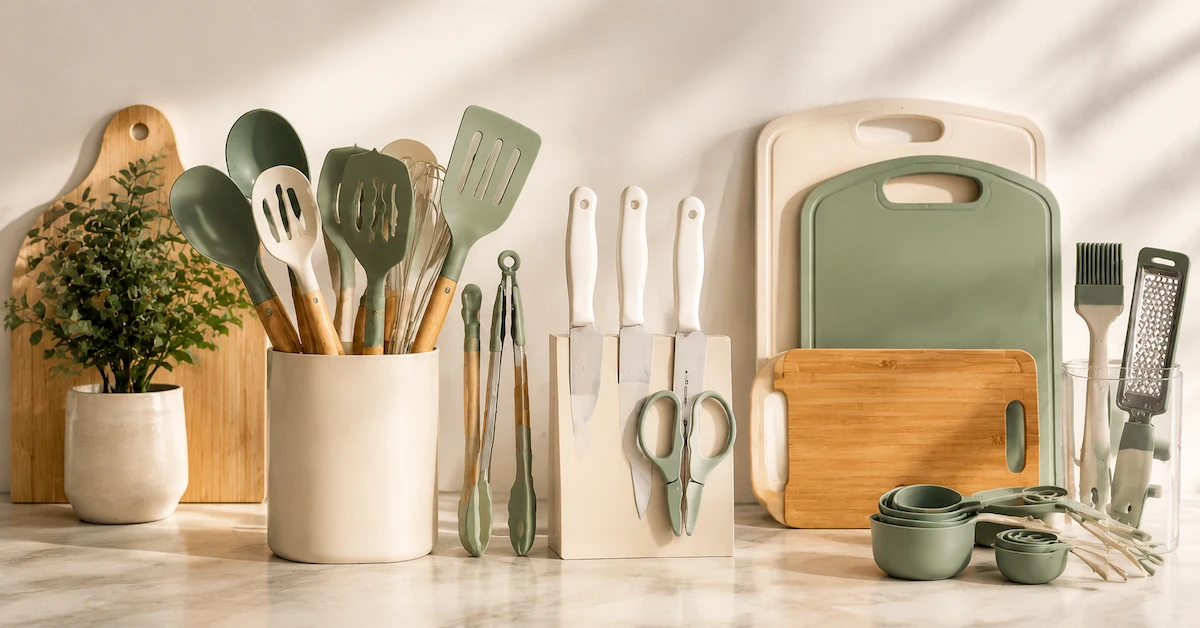
The original assortment shown here includes common kitchen items such as spatulas, spoons, a whisk, tongs, measuring pieces, a peeler, scissors, knives, cutting boards, a grater, and a countertop holder. The muted green and cream palette, combined with wood or bamboo-looking accents, gives the set a coordinated retail appearance. That visual consistency is useful, but buyers should evaluate function, packaging, and supplier transparency before committing to any private label kitchenware program.
Key Takeaways
- A private label kitchen tool set should be judged by daily usability, not only by color matching or shelf appeal.
- Mixed materials are common, but buyers should ask exactly which parts are silicone, metal, wood, bamboo, plastic, or coated material.
- Packaging design matters because bundled tools can shift, scratch, or look compressed during shipping.
- Ask suppliers for item-by-item details before writing product pages, labels, or marketplace listings.
Why Private Label Kitchen Tools Appeal to Retail Buyers
Kitchen tools are familiar, repeatable products with broad household demand. For private label programs, this makes them attractive because a retailer can build a recognizable collection without relying on a national brand. A complete tool set also gives shoppers a simple decision: buy one coordinated bundle instead of comparing several individual utensils.
For grocery chains, home goods stores, online marketplaces, and promotional distributors, bundled kitchenware can support seasonal campaigns, starter-home assortments, giftable sets, or value-focused household ranges. The challenge is that a bundle multiplies the number of details a buyer must check. One weak component can lower the perceived quality of the entire set. A flimsy whisk, an uncomfortable handle, or a cutting board that does not sit flat can affect reviews even if most other pieces perform acceptably.
What Buyers Should Evaluate First
Start with the intended customer. Is this set meant for first apartments, casual home cooks, gifting, pantry refreshes, or a design-led retail display? A broad household set does not need to behave like professional restaurant equipment, but it should feel reliable for everyday tasks such as stirring, scraping, measuring, peeling, and serving.
Buyers should also separate display value from handling value. A countertop holder can make the assortment look organized. Matching colors can make the product easier to merchandise. However, the real user experience comes from grip comfort, tool balance, head flexibility, blade or grater performance, and cleaning expectations. Before placing an order, request physical samples and test the items with realistic kitchen tasks rather than reviewing the set only in arranged photography.
Material Mix and Construction Questions
The visible set appears to combine flexible utensil heads, wood or bamboo-looking handles, metal components, cutting boards, and other accessory pieces. This type of mixed-material construction is common in private label utensils because it balances appearance, cost, and function. Still, buyers should not assume material grades, heat ratings, dishwasher suitability, or durability claims unless the supplier provides clear documentation.
Useful supplier questions include:
- What is the material breakdown for every item in the set?
- How are utensil heads attached to handles?
- Are wooden or bamboo-looking handles sealed or finished, and what care instructions should be given?
- What use limitations should appear on packaging or online listings?
- Are knives, graters, scissors, and peelers packed with protection to prevent transit damage?
These questions help prevent overpromising. If care instructions are unclear, product listings may create customer expectations that the set cannot support. For example, buyers should confirm whether any pieces are intended for dishwasher cleaning or whether hand washing is recommended.
Set, Loose Items, or Mixed Collection?
Not every private label kitchenware project should be a large set. A complete bundle works best when shoppers want convenience and visual coordination. Loose items may be better when the target customer already owns basic tools and wants to upgrade specific pieces. A mixed private label collection can also work well when a retailer wants several related SKUs under one color palette without forcing every customer into the same bundle.
| Format | Best Use Case | Buyer Watchouts |
|---|---|---|
| Full kitchen tool set | Starter kitchens, gifts, seasonal retail, e-commerce bundles | One weak item can affect the whole product rating |
| Loose individual tools | Replacement purchases and targeted upgrades | Harder to create a high-value basket without strong merchandising |
| Mixed private label collection | Retail ranges with coordinated colors and multiple price points | Requires careful SKU planning and consistent material communication |
| Holder-based utensil set | Countertop display and organized home storage | Check stability, packing method, and whether tools fit comfortably |
Packaging and Merchandising Considerations
Packaging is often where private label kitchen tool projects become more complicated than expected. A bundle may include long utensils, nested measuring cups, sharp tools, flat boards, and a holder. These pieces must be arranged securely enough for shipping while still looking clean when opened or displayed.
Buyers should ask whether the holder ships filled or separate, how sharp or abrasive parts are protected, whether boards can scuff during transit, and how the set is presented for retail inspection. If the packaging is too tight, handles or flexible heads may bend. If it is too loose, components may rattle and scratch. For e-commerce programs, drop-test expectations, inner packing, and replacement policies should be discussed with the supplier before launch.
Common Sourcing Mistakes to Avoid
The most common mistake is choosing a set mainly because it photographs well. Muted colors and coordinated pieces help conversion, but they do not prove the tools are comfortable or durable. Another mistake is treating all items in the bundle as equally important. In reality, cutting, peeling, and grating tools usually need closer review because poor performance is noticed quickly.
Buyers should also avoid vague product claims. If a supplier has not confirmed material details, cleaning guidance, heat resistance, or food-contact documentation, do not invent those claims in a product description. Instead, request the information and keep consumer-facing language accurate. Clear communication reduces returns, negative reviews, and compliance risk.
Supplier Checklist Before Placing an Order
- Request a complete item list with dimensions, materials, and intended use for each component.
- Review samples for grip comfort, balance, flexibility, cutting performance, and storage fit.
- Ask what branding options are available for packaging, inserts, labels, or product markings.
- Confirm packing method, carton configuration, and protection for sharp or scratch-prone items.
- Ask what testing, compliance documents, or inspection reports are available for your target market.
- Clarify care instructions so retail packaging and online listings do not overstate performance.
Practical FAQ
Is a full private label kitchen tool set better than individual utensils?
It depends on the sales channel. Full sets work well for gifts, starter kitchens, and online bundles. Individual tools may perform better when shoppers want replacements or specific upgrades.
What should buyers ask about mixed-material kitchen tools?
Ask for the exact material of each component, how parts are joined, what care instructions apply, and whether the supplier can provide relevant documentation for the intended market.
Does a countertop holder add real value?
Yes, when it improves storage and presentation. Buyers should still check holder stability, tool fit, packaging method, and whether the holder makes the shipped set bulkier.
How can buyers reduce private label sourcing risk?
Test samples, verify product claims, inspect packaging, and require item-level details before approving artwork or marketplace content.
Final Sourcing Advice
A sensible private label kitchen tools program starts with the customer use case, then works backward to the assortment, materials, packaging, and supplier documentation. The best bundles feel coherent without hiding weak construction or unclear claims. For buyers, the goal is not simply to source a good-looking set, but to build a product that can be described accurately, shipped safely, and used confidently in everyday kitchens.
