




Why professional kitchens buy knives differently from home cooks
Buying professional kitchen knives wholesale is not the same as picking a few retail knives off a shelf. A restaurant, catering operation, or prep kitchen is not buying a single tool for occasional use; it is buying working equipment that will be handled all day, passed between staff, sharpened repeatedly, and judged by whether it keeps service moving. That changes the buying question from “What knife feels nice?” to “What knife lineup stays useful under real production pressure?”
For that reason, the wholesale buyer is usually looking for a practical mix: a longer chef’s knife for general prep, a shorter utility or santoku-style blade for more controlled work, and enough consistency across the batch that staff can swap knives without adjusting their technique every time. In other words, the decision is less about luxury and more about workflow, durability, and cost per usable shift.
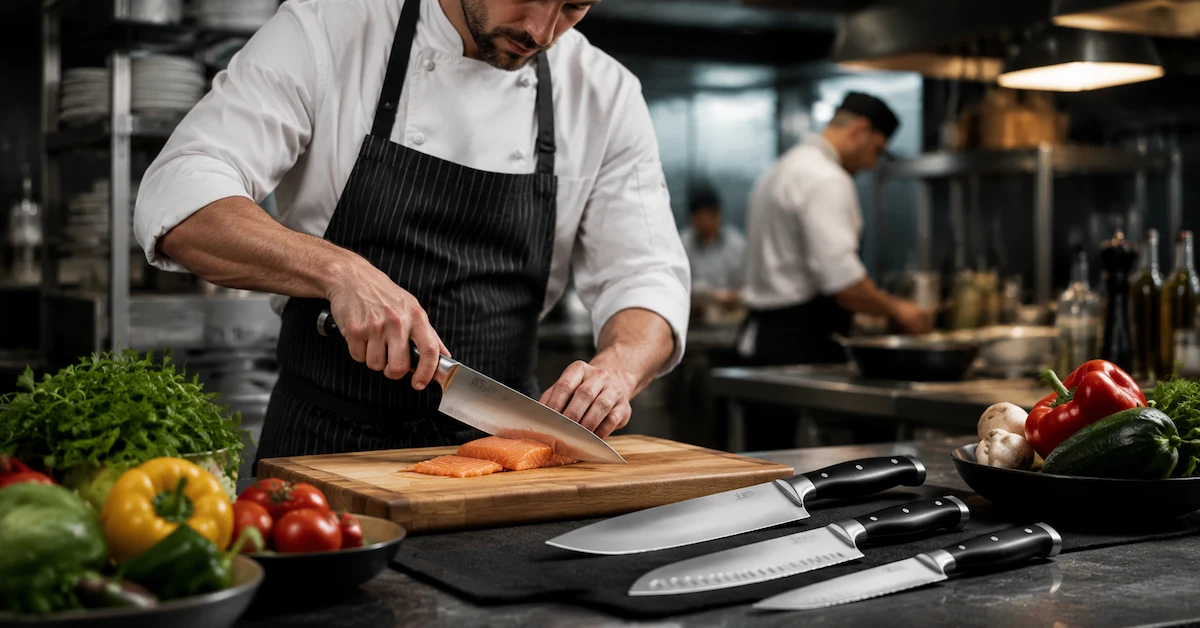
The visible knife style in the product data fits that reality well. You are looking at black ergonomic handles, polished stainless steel-looking blades, and at least one blade with shallow scalloped indentations that can help reduce sticking when slicing wet ingredients like fish or vegetables. That is the kind of feature set buyers in commercial kitchens actually notice, because it affects speed and cleanup more than it affects marketing copy.
What restaurant and catering buyers should be solving for
When sourcing restaurant kitchen knives, the real issue is not whether a blade looks premium in a photo. It is whether the knife supports the way a line, prep station, or catering team works under time pressure. A knife that feels comfortable for one cook but causes fatigue after a few hours may be a poor fit for a busy kitchen. A blade that slices cleanly but sticks to soft protein can slow production. A handle that is slippery when wet is not a small flaw; it is a daily frustration and a safety concern.
Wholesale buyers also have to think in terms of replacement cycles. Commercial cutlery is used harder than consumer cutlery, and the kitchen cannot afford a mismatch between front-of-house expectations and back-of-house reality. If a knife set is meant for prep stations, it should be easy to identify, easy to maintain, and consistent enough that new staff can learn the line quickly.
That is where catering kitchen knives and chef knives wholesale orders often differ from smaller retail purchases. Catering teams may need mobile, versatile tools that travel with prep equipment. Restaurants may care more about a narrow set of high-rotation knives that cover the majority of tasks. The point is not to buy the most expensive blade; it is to buy the right mix of blade shapes and handle styles for the job.
Quick reference: what the visible knife features suggest
Based on the product information provided, the knives appear to be a commercial-ready set with several common characteristics buyers often want in bulk orders:
Black ergonomic handles with visible rivets or pins suggest a design aimed at durability and grip stability. The handle shape matters because staff may work with wet hands, gloves, or cold prep conditions. The polished or satin metallic blade finish is also typical of knives designed for food prep because it is easy to inspect and generally familiar to kitchen teams. One blade includes scalloped indentations similar to granton-style pockets, which can help reduce drag when slicing sticky foods such as fish, roasted meats, or some vegetables.
There is also a useful spread of blade styles in the set: at least one longer chef’s knife, one santoku- or utility-style knife, and a fish-cutting use case shown on the board. That is exactly the kind of practical variety many buyers want when comparing professional kitchen knives wholesale options. A set with only one style of blade is rarely enough for a serious prep operation.
Why blade shape matters in commercial prep
Blade geometry affects more than appearance. In food service, it changes how a knife moves through ingredients, how fast a cook can work, and how much force is needed for clean cuts. A broad chef’s-knife profile with a curved edge is a workhorse choice because it supports rocking cuts for herbs, vegetables, and general prep. A santoku-style blade tends to feel more controlled for straight slicing and repetitive chopping. A utility knife sits in the middle, handling smaller tasks without making the cook reach for a larger blade.
For fish, the cutting task visible in the product data is a good example. Fish requires a clean, deliberate slice rather than a rough sawing motion. A smooth, sharp blade with the right length and balance can help preserve texture and presentation. In kitchen operations where product appearance matters, that is not a cosmetic detail. It can affect plate quality, portion consistency, and waste.
Scalloped indentations, when present, are often useful for reducing sticking. That does not make a knife better for every task, and buyers should be careful not to treat one feature as a cure-all. But in wet or adhesive foods, it can be a practical advantage. For a line cook making repeated slices, even a modest reduction in drag can improve rhythm.
Material and construction: what you can reasonably infer
The provided information indicates stainless steel-looking blades with black molded or composite-style handles. That is common in mass-produced commercial cutlery because it balances cost, corrosion resistance, and easy handling. The exact steel grade, heat treatment, and manufacturing method are not provided, so those details should not be assumed. A careful buyer should resist the temptation to read too much into a polished blade finish alone.
Likewise, the presence of rivets or pins on some handles suggests a mechanically secured handle structure, but it does not prove full tang construction or any specific forging method. Some wholesale knives are forged, some are stamped, and some combine features of both in ways that are not obvious from a photograph. If those details matter to your kitchen or purchasing standard, they should be confirmed with the supplier before placing a bulk order.
That caution is worth stating plainly. In wholesale purchasing, visual quality and actual long-term performance are not always the same thing. A knife can look solid on arrival and still behave differently after repeated sharpening or hard service. Good sourcing teams ask for the information that matters: steel specification, sharpening requirements, handle material, cleaning guidance, and the supplier’s replacement policy if the batch is inconsistent.
How to compare wholesale knife options without getting lost in features
When evaluating chef knives wholesale offers, the best comparison method is functional. Start with the tasks your team performs most often. If the kitchen spends most of its prep time on vegetables, herbs, and proteins that need clean slicing, then a balanced chef’s knife and a smaller companion blade may be enough. If the operation handles a wider menu, a set with multiple blade shapes is more useful.
Next, look at grip. A handle should feel secure in a wet prep environment and not force an awkward wrist angle. Black ergonomic handles, like the ones described in the product data, are popular because they usually provide a familiar, non-distracting hold. Still, the handle shape should be tested by the people who will actually use it. A purchasing team can approve a spec sheet; a prep cook has to use the knife fifty times before lunch.
Then look at maintenance. Commercial kitchens care about sharpening access, blade edge retention, and whether the knife is easy to clean. Even if a supplier does not provide every answer, a credible wholesale partner should be able to discuss care requirements without evasiveness. If the conversation turns vague at this stage, that is usually a warning sign.
Common mistakes buyers make when sourcing in bulk
One common mistake is overbuying a knife style that looks impressive but sees little use. Another is choosing one general-purpose blade for every station and expecting it to solve every task. Kitchens are too varied for that. A prep-heavy restaurant may want more chef’s knives and santoku-style blades. A catering team may need a broader assortment that can cover transport, banquet prep, and last-minute slicing. The wrong mix leads to improvised habits, and improvised habits usually lead to damage or inconsistent output.
Another mistake is ignoring handle comfort because “the team will get used to it.” Sometimes they do, but sometimes they simply work around the knife, which slows production. A third mistake is buying wholesale without asking about edge maintenance. A blade that starts sharp but is difficult to keep sharp becomes an expensive nuisance.
There is also a quieter mistake: assuming all knives in a set will be equally suitable for every station. The product data shows multiple knife types, which is a strength. Buyers should use that variety deliberately rather than issuing every knife in the same way.
Practical buying advice for restaurants, prep kitchens, and caterers
If you are sourcing professional kitchen knives wholesale for a restaurant, start by mapping knife use to station needs. Prep teams usually need the most versatile blades. Fish and protein stations may value cleaner slicing and reduced sticking. Catering operations often benefit from a set that includes several blade types so staff can pack according to the menu rather than improvise on site.
Ask for samples if possible, and have them tested by real kitchen staff during normal prep, not in a quiet office. Test grip with wet hands, check whether the knife feels balanced during repeated cuts, and see whether the blade shape matches the menu. This is especially important when choosing between restaurant kitchen knives that all claim to be “professional” but differ in subtle ways that matter only in use.
It is also smart to think about standardization. If one set becomes the house standard, the restocking process is simpler and training is easier. That matters more than people admit. Staff turnover and cross-training are facts of life in food service, and knives that behave predictably help the kitchen stay stable.
FAQ buyers usually ask before placing a wholesale order
Are these knives only for chefs?
Not necessarily. They are suitable for line cooks, prep teams, catering staff, and any operation that needs reliable food-prep tools. The main point is utility, not job title.
Is one knife type enough for a kitchen?
Usually not. A small set with different blade shapes is more practical because commercial kitchens face mixed tasks all day.
Should I focus on finish or construction first?
Construction and usability first, finish second. A polished blade is nice, but grip, balance, and maintenance matter more in daily use.
Can I assume the steel quality from appearance?
No. The product may look like stainless steel, but exact alloy and heat treatment should be confirmed with the supplier if they matter to your purchasing standard.
A sensible next step for buyers
If you are reviewing professional kitchen knives wholesale options, use the product details as a starting point, not a final verdict. The described knife set has several signs of practical commercial use: multiple blade shapes, ergonomic black handles, visible rivets, and a blade profile that suggests real prep work rather than display. That is a good base, but wholesale decisions should still be grounded in actual kitchen needs.
Before ordering in volume, ask for the information that affects daily performance and replacement risk. Confirm the blade specification, handle construction, care guidance, and any minimum order terms. Then compare the set against the tasks your kitchen performs most often. A supplier can sell a knife. A good buyer buys a tool that disappears into the work because it simply does its job.
