




Why wholesale knife buyers look past the price tag
When sourcing professional kitchen knives wholesale, the first mistake is usually treating a knife set like a commodity. For a hotel kitchen, a catering team, a culinary school, or a resale buyer building out a shop floor, the real question is not simply what the set costs. It is whether it supports fast prep, sensible storage, and enough consistency that staff can work without fighting the tools.
A coordinated knife set with a wooden block, multiple blade profiles, and a pair of kitchen scissors is a familiar format for good reason. It solves several practical problems at once: keeping blades organized, reducing countertop clutter, and giving the buyer a ready-made bundle that is easy to merchandize or distribute. That matters in wholesale kitchen knives purchasing because the set is often judged not just by the knives themselves, but by how cleanly it fits into daily use and shelf presentation.
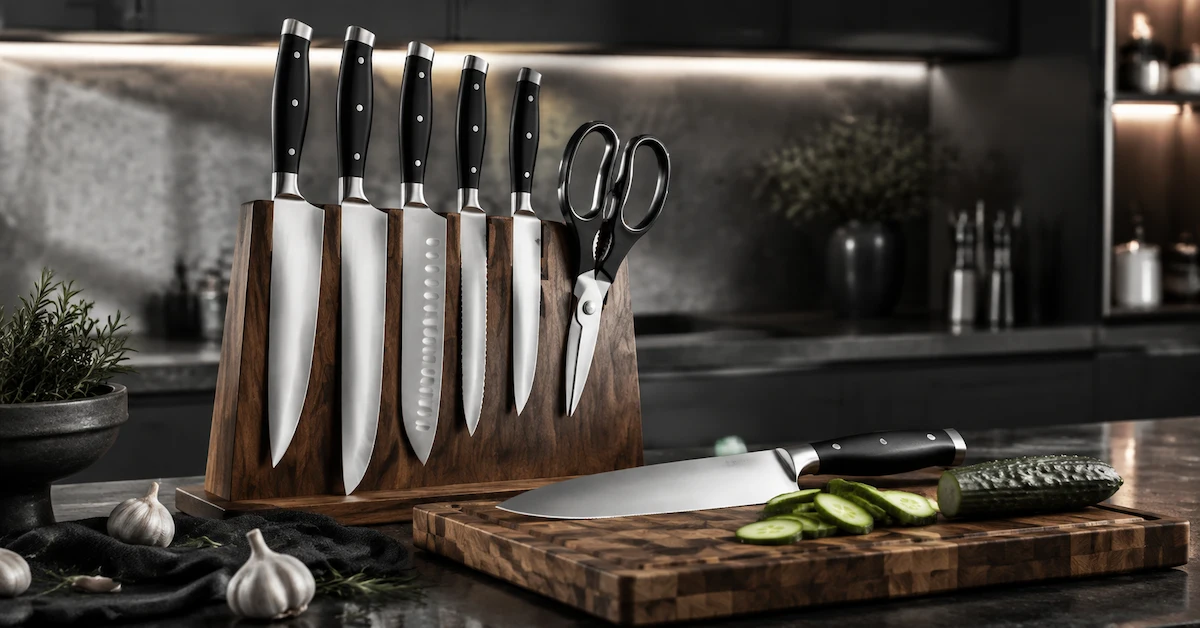
The visible setup here points to that kind of buyer need. You are looking at polished metal blades, black handles with a riveted look, a dark wood block, and a matching cutting board surface with visible grain. It is a straightforward, utility-first presentation. No theatrics, which is usually what the better buyers want anyway.
What this type of knife set is good for
This kind of coordinated set is built around general food preparation. The larger chef’s knife handles broad chopping and slicing. Medium utility-style knives cover smaller trimming jobs. A serrated or partially serrated blade helps with bread, tomatoes, and other items where a smooth edge can struggle. The smaller paring-style knife is for detail work, peeling, and quick trimming. The scissors round out the set for light kitchen cutting tasks, such as packaging, herbs, or poultry-related prep, depending on kitchen practice.
That versatility is exactly why buyers search for commercial kitchen knives in sets rather than piece by piece. A set can standardize the workstations in a small operation, give a retail customer a complete starter bundle, or help a distributor offer a giftable package with obvious value. The block also gives the customer an immediate storage solution, which sounds minor until you are dealing with crowded prep tables and staff reaching for the wrong blade.
Quick buyer takeaways
For sourcing teams, the decision usually comes down to three points:
First, does the set cover the most common prep tasks without forcing users to improvise? Second, is the storage format practical for the intended environment? Third, does the visual design support the market you are selling into, whether that is restaurant back-of-house, culinary training, or consumer retail?
This set appears to answer yes to the first two and probably yes to the third, depending on your audience. The wood-and-black styling is neutral enough for many kitchens, yet tidy enough to sit on a countertop without looking disposable. That balance is often underrated in wholesale buying.
Materials and construction: what can be seen, and what cannot
Based on the provided product information, the blades appear to be stainless steel or a similar reflective metal. The handles look like synthetic composite or resin, likely chosen for durability and easy cleaning. The knife block and board appear to be hardwood with visible grain. Those choices make sense for a general-purpose kitchen set, especially where buyers want a familiar appearance and a practical storage block.
What cannot be confirmed from the available information is just as important. Exact steel grade, hardness, forging versus stamping, full tang construction, and edge retention are not visible here. Nor can you assume dishwasher safety or any formal certification without supplier documentation. In procurement, that caution matters. Many buyers have learned the hard way that a polished blade and a solid-looking block do not tell the whole story.
If you are comparing multiple wholesale kitchen knives options, ask for the same details every time: blade material, handle material, construction method, edge profile, cleaning guidance, and packaging format. If those answers are vague, the nice photo is doing more work than the product sheet.
How buyers should evaluate a set like this
1. Knife mix
Look for a blade range that fits daily prep, not just an attractive silhouette. A useful set should include the workhorse chef’s knife, at least one smaller knife for precision tasks, and a serrated blade for foods that dislike pressure. If the set is intended for restaurants or culinary classrooms, the mix should reduce tool sharing and keep the line moving.
2. Handle design
The black handles here appear straightforward and functional, with visible fasteners. That can be a plus for buyers who prefer a traditional look and a more substantial hand feel. Still, the real test is grip security under wet or greasy conditions. A handle that looks good in the catalog may not be the one staff trust during a busy lunch rush.
3. Storage block quality
The block does more than hold blades. It protects edges, organizes the set, and creates the first impression on a countertop. Slots should be sized sensibly, and the block should sit stable when knives are inserted or removed. A wobbly block is a small annoyance until it becomes an everyday one.
4. Scissors inclusion
A matching pair of kitchen scissors is a useful add-on, especially in starter sets and retail bundles. It improves the perceived completeness of the package and covers small cutting tasks without pulling out another knife. For wholesale buyers, that can raise the set’s shelf appeal without changing the core use case.
Common mistakes when sourcing knife sets in bulk
One common mistake is overbuying on appearance and underbuying on utility. A buyer sees a handsome block, a shiny finish, and a coordinated look, then discovers the set lacks the blade variety the kitchen actually needs. Another mistake is assuming that all steel, handles, and blocks are alike. They are not, and the differences show up in cleaning, feel, and wear.
Another practical issue is inventory fit. Some wholesale kitchen knives sets look complete but are not easy to store, ship, or merchandise. If you are supplying retail, space on the shelf matters. If you are supplying foodservice, the footprint on the counter matters. The best set is the one that can live where it is supposed to live without creating extra work.
There is also a tendency to overlook maintenance guidance. Even a solid-looking set needs proper care. Buyers should know whether the supplier recommends hand washing, how the block should be cleaned, and how the blades should be maintained over time. Those details are not glamorous, but they reduce complaints later.
Who this set suits best
This style of knife set is a good fit for restaurants that want an organized prep station, caterers that need a portable but presentable countertop setup, culinary schools that need standardized tool bundles, and wholesale retailers looking for a coordinated display item. It can also work for home-kitchen customers who prefer a complete set over piecing together individual knives.
For professional users, the appeal is mainly operational: easy access, simple storage, and a basic spread of blade types. For retail buyers, the appeal is visual and practical at the same time. The set looks complete, and it communicates value quickly.
What to ask your supplier before placing a bulk order
Before you commit to professional kitchen knives wholesale quantities, ask for the details that affect actual use. Confirm the number of pieces included. Request blade and handle material information in writing. Check whether the block dimensions fit your packaging or counter plan. Ask how the set is packed for transit, because knife blocks and glassy-looking finishes can suffer in rough shipping even when the product itself is fine.
If your market is sensitive to presentation, request photos of the set from multiple angles and, if possible, the packaging interior. Buyers who sell through retail channels often underestimate how much unboxing matters. A knife set is one of those products that can feel much more expensive or much cheaper depending on how it arrives.
Practical final advice for sourcing teams
As a wholesale purchase, this type of knife set is less about chasing a premium story and more about balancing function, finish, and stock reliability. The visible design suggests a sensible everyday tool set with coordinated storage, not a specialized chef’s line or a heavy industrial product. That is not a weakness. In many markets, that is exactly the point.
If you are comparing wholesale kitchen knives for restaurants, catering supply, or retail resale, use the set’s combination of blade variety, block organization, and straightforward styling as your first filter. Then press the supplier for the missing specifications. A clean product photo is useful, but it is not a substitute for knowing what you are actually buying.
If you need a coordinated knife bundle for distribution or shelf display, the next step is simple: request the full specification sheet, packaging details, and available order quantities before you commit to volume.
