




Why Retail-Ready Kitchenware Matters
A retail ready kitchenware supplier is not just a source of boxes and product variety. For sourcing managers, it is often the difference between a shelf that moves and one that sits crowded with generic stock. In kitchenware, presentation affects perceived quality almost as much as the item itself. A neatly packaged utensil set, a matched measuring cup and spoon set, or a stacked storage container range can look like a proper retail line before a shopper ever touches it.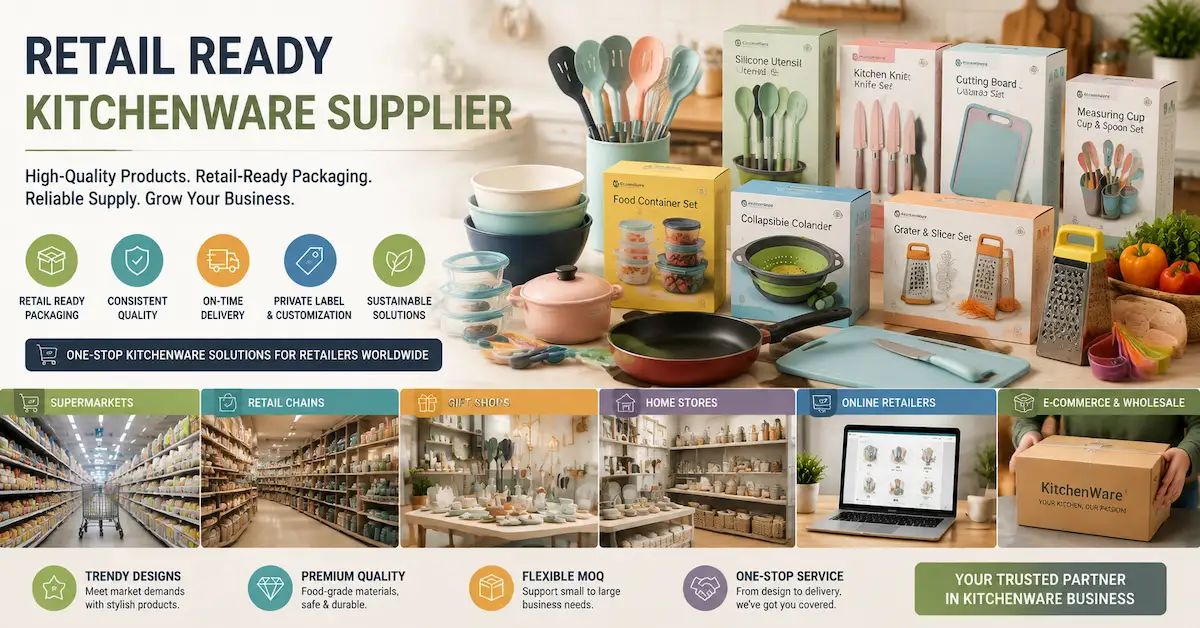
That matters because the buyer is usually making a fast judgment. Supermarket teams, chain-store merchandisers, home goods retailers, and online sellers all need products that can be placed quickly, explained quickly, and sold with minimal friction. The right supplier helps solve that problem by combining assortment, packaging, and customization into a single buying decision. That is the real question behind this category: which supplier can support retail presentation without sacrificing product consistency or operational simplicity?
What Buyers Usually Need From This Category
When people search for a ready to sell kitchenware supplier, they are often trying to reduce the number of moving parts. Instead of sourcing a knife set from one vendor, a colander from another, and storage containers from a third, they want a practical assortment with retail-facing packaging and a predictable service structure.
The product mix commonly seen in this category includes silicone utensil sets, knife sets, cutting board sets, measuring cup and spoon sets, food container sets, collapsible colanders, grater and slicer sets, cookware or pans, bowls, chopping or serving boards, and storage containers. That range tells you something important: this is about kitchen merchandising, not a single specialty SKU.
For buyers, the value is in breadth and packaging discipline. A shelf-ready assortment lets a retailer cover cooking, prep, serving, and storage in one sourcing lane. It also makes seasonal resets easier. A home goods store may want pastel packaging one quarter and more neutral retail presentation the next. A marketplace seller may want private label support for a consistent storefront look. A chain buyer may care most about repeatability across stores and predictable replenishment.
Retail-Ready Is Not the Same as Production-Ready
This distinction matters more than it sounds. A factory can make kitchenware that performs well in bulk, but that does not automatically make it retail ready. Retail-ready products need to survive handling, transport, display, and customer comparison. Packaging has to protect edges, prevent confusion, and make the set understandable at a glance.
In this category, mixed-material products are common. Silicone handles, plastic housings, metal or stainless steel parts, and possibly nonstick-coated cookware all have different production and packaging needs. A supplier that understands retail will usually think about how those components look together, how they nest, and how they present on shelf. That is especially important for boxed sets with multiple pieces, because shoppers are buying the completeness of the bundle as much as any single item.
There is also a merchandising reality that gets overlooked: clutter kills confidence. If a supplier’s assortment feels inconsistent in finish, scale, or packaging language, the range can look cheaper than it is. Retail buyers tend to notice that immediately.
Product Assortment: Where the Range Helps and Where It Can Hurt
A broad assortment is useful, but only if the supplier can keep it coherent. Kitchenware spans several use cases, and each has a different buyer expectation.
Silicone utensil sets are usually judged on comfort, finish, and visual cleanliness. Knife sets raise different questions about blade presentation and packaging safety. Cutting board sets and serving boards need to look durable and easy to merchandise. Measuring sets depend on clarity and nesting. Food container sets must communicate storage logic. Collapsible colanders attract attention because they show space-saving design. Grater and slicer sets need to feel secure in hand. Cookware and pans are evaluated more like core kitchen staples, where buyers expect a more serious finish.
This is where a wholesale kitchenware supplier can add value, but only if the assortment does not become a random pile of products. The strongest suppliers usually group items by use case or collection logic. That helps the retailer build a cleaner shelf story and makes private label work easier later.
Materials, Finish, and the Parts Buyers Should Inspect
The visible materials in this kind of line often include silicone, plastic, metal, stainless steel, and possibly nonstick-coated cookware surfaces. Exact grades are not confirmed here, so a buyer should not assume more than the supplier has documented.
Still, even without lab data, there are practical checks worth making. First, inspect finish consistency across the range. Matte and glossy surfaces can sit together well, but only if the color and texture choices feel intentional. Second, examine the seams, handles, and edges on multi-piece items. Retail packaging can hide flaws, but consumers notice them after opening. Third, consider how materials age in display lighting. Some plastics look acceptable in storage and flat on a pallet, then feel dull or cheap under bright retail lights.
For a buying team, this is not a technical purity contest. It is a shelf-performance question. The best-looking item on a sample table is not always the one that sells best after six weeks in store.
What Private Label and Customization Usually Change
Private label and customization are often listed alongside one-stop kitchenware solutions, and for good reason. Branding changes the economics of this category. A private-label line can help a retailer separate itself from commodity competitors, especially when the functional product itself is widely available.
Customization may involve packaging design, colorways, assortment choices, or branded labeling. Sometimes it also means adjusting the retail presentation so the product set fits a chain’s shelving and pricing structure. That flexibility matters for e-commerce too, where the product page has to communicate value quickly and the packaging still needs to survive the warehouse.
The caution here is simple: customization should not create operational drift. If every SKU becomes special in a different way, replenishment gets messy. Buyers should ask how the supplier handles repeat orders, whether artwork revisions are controlled, and whether the line can remain stable over time. Retail programs fail as much from inconsistency as from weak product design.
Selection Criteria That Actually Help
When comparing suppliers in this space, focus on a few practical factors rather than trying to score every detail equally.
First, evaluate assortment coherence. Does the line look like a retail program or a loose collection of items? Second, look at packaging readiness. Are the products protected, clearly labeled, and easy to display? Third, check manufacturing flexibility. Can the supplier support multiple formats, from gift shop packs to chain-store bundles? Fourth, confirm communication around MOQ, delivery, and customization early. Those are operational issues, not afterthoughts.
The marketing phrases often attached to these products, such as safe and durable, flexible MOQ, or on-time delivery, should be treated as claims until a buyer has supplier documentation and a real production history. That is standard practice, not skepticism for its own sake.
Common Mistakes Buyers Make
One common mistake is assuming all kitchenware is interchangeable. It is not. A silicone utensil set and a grater set do not face the same failure points, the same display problems, or the same customer objections.
Another mistake is buying too broadly without a shelf plan. A supplier may offer bowls, boards, containers, and cookware, but a retailer still needs a clean merchandising logic. Otherwise the range reads as inventory, not a category.
A third issue is overlooking packaging durability. Retail-ready kitchenware has to move through warehousing, shipping, and store handling before the customer ever sees it. Light packaging that looks attractive in photos can be expensive in returns and damage.
Practical Buyer Advice
Before placing a larger order, ask for sample packs that reflect the actual retail presentation, not just loose factory samples. Check how the set looks from arm’s length, since that is closer to real shelf behavior. Verify whether the assortment is a single SKU or a product range, because that distinction affects inventory planning and pricing models.
If you sell online, pay attention to how the assortment photographs. Some kitchenware looks plain in a warehouse shot and much better once it is arranged as a retail set. If you sell in-store, think about how quickly staff can stock and face the product. A good line should make that easier, not harder.
FAQ
Is a retail-ready kitchenware supplier only for large chains?
No. The same model can work for supermarkets, gift shops, independent home goods stores, and e-commerce sellers. The scale changes, but the need for shelf-ready presentation stays the same.
Does a broader assortment automatically mean a better supplier?
Not necessarily. A wide line is useful only if the finishes, packaging, and product logic stay consistent.
What should I confirm before I commit?
Ask about customization options, order structure, packaging format, and how the supplier handles repeat business. If exact material claims or certifications matter to your market, require documentation rather than relying on a brochure.
Next Step
If your goal is to build a kitchenware range that can move from factory to shelf with minimal rework, start with suppliers that already think in retail terms. Review the assortment, inspect the packaging, and test how the line supports your channel, whether that is a store aisle, a marketplace listing, or a private-label program. The right partner is not just making kitchen tools. It is helping you sell them cleanly.
