




Why retail-ready kitchenware is a harder sourcing problem than it looks
A retail ready kitchenware supplier is not just selling utensils and containers. They are helping a buyer solve a packaging, merchandising, and replenishment problem at the same time. That matters because a kitchenware program can look strong on paper and still fail on shelf if the assortment is inconsistent, the carton presentation is weak, or the supply plan does not fit the channel.
For sourcing managers and product teams, the real decision is usually not whether to buy kitchenware. It is how to buy it in a form that can move from warehouse to shelf, gift aisle, or online fulfillment line without extra handling. That is where retail-ready supply earns its place. It combines product assortment with private-label presentation, so the buyer can launch faster and keep the line visually coherent across categories such as silicone utensils, knife sets, cutting boards, measuring tools, colanders, graters, bowls, and storage containers.
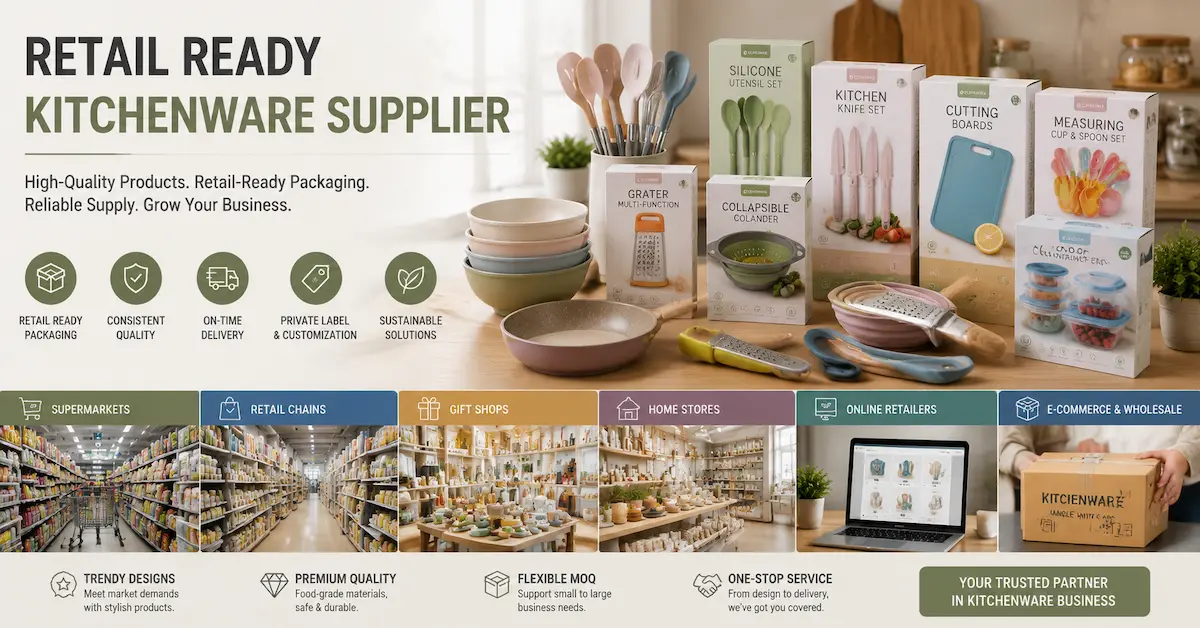
The packaging format shown in the supplied material points to a supplier offering built around branded cartons, product windows, and grouped sets. That is useful for shelf appeal, but it also raises the usual buyer questions: what is in the box, how stable is the assortment, can the line be customized, and what happens when volumes rise? Those are the questions this article is meant to help answer.
What retail-ready actually changes
In a conventional bulk kitchenware program, a distributor may ship cartons of mixed stock and leave the retailer to handle display, labeling, and sometimes bundling. A retail-ready program moves more of that work upstream. The goods are organized for immediate merchandising, and the outer presentation is part of the product strategy, not an afterthought.
That shift matters for several reasons. First, it reduces handling. Second, it gives the retailer a more predictable shelf look. Third, it supports private label positioning, which is often the difference between a generic utility aisle and a branded home goods line that can hold margin better. The supplied material suggests a one-stop model with flexible MOQ, private label customization, sustainable solutions, and on-time delivery as part of the offer. Those are useful claims, but a buyer should still validate them against the actual program structure and replenishment plan.
Quick reference: where this model fits best
Retail-ready kitchenware is usually a strong fit for supermarket programs, chain stores, gift shops, home goods retailers, and e-commerce sellers that need a consistent consumer-facing presentation. It is less effective when the buyer wants highly technical cookware specifications, laboratory-grade compliance detail, or deeply customized industrial tooling. This is a merchandising and sourcing solution first.
For a bulk kitchenware supplier, the best programs are the ones where assortment discipline matters more than technical complexity. A line with grouped tools, coordinated finishes, and repeatable packaging can be easier to buy, easier to replenish, and easier to present in store than a loose set of random SKUs. A kitchenware distributor with retail-ready capability can also help bridge the gap between factory output and channel-specific packaging requirements.
What is typically inside a retail-ready kitchenware line
The supplied product information shows a broad consumer kitchen assortment rather than a single SKU. That matters because the value is in the line architecture. The visible items include silicone utensil sets, kitchen knife sets, cutting boards, measuring cup and spoon sets, collapsible colanders, graters, bowls, storage containers, and ladles or spatulas. In other words, this is a kitchen essentials program designed for household use, gift retail, and general merchandise channels.
Materials and finishes appear to vary in a practical retail way. Silicone utensils are shown in pastel colors. Packaging is mostly carton-based, with a retail-display orientation. A metal grater is visible, along with likely stainless steel knife components, plastic cutting boards, and storage jars that appear to be glass or plastic. Bowls look ceramic or melamine-style. The common thread is not a single material system, but a shelf-ready presentation that makes the assortment easy to browse.
That variety is useful, but it also deserves caution. A mixed-material kitchenware line can be strong commercially and still require careful item-level review for food-contact expectations, cleaning guidance, and packaging durability. A buyer should not assume a bundled assortment means unified performance characteristics.
Why private label matters in kitchenware
Private label is often the real commercial lever in this category. Kitchenware is crowded, and many products compete on function alone. Once the item is ordinary enough to be substituted easily, packaging and brand consistency become more important. A private-label kitchenware supply program lets the buyer control the visual language, create a recognizable shelf block, and avoid the generic look that often compresses margin.
For retailers, private label also makes assortment planning simpler. The brand can be extended across utensils, prep tools, and storage items without rewriting the shelf every time a new SKU is added. That is one reason a retail ready kitchenware supplier can be more valuable than a simple factory source. The supplier is not only making goods; they are helping translate a product set into a store-ready program.
Still, there is a practical warning here. Private label works best when the supplier can keep artwork, carton specs, pack counts, and replenishment rules under control. If packaging changes too often, or if one part of the assortment drifts in finish or size, the retail shelf starts looking improvised. Buyers should ask for a clear control process before they scale the line.
How buyers should evaluate a supplier
The first question is obvious: can they deliver the category you need in the format you need? But the better question is whether they can do it repeatedly. Kitchenware programs often look easy in sample form and complicated in volume. The supplier should be able to explain how they handle grouping, boxing, labeling, and brand customization without breaking the line visually.
Buyers should also look at assortment logic. A good program has internal order. The storage items, prep tools, and serving items should feel like they belong to the same retail family. That does not mean every product must share the same material or finish. It does mean the line should make sense to a shopper scanning a shelf in a few seconds.
Flexible MOQ is attractive, especially for chains testing a new range or online sellers validating demand. But low MOQ can hide a production issue if the supplier is not organized. Small trial runs should still use the same packaging discipline and QC expectations as larger orders. Otherwise the pilot proves little.
Questions that should be on the table
Ask how the supplier structures private-label customization, whether packaging can be adapted for different retail channels, and how they manage mixed-product assortments in one program. Ask what can be standardized and what needs item-level approval. If sustainability claims are part of the pitch, ask what they mean in practice. That can range from recyclable packaging choices to material substitution, and those are not interchangeable.
Also ask for clarity on the items that are not visible in a collage. Exact materials, dimensions, unit counts, and compliance details should be confirmed before any commercial decision. The supplied information does not provide those specifics, and it would be careless to assume them.
Common sourcing mistakes
The first mistake is treating retail-ready packaging as a cosmetic layer. It is not. The packaging drives handling, display, and often perceived quality. If the carton buckles, the print feels off-brand, or the set is unclear from the shelf, the retail value drops fast.
The second mistake is overloading the program with too many lookalike products. Kitchenware buyers sometimes add one more spoon set, one more bowl variant, one more storage jar, and then wonder why the line does not sell cleanly. A tight assortment usually performs better than a sprawling one.
The third mistake is assuming a private-label kitchenware supplier will automatically understand every channel. Supermarket shelving, gift retail, and e-commerce each have different expectations for packaging depth, barcode placement, outer case design, and carton strength. A distributor or supplier that understands one channel well may still need guidance on another.
Practical buyer advice
If you are building a new line, start with the products that create the clearest consumer use case. Utensils, cutting tools, prep accessories, and storage pieces can form a coherent opening program. Then decide whether the line needs soft-color household styling, a more neutral retail look, or a value-led presentation. The supplied images lean toward soft pastels and display-friendly cartons, which suggests a consumer-facing range designed to feel approachable rather than technical.
For online retail, consistency matters even more. Customers cannot touch the product before purchase, so packaging and set composition become part of the promise. For physical stores, shelf readability matters most. Either way, the program should look intentional from five feet away and still make sense when a buyer picks up the box.
One small but important caution: mixed-material kitchenware sets can create hidden complexity in warehousing and fulfillment. Separate components, accessory packs, and nested items all need disciplined packing instructions. That is not glamorous work, but it is where many otherwise good programs lose time.
FAQ
Is retail-ready the same as wholesale?
Not exactly. Wholesale is a sales channel. Retail-ready describes how the product is packaged and prepared for shelf or display. A wholesale kitchenware order can be retail-ready, but not all wholesale supply is built that way.
Can a bulk kitchenware supplier also support private label?
Yes, but the supplier needs packaging control, artwork discipline, and channel awareness. Bulk capacity alone does not guarantee a retail-facing program will hold together.
What makes a kitchenware distributor useful in this category?
A distributor can help bridge assortment, logistics, and retail presentation. In practice, that often means managing the product mix so the line arrives ready for sale rather than ready for additional work.
Next step
For buyers evaluating a retail-ready kitchenware supplier, the next move is to request a line review that covers packaging format, assortment structure, private-label options, MOQ, and the exact product details behind each set. The collage in the supplied material points to a broad consumer kitchenware program with retail-display packaging, but the commercial decision still depends on the item-level spec sheet and the supplier’s ability to keep the range consistent as volumes grow.
That is the real test: not whether the products look good in a brochure, but whether the program can move cleanly from sourcing desk to shelf without extra handling, confusion, or rework.
