




How Should Buyers Source Safety School Scissors Wholesale?
The best safety school scissors wholesale program starts by defining the intended student group, cutting application, sales channel, product design, packaging, and applicable market requirements before comparing prices.
For a retailer or school-supply distributor, the right product should balance:
- Appropriate blade and tip design
- Comfortable student handling
- Controlled cutting performance
- Durable assembly
- Storage protection where required
- Retail-ready packaging
- Repeat-order consistency
- OEM/private-label flexibility
The lowest-priced scissors are not necessarily the lowest-cost option. Poor cutting performance, uncomfortable handles, loose pivots, packaging failures, or inconsistent repeat production can create returns and damage a retailer's reputation.
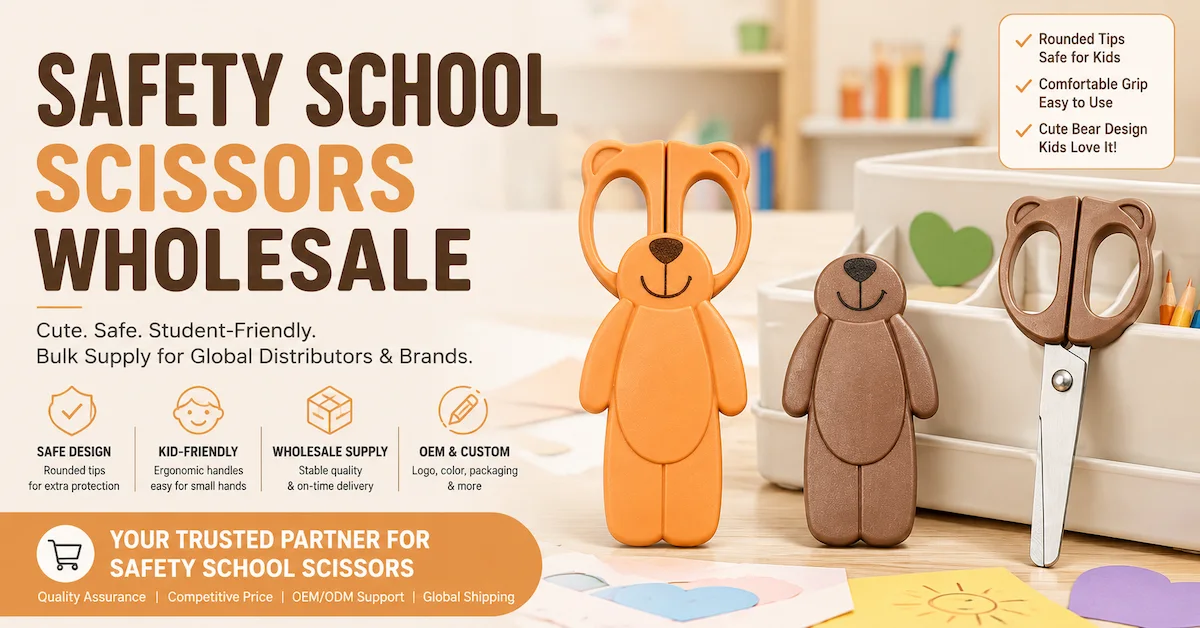
BONET's current school-scissors range includes student name-card scissors, 5-inch school scissors, kids-oriented models, safety-oriented designs, models with covers, ergonomic products, and other student-focused styles.
Who Buys Safety School Scissors in Bulk?
Different buyers require different product strategies.
School-Supply Distributors
Distributors typically prioritize:
- Reliable bulk availability
- Multiple sizes or models
- Consistent specifications
- Practical carton packing
- Repeat-order stability
Their goal is usually to build an assortment that can serve different schools, stationery stores, and regional retailers.
Supermarkets and Retail Chains
Retail buyers often focus more on:
- Shelf appeal
- Clear product positioning
- Attractive colors
- Packaging efficiency
- Suitable price tiers
- Barcode/SKU management
Education and Stationery Brands
Private-label education brands may need:
- Brand-specific colors
- Custom packaging
- Logo application
- Product differentiation
- Exclusive models
E-Commerce Sellers
Online sellers may prioritize:
- Strong product photography
- Clear safety-oriented design features
- Compact packaging
- Easy-to-understand benefits
- Low complaint and return risk
A serious wholesale supplier should first understand which of these channels you serve before recommending a product.
Which Safety School Scissors Models Should Buyers Compare?
There is no single “best” school scissors design for every market.
| Product Type | Main Feature | Best For | Buyer Priority |
|---|---|---|---|
| Basic student scissors | Simple cutting design | General school supply | Cost + consistency |
| Rounded-tip style | More student-oriented tip profile | Younger-user programs | Product design |
| Scissors with cover | Protective storage | School bags and retail | Storage convenience |
| Name-card scissors | Identification feature | Classroom programs | Personalization |
| Ergonomic scissors | Improved grip geometry | Frequent student use | Comfort |
| Colorful kids scissors | Strong visual appeal | Retail / e-commerce | Shelf differentiation |
| Private-label model | Custom branding | Education brands | Brand control |
BONET's existing school-scissors category already covers several of these directions, which gives buyers a useful starting point before requesting deeper OEM customization.
What Does “Safety” Mean When Buying School Scissors?
“Safety” should not be treated as a generic marketing word.
For B2B procurement, it should be translated into specific product requirements.
Tip Design
Depending on target users, buyers may consider:
- Rounded or less aggressive tip profiles
- Appropriate blade length
- Controlled point geometry
The correct specification depends on the intended age group and use case.
Cutting Performance
A student product still needs to cut reliably.
If scissors are too difficult to operate, users may apply excessive force, reducing control.
Buyers should therefore evaluate:
- Smooth cutting
- Proper blade alignment
- Consistent opening and closing
Handle Control
The handle should support:
- Stable grip
- Appropriate finger openings
- Comfortable operation
- Suitable leverage
Pivot Stability
The pivot should not be:
- Excessively loose
- Unnecessarily stiff
- Unstable between samples
Protective Cover
For selected models, a sheath or cover can provide a practical storage benefit.
Buyers should check whether it:
- Fits securely
- Is easy to remove
- Stays attached during transport
- Works with the intended packaging
What Specifications Should You Send to a Wholesale Supplier?
A weak inquiry might say:
“Please quote kids scissors.”
A high-quality RFQ defines the actual product.
| Specification | What Buyer Should Confirm |
|---|---|
| Target user | Intended student/age group |
| Use | Paper, classroom craft,general school use |
| Product size | Required or reference dimensions |
| Blade material | Confirm required specification |
| Tip profile | Required geometry |
| Handle | Material, color, grip design |
| Cover | Required / optional |
| Branding | Logo and placement |
| Packaging | Card, blister, box,set |
| Quantity | Units per SKU |
| Market | Destination country |
| Compliance | Buyer/retailer requirements |
This makes quotations much easier to compare.
Two suppliers quoting “school scissors” may actually be quoting products with completely different blade structures, handles, packaging, and inspection requirements.
Blade and Handle Quality: What Matters in Bulk Orders?
Blade Alignment
The two blades need controlled contact through the cutting cycle.
Poor alignment can cause:
- Incomplete cuts
- Material slipping
- Excessive cutting force
Edge Consistency
The required edge should match the approved application rather than simply be described as “sharp.”
Handle Assembly
For bulk orders, check:
- Handle attachment
- Mold consistency
- Surface defects
- Finger-opening dimensions
Pivot Performance
Sample several units rather than testing only one showroom sample.
A reliable wholesale program requires consistency across cartons, not just one good prototype.
A Practical Safety School Scissors QC Checklist
For safety school scissors wholesale, buyers should convert “good quality” into measurable inspection items.
| QC Item | What to Inspect |
|---|---|
| Blade alignment | Smooth and consistent contact |
| Cutting performance | Matches agreed classroom use |
| Tip geometry | Matches approved sample |
| Pivot | Smooth,secure movement |
| Handle | Stable and comfortable |
| Cover/sheath | Secure fit if included |
| Surface | No unacceptable defects |
| Color | Matches approved reference |
| Logo | Correct placement and appearance |
| Packaging | Correct artwork and SKU |
| Carton quantity | Matches PO |
| Repeat production | Matches approved reference |
The final approved sample should ideally become the production and repeat-order reference.
Compliance: Avoid Asking Only “Do You Have Certificates?”
This is an important procurement risk.
There is no universal certificate called a “school scissors safety certificate” that automatically proves a product can be sold everywhere.
Requirements depend on:
- Product classification
- Intended user
- Destination market
- Materials
- Retailer requirements
United States
If a product is classified as a children's product in the U.S., buyers need to determine which CPSC/CPSIA requirements apply. CPSC states that children's products generally must comply with applicable safety rules, undergo required third-party testing unless exempt, carry a Children's Product Certificate where applicable, and include permanent tracking information on the product and packaging where practicable.
Tracking information can include the manufacturer or private-labeler identity, production location/date, and batch or production information.
CPSC Children's Product Guidance
European Union
For consumer products covered by the EU's General Product Safety Regulation, Regulation (EU) 2023/988 establishes a general safety framework. It requires economic operators to place only safe products on the market and addresses factors including product design, technical characteristics, packaging, instructions, warnings, intended consumers, risk analysis, technical documentation, and traceability. The GPSR has applied since December 13, 2024.
EU General Product Safety Regulation Summary
The practical takeaway for importers is:
Tell the supplier the destination market first, then confirm which documents, tests, labels, and product requirements apply to that specific SKU.
Do not assume one report covers all models, markets, or production batches.
How to Evaluate a Safety School Scissors Wholesale Supplier
A strong supplier evaluation should cover product capability and commercial reliability.
1. Existing School Scissors Experience
Look for existing experience with:
- Student scissors
- Kids scissors
- Covered scissors
- Ergonomic scissors
- Personalized models
BONET's dedicated school-scissors category indicates an established range across several student-oriented product styles.
2. Sample Development
Before bulk purchasing, request representative samples.
Test:
- Cutting performance
- Grip
- Pivot
- Tip profile
- Cover fit
- Overall finishing
3. Quality Control
Ask:
- Which production stages are inspected?
- How is blade alignment checked?
- How are approved colors controlled?
- How are packaging errors prevented?
4.OEM Capability
A supplier should clearly distinguish between:
- Existing-model branding
- Color customization
- Packaging customization
- Structural modification
5. Repeat-Order Control
For distributors, this is especially important.
Ask how subsequent orders are matched to:
- Approved product specification
- Golden sample
- Pantone/color reference
- Logo artwork
- Packaging files
OEM Safety School Scissors for Private Label Brands
OEM is one of the strongest conversion opportunities for this product category.
BONET states that its OEM/ODM services support scissors and other kitchen/household products for brands, wholesalers, retailers, supermarket chains, and e-commerce sellers, including product development and large-scale production.
Custom Handle Colors
Useful for:
- Brand identity
- School-grade segmentation
- Seasonal programs
- Product-family consistency
Custom Logo
Possible branding requirements should be discussed according to:
- Product material
- Available marking area
- Logo durability requirement
Private-Label Packaging
Packaging can include:
- Retail graphics
- Brand information
- Product features
- Barcode/SKU
- Market-required information
Product Development
For stronger differentiation,buyers can discuss feasibility for:
- Handle redesign
- Protective-cover concepts
- Identification features
- Product sets
Wholesale vs OEM: Which Route Is Better?
| Requirement | Standard Wholesale | OEM / Private Label |
|---|---|---|
| Speed to market | Usually faster | More development |
| Existing design | Yes | Can be customized |
| Branding | Limited | Strong |
| Packaging control | Standard / limited | Custom |
| Differentiation | Lower | Higher |
| Sampling needs | Lower | Higher |
| Ideal for | Distributors testing demand | Retail brands building a range |
If you are launching a new market, an existing proven model may reduce development complexity.
If you already have stable demand, OEM can create stronger brand differentiation and protect margin.
What Affects Safety School Scissors Wholesale Pricing?
Price should be compared only after specifications are aligned.
Common cost drivers include:
- Product size
- Blade construction
- Handle design
- Protective cover
- Number of colors
- Logo method
- Packaging complexity
- Order volume
- Number of SKUs
- Testing/document requirements
- New tooling
A quotation 8% lower is not necessarily cheaper if it excludes custom packaging, inspection, or the same material specification.
Ask every supplier:
“What exactly is included in this price?”
MOQ and Lead Time: Ask the Right Question
There is no single useful MOQ for all school scissors.
MOQ can change according to:
- Existing or custom model
- Handle color
- Number of variants
- Packaging
- Branding
- Tooling
Instead of asking:
“What is your MOQ?”
Ask:
“What is the MOQ for this school scissors model with three handle colors, our logo, custom retail packaging, and X units per SKU?”
The same applies to lead time.
Lead time can include:
- Sample development
- Sample revision
- Packaging artwork
- Material preparation
- Bulk production
- Final inspection
Confirm these separately when planning a retail launch.
How to Reduce Risk Before a Bulk Order
A good procurement sequence is:
- Define user and target market.
- Select suitable product type.
- Confirm product specification.
- Review required compliance documentation.
- Request samples.
- Test samples internally.
- Lock logo and packaging.
- Approve the final sample.
- Confirm inspection criteria.
- Place bulk order.
Skipping steps 5–8 is one of the most common ways buyers create expensive production disputes.
A Better RFQ for High-Quality Quotations
When contacting BONET or another supplier, send enough information for a real project evaluation.
A strong inquiry can look like:
“We are a school-supply distributor developing a private-label safety scissors range for our retail customers. We need two student-scissors models, three handle colors, protective covers on one SKU, our logo and custom card packaging. Initial volume is X units per SKU for the [market]. Please recommend suitable existing models and confirm customization, sample, MOQ, testing/documentation and lead-time requirements.”
That immediately tells the supplier:
- Who you are
- What you need
- How much you need
- What must be customized
- Where the product will be sold
This type of inquiry is much more likely to receive an actionable quotation.
Send Your School Scissors RFQ to BONET
Common Mistakes When Buying Safety School Scissors Wholesale
Choosing by Appearance Alone
Colorful scissors can still have poor grip or inconsistent cutting.
Using “Safety” Without a Defined Requirement
Define the tip, blade, cover, user group, and intended use.
Comparing Non-Equivalent Quotes
Ensure every supplier is quoting the same product and packaging specification.
Skipping Samples
Catalog photos cannot show pivot tension or real cutting behavior.
Asking for Compliance Too Late
Destination-market requirements should be discussed before finalizing the product.
Over-Customizing the First Order
Too many SKUs, colors, and structures can increase MOQ and inventory complexity.
Ignoring Repeat Orders
A wholesale program should be designed for replenishment, not just the first shipment.
Why Consider BONET for School Scissors Sourcing?
BONET offers a dedicated school-scissors range with several student-focused styles and also provides OEM/ODM services for wholesalers, retailers, supermarket chains, e-commerce sellers, and brands.
For buyers seeking safety school scissors wholesale, the most efficient next step is not simply requesting a catalog.
Send BONET:
- Your target student group
- Destination country
- Product reference
- Required quantity
- Number of SKUs
- Handle colors
- Cover requirement
- Logo
- Packaging concept
- Required compliance/documentation
This gives the supplier enough information to recommend an appropriate model and prepare a more meaningful quotation.
FAQ
What are safety school scissors?
Safety school scissors are student-oriented scissors designed with product features appropriate to the intended school or classroom use. Exact blade, tip, handle, storage, and compliance requirements should be defined for the target users and destination market.
Where can I buy safety school scissors wholesale?
Wholesale buyers can source from specialized school scissors suppliers or manufacturers that support bulk production, sampling, packaging, quality control, and repeat orders.
How do I choose a safety school scissors wholesale supplier?
Evaluate existing school-scissors experience, sample quality, blade and pivot consistency, handle design, QC processes, OEM capability, packaging support, compliance documentation, MOQ, and repeat-order reliability.
Are rounded-tip scissors always required for students?
Not necessarily. The appropriate tip profile depends on the intended users, application, retailer requirements, and local product rules. Buyers should specify the target age and market.
Can school scissors come with protective covers?
Yes. Some school scissors are available with protective covers or sheaths for storage. Buyers should test cover retention and ease of use before bulk production.
Can BONET customize school scissors?
BONET offers OEM/ODM services that can include product, color, logo, packaging, and development support depending on project requirements.
What is the MOQ for OEM school scissors?
MOQ varies by existing model, customization, color quantity, packaging, number of SKUs, and tooling requirements. It should be quoted against the exact specification.
Do school scissors need CPSIA certification?
If the product is classified as a children's product in the U.S., applicable CPSC/CPSIA requirements must be determined. CPSC states that children's products generally require compliance with applicable rules, relevant testing, certification, and tracking information.
What should I test before placing a bulk order?
Test blade alignment, cutting performance, pivot movement, tip profile, handle comfort, cover fit where applicable, finishing, branding, and packaging.
What should I send BONET to get an accurate quote?
Send the product style or reference, target student group, market, quantity per SKU, colors, logo, packaging, cover requirement, compliance needs, and expected delivery window.
Conclusion
A successful safety school scissors wholesale program is built around more than colorful handles and a low unit price.
Retailers, distributors, importers, and education brands should evaluate the complete procurement package:
- Product suitability for intended students
- Blade and tip design
- Cutting consistency
- Handle ergonomics
- Protective storage options
- QC
- Market compliance
- Private-label packaging
- MOQ
- Lead time
- Repeat-order control
For buyers planning an OEM or bulk school-scissors program, the fastest route to a meaningful quotation is to define the target user, destination market, product configuration, quantity, branding, and packaging before contacting the supplier.
BONET's dedicated school-scissors range and OEM/ODM capabilities provide a practical starting point for both standard wholesale sourcing and private-label development.
