




A reliable scissors manufacturer China partner should make the product, evidence and commercial assumptions visible. This guide helps importers compare a scissors factory China , China scissors manufacturer, OEM route, custom scissors manufacturer, private label program, stainless steel scissors supplier and wholesale scissors China offer.
China is a major sourcing base for scissors, but “made in China” is not a quality specification. A small household pair, a kitchen shear, a garden tool and a professional cutting instrument can use different steels, forming routes, edge geometries, finishes, fasteners and inspection methods. Even within kitchen scissors, a basic opening tool, a multifunction model and a magnetic-storage design create different risks. Buyers who send one generic product photograph often receive several non-comparable offers.
This article is written for brand owners, importers, distributors, retailers, food-service buyers and e-commerce teams. It focuses on the decisions that are easiest to lose between an inquiry and a repeat order: what the factory actually controls, which evidence belongs to the selected SKU, how an OEM or private-label change is priced, and how a wholesale order is released. BONET HOUSEWARE public pages are used as product and process references; project-specific commercial details still require written confirmation.
1. Define the Scissors Category and Buying Job
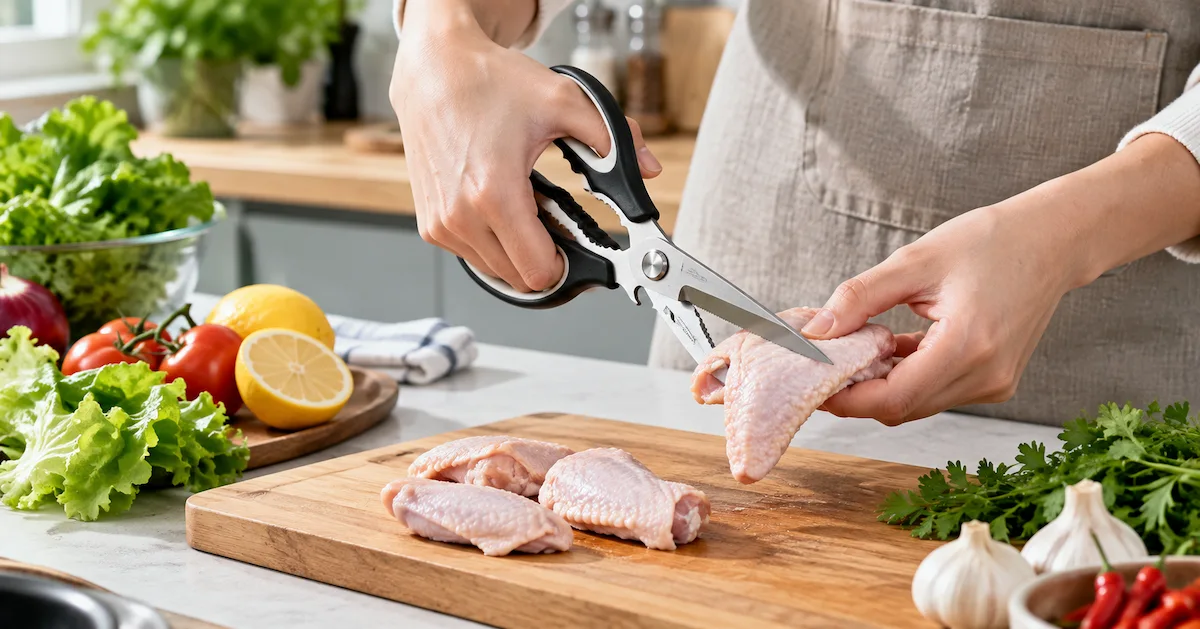
Start with the job, not the factory name. “Scissors” may mean kitchen scissors, sewing scissors, household scissors, poultry shears, office scissors or a multi-purpose tool. Each category has a different user expectation. A kitchen buyer may need food-package cutting, herb trimming, cap opening and easy cleaning. A sewing buyer may prioritize fine tip control and light resistance. A distributor may need a broad assortment with several handle colors and pack formats.
Write the intended use in plain language and identify prohibited use. State the user, sales channel, destination market and expected frequency. Add a reference model only after describing what must remain unchanged. A photograph can show a silhouette, but it rarely shows edge preparation, pivot resistance, handle fit or protective packaging. Those details belong in the first brief.
| Buying input | What to state | Why it changes factory selection |
|---|---|---|
| Category | Kitchen, household, textile, garden, professional or mixed assortment | Determines relevant forming, edge, assembly and inspection knowledge. |
| Primary job | Material to cut, action frequency and user environment | Guides blade geometry, pivot feel, handle and care communication. |
| Channel | Retail peg, gift box, e-commerce parcel, distributor carton or food service | Changes protection, label, pack size and carton assumptions. |
| Market | Destination country, language and required documents | Shapes packaging review and any market-specific compliance work. |
| Commercial frame | Trial quantity, reorder expectation, target date and destination | Allows a project-specific MOQ, quote and schedule discussion. |
A candidate custom scissors manufacturer should be able to repeat this brief and ask useful questions. If the first reply contains only a unit price and a stock photograph, the buyer still has work to do before comparing it with a factory that has identified the model and assumptions.
2. Verify That the China Scissors Manufacturer Controls the Relevant Process
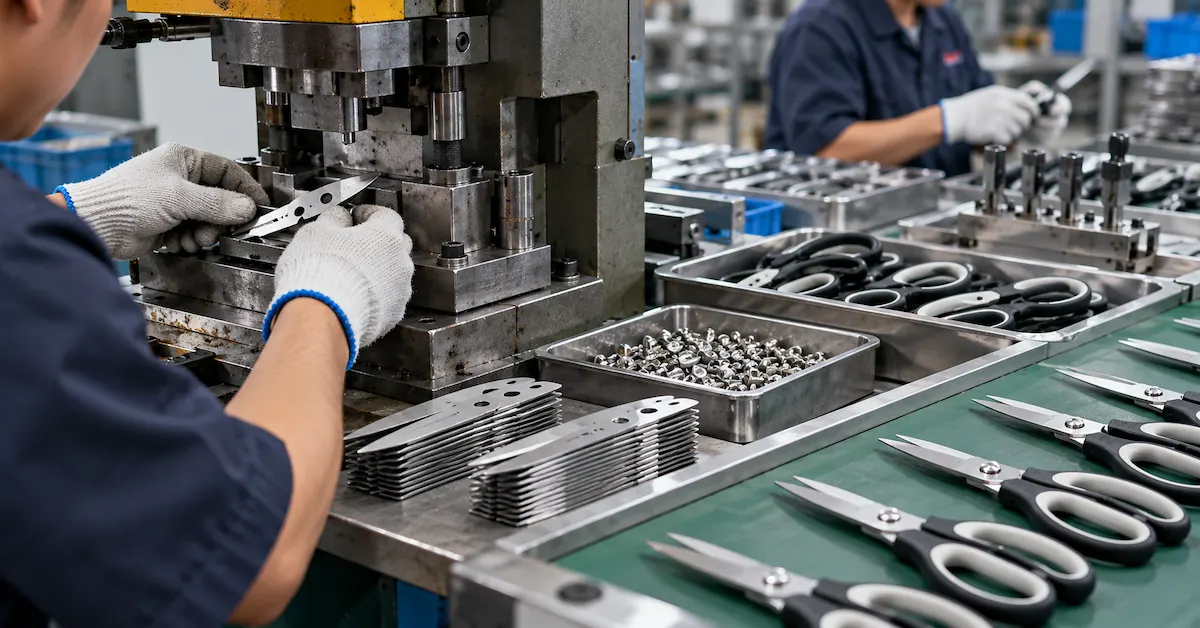
Factory verification is not a contest to collect the longest equipment list. It is a check that the supplier can explain how the selected scissors are formed, finished, assembled, cleaned, inspected and packed. BONET's public manufacturing description lists stages including stamping, straight adjustment, heat treatment, rough grinding, water grinding, polishing, injection molding, ultrasonic cleaning, setting and assembly, quality checks, final cleaning and packing. Not every SKU uses every stage. Ask which stages apply to your model.
Separate internal work from coordinated work. If a component or finish is outsourced, ask who owns the drawing, approval sample, incoming check and corrective action. A trading company can still coordinate a useful program, but the buyer should know where the product record lives and who can authorize a change. Process capability is meaningful only when it is connected to the item being purchased.
| Process area | Buyer question | Evidence to request |
|---|---|---|
| Stamping and straight adjustment | How are profile, flatness and hole position controlled? | Drawing reference, in-process check or recorded sample. |
| Heat treatment | What requirement is connected to the proposed steel and process? | Agreed material direction and available process record. |
| Grinding and polishing | Where are edge, geometry and surface appearance reviewed? | Visual standard, work reference and inspection result. |
| Handle molding | How are color, flash and metal-to-handle fit checked? | Color reference, approved sample and defect criteria. |
| Assembly and packing | How are pivot, function, protection and contents verified? | Item checklist, packed sample and carton record. |
3. Read Stainless Steel Claims at SKU Level
“Stainless steel” describes a material family, not the complete cutting result. A stainless steel scissors manufacturer should identify the proposed grade for the exact model and explain how it is documented. BONET public product examples list 420 stainless steel for named scissors models such as S52034, SKI090, SKI022 and G2011. Those details apply to the identified products; they should not be copied across every model in a catalog.
Ask the factory to connect material, geometry, edge preparation, finish and pivot to the intended task. A blade with a clean surface can still feel poor if the two halves do not align. A strong handle can still be uncomfortable if the rings are too small. A polished surface can still show burrs around a notch or opener. Material evidence is useful when it sits beside a physical sample and a function test.
| Specification | What to record | What the sample should show |
|---|---|---|
| Steel direction | Proposed grade and model reference | Surface, edge condition and result on agreed media. |
| Blade geometry | Profile, length, thickness and edge form | Alignment and continuous contact through the stroke. |
| Pivot | Fastener, assembly direction and any separation method | Resistance, play, smoothness and repeatable alignment. |
| Handle | Material, color, ring size, insert and logo area | Grip, molding, fit and comfort in the intended hand position. |
| Finish | Polish, coating, texture and uncoated surfaces | Consistent appearance without burrs or unsafe points. |
4. Decide Between Stock, OEM and Custom Scissors Programs
A China scissors manufacturer may offer an existing model, a modified platform or a drawing-led project. The route affects the time, evidence and commercial assumptions. A stock model can still require a new logo, color, sleeve or carton. A modified model may change a handle, blade profile, accessory or storage feature. A drawing-led OEM program may require tooling, feasibility review and several sample rounds. Call the route what it is.
For an OEM scissors manufacturer China inquiry, separate fixed elements from open recommendations. Identify the model, revision, material, dimensions, functions, logo, packaging and quantity. Ask the supplier to return a gap list. That list is often more valuable than an early quote because it shows whether the factory has understood the construction.
| Route | Buyer provides | Supplier should return | Approval gate |
|---|---|---|---|
| Existing model | Model reference, branding idea, quantity and pack direction | Confirmed construction, branding options and project quote | Identified sample and packed presentation. |
| Modified model | Reference sample plus marked changes | Feasibility notes, impact on tooling, sample and price | Revision-specific sample. |
| Drawing-led OEM | Drawing, tolerances, material and acceptance criteria | Technical review, open questions and development plan | Approved drawing and first article. |
| New custom program | User problem, target position and concept | Structure options, recommendations and prototype route | Defined product before production quote. |
Have a drawing, sample or product idea?
Have a drawing, sample or product idea?
Send Your Scissors Brief to BONET5. Build a Sample Gate That an Inspector Can Repeat
A sample is not a photograph with a favorable angle. Give it an ID, received date, model, revision and component list. Photograph the complete scissors, blade surfaces, pivot, handle, logo area, accessories and packaging. Record the test media and the result. If the sample changes, create a new revision. A marked image should never silently replace the physical reference.
Review in gates. First verify identity and contents. Then test the primary cutting job. Operate the pivot through a full stroke and inspect alignment. Test every named secondary function. Review grip, molding, cleaning access, protective parts and pack fit. Stop approval when the result is inconsistent, a claim cannot be supported or the packed product is exposed or incomplete.
| Sample gate | Practical review | Record to keep | Reason to stop |
|---|---|---|---|
| Identity | Model, revision, dimensions, components and pack contents | Sample ID, photos and received date | Unit cannot be tied to the current brief. |
| Cutting | Agreed media, full stroke, edge behavior and movement | Method, result and visible damage | Result is inconsistent or outside intended use. |
| Pivot | Opening, closing, resistance, play and alignment | Observation and approved reference feel | Movement binds, changes or permits unsafe separation. |
| Handle | Grip, molding, fit, color, logo and attached parts | Defect notes and approved appearance | Comfort, fit or assembly misses the brief. |
| Packaging | Retention, point protection, labels, barcode and carton fit | Artwork revision and packed photos | Product moves, is exposed or information is incomplete. |
6. Plan Private Label and Custom Branding Without Losing Traceability
A private label scissors manufacturer should treat branding as part of the product file. State logo method, position, size, orientation, color, surface and acceptable variation. A printed mark on a package card, laser engraving on a metal surface and molded relief on a handle are not interchangeable. Approve the actual surface under realistic lighting.
Keep the artwork, color reference, packaging dieline and product revision together. If a logo moves to make room for a grip feature, that is a product revision as well as an art revision. If a new color changes molding, ask whether it changes the quotation or sample requirement. If a protective sheath is added, review both the consumer presentation and the pack-out dimensions.
| Branding element | Buyer decision | Evidence before release |
|---|---|---|
| Logo route | Printing, engraving, molded mark, label or combination | Physical mark on the actual model surface. |
| Color | Reference standard, finish and acceptable variation | Approved color sample and lighting note. |
| Pack message | Primary job, secondary features, care and boundaries | Artwork proof matched to tested functions. |
| File control | Owner, revision, permitted use and obsolete-file handling | Controlled folder or documented release record. |
7. Make Export Packaging a Product Requirement
Packaging must survive the channel the buyer actually uses. A retail peg pack emphasizes visibility and hanging strength. A gift box emphasizes presentation. An e-commerce parcel needs protection from movement and point contact. A distributor carton needs clear SKU, color and quantity marks. Discuss the route before artwork is finalized.
BONET's public OEM/ODM page describes color boxes, gift boxes, retail packaging, barcode labels and export carton solutions. A project brief should add the inspectable details: insert construction, label language, barcode version, pack quantity, carton marks, point protection and removal experience. Place the approved scissors inside the real pack and check the result after ordinary handling.
| Packaging area | Question | Confirmation |
|---|---|---|
| Individual pack | Does the format fit the channel and protect points? | Packed sample and approved dieline. |
| Labels | Are product name, care, warnings and barcode correct? | Artwork revision and market review. |
| Retention | Can the product move, rub or contact the edge? | Shake, lift and removal observation. |
| Outer carton | Can the handler identify SKU, color, quantity and revision? | Carton specification and pack-out record. |
Need a private-label pack or export carton checked?
Need a private-label pack or export carton checked?
Request a Packaging and Sample Review8. Compare Wholesale Scissors China Quotations on One Revision
Wholesale offers are comparable only when the assumptions are comparable. A search for wholesale scissors China may return a bare-unit price, a retail-packed price and a delivered price. Normalize the model, material, features, accessories, logo, pack, quantity, inspection, delivery destination and commercial term.
Ask each scissors supplier China candidate to separate included, excluded, provisional and separately priced items. Record quote validity, currency, development charges, tooling, sample rounds and artwork changes. MOQ, price, lead time and shipping date are not universal numbers; they depend on the selected construction, quantity, packaging and live factory plan.
| Quote line | Normalize | Question to ask |
|---|---|---|
| Product | Model, revision, steel, finish, handle and features | Does this line refer to the approved sample? |
| Branding | Logo method, location, colors, setup and artwork | Which costs are one-time or recurring? |
| Packaging | Individual pack, insert, labels, barcode and carton | Is the packed sample included in the basis? |
| Development | Prototype, tooling, sample rounds and corrections | Which charges apply if the revision changes? |
| Delivery | Quantity, destination, timing and commercial term | What assumptions sit outside the unit price? |
9. Protect the Second Order and the Factory Relationship
The second order reveals whether a China scissors manufacturer has a repeatable system. Create an item master with model, revision, dimensions, material, finish, color, logo, accessories, packaging, carton arrangement and approved sample ID. Keep a change record that states what changed, what stayed fixed and which files or tests must be repeated.
Use a retained sample or controlled reference where the commercial process permits. When a new color, logo or accessory is proposed, do not edit the old file in place. Issue a new revision and link the quotation, sample, approval and production release to it. If a delivery issue appears, record the observed condition with photographs, batch information and quantity before discussing cause. Then request containment, corrective action and verification appropriate to the issue.
| Repeat-order record | Purpose | Owner |
|---|---|---|
| Item master | Preserves the approved construction and pack contents | Buyer and supplier contact |
| Feature and function notes | Keeps product claims tied to a tested result | Product and quality teams |
| Artwork and dieline log | Prevents obsolete logos, labels and barcodes | Brand and packaging teams |
| Quotation history | Explains changes in quantity, pack, tooling or delivery | Purchasing and finance |
| Issue log | Turns a delivery problem into a controlled improvement | Quality and supplier |
Factory Due-Diligence Questions
Before selecting a scissors manufacturer China partner, ask questions that are easy to answer with evidence:
- Which named SKU is closest to the requested construction?
- Which process stages apply to that SKU?
- Where are blade profile, flatness, edge and pivot checks recorded?
- Which material grade is proposed, and does the evidence belong to this model?
- How are logo, color and packaging revisions controlled?
- Who owns corrective action when a component or finish is coordinated outside the factory?
- Which sample ID and revision will the quotation use?
- Which MOQ, tooling, timing, inspection and delivery values are confirmed for this project?
FAQ About Sourcing a Scissors Factory China Partner
How do I find a China scissors manufacturer for a new brand?
Start with the exact category and consumer job. Shortlist factories that show relevant construction, then request a written brief recap, identified sample, process explanation and project-specific quotation. Catalog breadth alone is not enough.
What is the difference between an OEM scissors manufacturer China supplier and a private-label supplier?
OEM usually describes reproduction of a buyer's drawing, sample or defined specification. Private label describes selling an existing or developed product under the buyer's brand. A project may combine both: an existing model with a custom logo and retail pack, or a new structure with a private-label presentation.
How should I evaluate a stainless steel scissors manufacturer?
Confirm the exact grade for the model, then review geometry, edge preparation, finish, pivot, handle and cutting result together. A material line without a sample and test method is incomplete evidence.
Can a custom scissors manufacturer change the handle or blade?
Possibly, but a color change, new insert, altered grip, new mold and revised blade profile are different levels of work. Ask the factory to classify the change and confirm feasibility, sample rounds, tooling, MOQ, cost and timing for the selected design.
How do I compare wholesale scissors China prices?
Normalize product revision, material, features, accessories, logo, packaging, quantity, inspection, destination and delivery term. Separate one-time development charges from recurring unit costs. Compare the same assumptions, not the lowest isolated number.
What does ISO 9001 prove in a scissors purchase?
It informs a review of a quality-management system. The certificate cited for Yangjiang Master Scissor & Knife Manufacture Co., Ltd. is scoped to the production and sale of scissors. It does not replace an approved sample, item specification, function test or packaging review.
Final RFQ Checklist
- Category, intended job, user, market and channel are stated.
- Model, drawing or physical reference is identified.
- Blade, pivot, handle, accessories and storage are described separately.
- Material claims are tied to the exact SKU and evidence.
- Logo, color, packaging and artwork revisions are controlled.
- Every claimed function has a repeatable sample check.
- Applicable process stages and quality checkpoints are understood.
- Quotation lines separate product, branding, packaging, development, quality and delivery.
- MOQ, price, tooling, sample timing, production timing and shipping assumptions are confirmed in writing.
- An item master and approved reference are ready for the repeat order.
The strongest China sourcing programs are built from details that people can inspect. Define the job, verify the relevant process, read stainless steel claims at SKU level, choose the right OEM route, test the physical sample, approve the real pack and compare wholesale offers against one revision. That discipline gives a brand a scissors product that can be quoted, explained, checked and reordered with fewer surprises.
Ready to compare a scissors project on one controlled brief?
Send Your Scissors RFQ to BONET