




Silicone Spoon Supplier Guide for Kitchenware Buyers
Choosing a silicone spoon supplier looks easy until you compare real samples, packaging options, and product claims across several factories or trading partners. A cooking spoon is a simple kitchen tool, but for retail and wholesale buyers it must satisfy several expectations at once: safe food-contact use, comfortable handling, attractive colors, reliable construction, and a presentation that fits the sales channel.
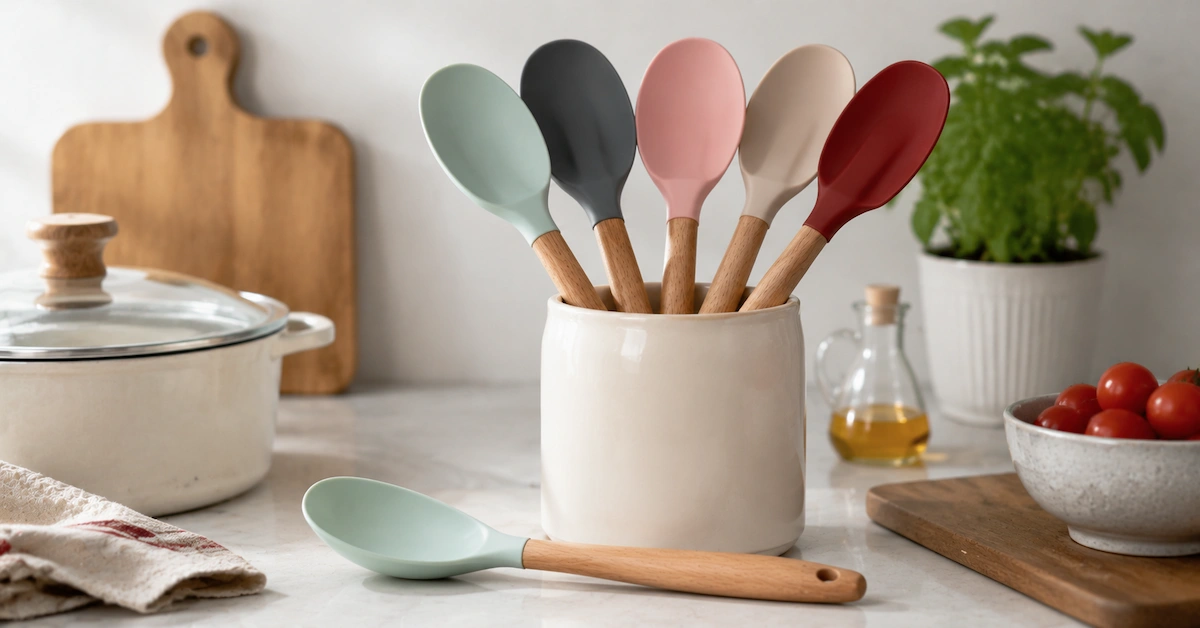
The product shown in the original article is a familiar retail style: a rounded silicone spoon head, a straight wood-finish handle, multiple colors such as mint green, gray, pink, beige, and red, plus a hanging hole at the handle end. Those visible details are useful, but they are not enough to approve a purchase order. Buyers still need to verify the material specification, heat guidance, handle construction, packaging, and repeatability before scaling an order.
Key Takeaways
- Do not approve a silicone spoon order based on product photos alone; request samples and written specifications.
- Ask the supplier to identify the silicone type, handle material, heat-use guidance, and food-contact documentation for your target market.
- Check the joint between the spoon head and handle because this is a common failure point in daily use.
- Evaluate color consistency, packaging, and hanging display options before committing to wholesale quantities.
Why Silicone Spoon Sourcing Requires Care
Silicone spoons are popular because they can be gentle on nonstick cookware, suitable for stirring and serving, and visually appealing in modern kitchen assortments. However, buyers should avoid treating every silicone spoon manufacturer as interchangeable. Similar shapes can hide major differences in material quality, surface finish, handle attachment, color control, and long-term durability.
For B2B buyers, the risk is not only a disappointed end user. A poorly specified utensil can create return issues, inconsistent shelf appearance, unclear online listings, and problems when customer service teams cannot answer basic product questions. A good supplier should help reduce uncertainty, not add to it.
What to Confirm Before Requesting a Quote
Before focusing on unit cost, collect the information needed to compare offers on the same basis. If a supplier cannot explain what the spoon is made from or how it should be used, the cheapest price may not represent the best landed value.
- Material details: Ask what type of silicone is used for the spoon head and what documentation is available for food-contact markets you sell into.
- Heat guidance: Request the supplier’s stated temperature range or recommended cooking use. Do not invent this information in your product listing.
- Handle material: Confirm whether the wood-finish handle is solid wood, coated wood, bamboo, or another substrate.
- Care instructions: Ask whether the product is intended for hand washing, dishwasher use, or limited exposure to water and heat.
- Color options: Confirm available colors, tolerance for shade variation, and whether repeat orders can match previous batches.
- Packaging: Review whether the spoon ships as a single item, set, hang-card item, sleeve-packed product, or private-label package.
Sample Evaluation Checklist
A first sample should be tested in the way a consumer will actually use the spoon. Visual inspection matters, but it should not be the whole review. Stir sauce, scrape a bowl, scoop soft food, and hold the spoon for several minutes. Buyers often discover balance, grip, or bowl-shape issues only after practical handling.
| Check Point | What to Look For | Question to Ask the Supplier |
|---|---|---|
| Spoon head | Smooth surface, useful bowl depth, flexible but not flimsy feel | What silicone specification and food-contact documents can be provided? |
| Handle | Even wood-finish appearance, comfortable grip, no rough edges | What is the exact handle material and finish process? |
| Joint area | No visible looseness, gaps, or weak transition between head and handle | How is the head attached to the handle, and how is it checked? |
| Color | Consistent shade across samples and acceptable finish uniformity | What color tolerance applies between production batches? |
| Retail readiness | Hanging hole works, packaging protects the item, labeling is clear | What packaging formats are available for wholesale or private label? |
How to Compare Silicone Spoon Suppliers
A professional silicone spoon supplier should respond clearly to technical and commercial questions. You do not need exaggerated claims; you need accurate information. When comparing suppliers, look at how each one handles specifications, sample revisions, packaging discussion, and production communication.
Ask whether the supplier can provide a product spec sheet, sample approval record, packaging artwork template if applicable, and pre-shipment inspection criteria. If you need OEM or private-label support, ask what customization is realistic: logo placement, handle color, spoon-head color, packaging design, barcode labeling, carton marks, or set configuration. Avoid assuming any custom service is included until it is confirmed in writing.
For wholesale programs, also ask how replacement samples, color standards, and production photos are managed. A supplier that communicates small details early may help prevent larger quality disagreements later.
Wholesale Buying Strategy: Start Narrow, Then Expand
Multiple colors can make silicone cooking spoon wholesale programs more flexible. The mint green, gray, pink, beige, and red options mentioned in the source can support coordinated kitchen sets, seasonal displays, online variations, or giftable assortments. Still, more colors also mean more inventory decisions and more chances for inconsistent demand.
A practical approach is to begin with a focused color range and expand after sell-through data is available. If your channel is retail shelving, neutral colors may support broad appeal. If your channel is online marketplaces, brighter colors may help product images stand out. If the spoon is part of a set, make sure the colors coordinate with spatulas, ladles, tongs, or other utensils before committing to packaging artwork.
Common Mistakes to Avoid
The first mistake is selecting only by price. A low unit quote can become expensive if the product needs repacking, creates returns, or looks inconsistent beside other kitchenware. Compare total landed value, including packaging, inspection, freight impact, labeling, and the supplier’s ability to repeat the approved sample.
The second mistake is assuming care instructions. A wood-finish handle may have different washing limits than a one-piece silicone utensil. If dishwasher suitability is not stated by the supplier, do not claim it in your listing or packaging.
The third mistake is overlooking merchandising. The hanging hole is a useful feature, but buyers should test whether it fits the intended peg hook or display format. Packaging should protect the handle finish, prevent dust exposure where needed, and communicate product use without overstating unsupported claims.
Questions to Ask Before Placing an Order
- Can you provide the current product specification sheet for this silicone spoon?
- What food-contact documentation is available for the markets where we plan to sell?
- What is the stated heat-use guidance for cooking applications?
- What is the handle made from, and how should consumers clean it?
- Can production colors be matched to the approved sample or a defined color standard?
- What packaging options are available for retail, wholesale, or private-label programs?
- What quality checks are performed on the spoon head, handle finish, joint strength, and packing?
- What commercial terms, MOQ, lead time, and customization limits should we confirm before artwork approval?
Practical FAQ
Is every silicone spoon safe for cooking?
No. Buyers should request the supplier’s material specification, food-contact documentation, and heat-use guidance. Do not rely on appearance alone.
Can a wood-finish handle go in the dishwasher?
Do not assume it can. Ask the supplier for care instructions and test samples according to the intended use before making any consumer-facing claim.
What matters most in a supplier sample?
Check practical handling, spoon-head firmness, surface finish, handle comfort, joint security, color consistency, and packaging fit for your sales channel.
Should wholesale buyers order all colors at once?
Not always. A smaller initial color range can reduce inventory risk and help identify which shades perform best before expanding the assortment.
What makes a silicone spoon supplier reliable?
Reliable suppliers provide clear specifications, consistent samples, realistic customization answers, transparent packaging options, and responsive communication before and after order approval.
Final Sourcing Advice
A silicone spoon is a simple product, but sourcing it well requires disciplined questions. Confirm the material and handle details, test real samples, document packaging expectations, and avoid unsupported claims. The best supplier for a kitchenware buyer is not necessarily the one with the lowest quote; it is the one that can repeat the approved product consistently and provide the information your team needs to sell it responsibly.
