




Spiralizer Manufacturing: Innovations, Processes, and Sourcing Guidance
Spiralizer manufacturing sits within the broader kitchen tool and food preparation category, where buyers expect products to be practical, safe to handle, easy to clean, and consistent in performance. A spiralizer may look simple, but its quality depends on several coordinated production steps: material selection, blade forming, molding, assembly, inspection, and packaging. For B2B buyers, importers, and private-label brands, understanding these steps helps reduce sourcing risk and improves conversations with a factory or supplier.
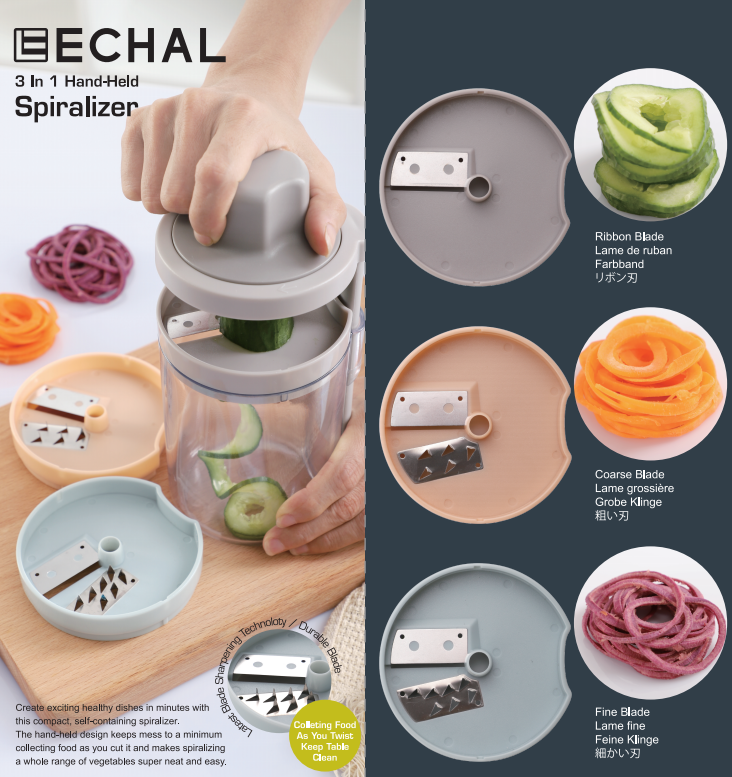
The original appeal of a spiralizer is straightforward: it turns vegetables into spiral shapes for salads, stir-fries, garnishes, and alternatives to noodles. Some products are standalone spiralizers, while others are part of broader food preparation sets. For example, a multi-function food processor and slicer set may include interchangeable, color-coded discs for tasks such as fine chopping or coarse grating. When sourcing this type of product, buyers should confirm exactly which functions are included rather than assuming every set has the same configuration.
Key Takeaways
- Spiralizer quality depends heavily on blade precision, stable assembly, and user-friendly handling.
- Factories may use plastics and stainless steel components, but buyers should verify the exact material specifications.
- Interchangeable discs and multi-function designs require tighter fit and performance checks than single-purpose tools.
- B2B buyers should ask clear questions about samples, quality control, packaging, and replacement parts before ordering.
How Spiralizer Manufacturing Typically Works
A spiralizer factory generally begins with product design and component planning. The design must define the cutting structure, handle position, container or base shape if included, blade interface, and any accessories such as discs or cleaning tools. Once the design is confirmed, molds and tooling are prepared for plastic parts, while metal components such as blades are cut or formed separately.
Plastic components are commonly produced through molding, then trimmed and checked for shape consistency. Blade components are shaped to achieve a cutting edge that can produce regular spirals or slices. Assembly workers or semi-automated stations then fit blades, handles, housings, and interchangeable parts together. In multi-function slicer sets, the fit of each disc is especially important because wobbling, loose locking, or difficult removal can affect both performance and user experience.
Materials, Blades, and Components to Verify
The original product discussion mentions high-grade plastics, stainless steel, and BPA-free materials. These are common sourcing terms, but buyers should not rely on general descriptions alone. Instead, request the exact plastic type, the stainless steel grade if relevant, and any available documentation the supplier can provide. If BPA-free plastic is required for the target market, ask the supplier what evidence supports that statement and whether it applies to all food-contact plastic parts.
Blade quality is one of the most important factors in spiralizer manufacturing. A blade that is too dull may crush vegetables instead of cutting them cleanly. A blade that is too thin or poorly fixed may bend or loosen during use. Buyers should evaluate whether the product works on typical vegetables such as zucchini, carrots, cucumbers, and potatoes, and whether performance changes after repeated use. For sets with color-coded discs, confirm that each disc performs its intended task clearly and that color coding is explained in the instructions or packaging.
Production Improvements and User-Focused Design
Innovation in vegetable spiralizer production is not only about adding more accessories. Useful improvements often come from small details: smoother rotation, better grip, safer blade storage, easier rinsing, and more intuitive part changes. The original article references ergonomic designs and non-slip handles; when these are part of a specific product, buyers should test whether the grip remains stable with wet hands and whether the handle position is comfortable for different users.
For multi-function tools, simplicity matters. A set with many discs may look attractive in a catalog, but it can create customer complaints if the parts are hard to identify, difficult to install, or awkward to clean. A strong supplier should be able to explain why the product is designed the way it is, how the parts are used, and what common issues have been addressed during development.
Quality Control Checklist for Buyers
Before placing a wholesale or OEM order, buyers should create a practical checklist that covers product function, safety-related handling, labeling, and packaging durability. The table below outlines common checkpoints to discuss with a spiralizer supplier.
| Checkpoint | What to Review | Questions to Ask the Supplier |
|---|---|---|
| Blade performance | Clean cutting, consistent spirals, no excessive crushing | Which vegetables are used in routine testing? |
| Material details | Plastic type, metal components, food-contact parts | Can you provide material specifications or supporting documents? |
| Assembly fit | Secure discs, stable handles, no loose parts | How is fit checked during production and final inspection? |
| Ease of use | Part changing, grip comfort, cleaning access | Can we test pre-production samples with our target users? |
| Packaging | Protection in transit, clear instructions, accessory organization | What packaging options are available for OEM or retail orders? |
OEM and Wholesale Sourcing Considerations
For B2B sourcing, the most important step is to separate confirmed product facts from assumptions. If a catalog says “multi-function,” ask for a complete parts list. If it mentions interchangeable discs, request photos, samples, and a function description for each disc. If color-coded discs are included, confirm the colors, functions, and whether custom colors are possible.
Buyers should also ask about production workflow and inspection points without expecting the supplier to disclose proprietary processes. Useful questions include: What sample types are available before mass production? How are defects classified? Can packaging be customized? Are replacement blades or discs available? What are the lead time, MOQ, and pricing conditions? These commercial details vary by supplier and should be confirmed directly rather than assumed.
Packaging, Instructions, and After-Sales Clarity
Packaging is often underestimated in kitchen tool sourcing. Spiralizers and slicer sets may include sharp components, so the packaging should prevent parts from moving around during transport and help users identify accessories quickly. Retail packaging should also show the included parts accurately. If the product includes fine chopping and coarse grating discs, those functions should be named consistently in the instructions and on the package.
Clear instructions reduce confusion and returns. A practical manual should explain how to install and remove blades or discs, what foods are suitable, how to clean the components, and how to store sharp parts. Buyers selling into multiple markets should discuss language requirements and labeling expectations with the supplier early in the project.
Practical FAQ
What should I test in a spiralizer sample?
Test cutting performance on common vegetables, check whether the handle or base feels stable, confirm that discs lock securely, and inspect how easy the parts are to clean after use.
Is a multi-function slicer set better than a standalone spiralizer?
It depends on the target customer. A multi-function set can offer more preparation options, while a standalone spiralizer may be simpler to use and store. Buyers should match the product format to the retail channel and user expectations.
Can I request OEM packaging or custom colors?
Many suppliers may offer customization, but availability, MOQ, cost, and lead time must be confirmed directly. Ask for samples or mockups before approving mass production packaging.
What information should a supplier provide before an order?
At minimum, request a product parts list, material details, sample policy, packaging options, inspection process, and clear commercial terms. If specific compliance or documentation is required for your market, ask whether the supplier can provide it before placing the order.
Final Thoughts
Spiralizer manufacturing combines simple product purpose with detailed execution. Good sourcing decisions come from checking blade performance, material information, assembly quality, packaging, and usability rather than relying on broad claims. For buyers evaluating a vegetable spiralizer supplier or a multi-function food processor and slicer set, the best approach is to request samples, document requirements clearly, and ask practical questions before moving to wholesale or OEM production.
