




Stainless Steel Houseware Manufacturer: What Buyers Should Look For
Choosing a stainless steel houseware manufacturer is not only about finding products that look bright in a catalog. For retail, wholesale, foodservice, and private-label programs, the stronger question is whether the items can survive normal kitchen use, arrive without avoidable scratches, and remain consistent from one production batch to the next.
Stainless steel houseware often includes bowls, colanders, utensil holders, ladles, whisks, spatulas, tongs, graters, measuring cups, and other preparation or serving tools. These products have different functions, but buyers should judge them by similar sourcing principles: stable forming, smooth edges, practical handling, reliable finishing, and packaging that protects the surface in transit.
Key Takeaways
- Evaluate stainless steel houseware by use performance, not only by shine or sample photos.
- Check bowls, perforated items, and hand tools separately because each has different failure points.
- Ask suppliers clear questions about finish consistency, edge treatment, packing, and batch control.
- For OEM or private-label sourcing, define the assortment, packaging format, and quality expectations before requesting pricing.
What a Stainless Steel Houseware Range Usually Includes
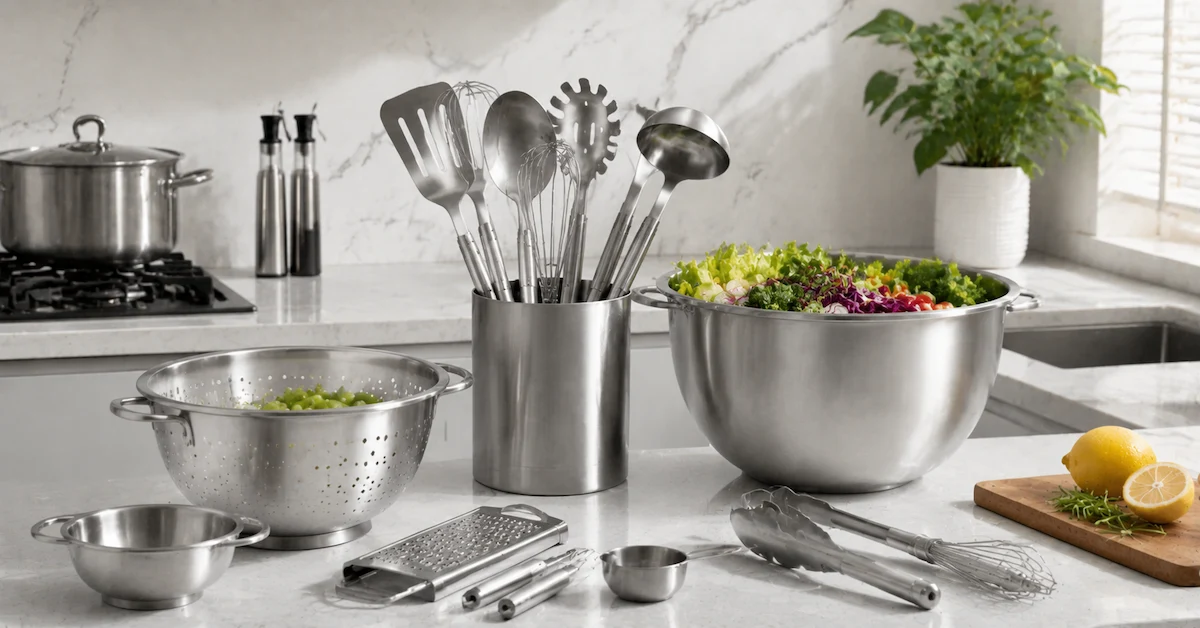
The product family shown in the source material represents a mixed kitchenware assortment rather than one single item. It includes a large mixing bowl, a smaller bowl, a perforated colander or strainer with side handles, a utensil holder or canister, and several hand tools such as a ladle, whisk, slotted utensil, pasta server, grater, and small measuring cup or condiment cup.
This variety matters for B2B buyers. A supplier that can offer bowls, perforated parts, wire-formed tools, stamped accessories, and storage pieces may help simplify sourcing when a buyer wants a coordinated line. However, a broad catalog does not automatically prove quality. Buyers still need to inspect each product type and ask how the supplier controls forming, polishing, assembly, and packing.
Why Assortment Planning Matters for Buyers
Many buyers do not need a complete kitchen range at launch. A practical rollout may start with a bowl set, one colander, a utensil holder, and a small group of tools. This allows a retailer or distributor to test price points, packaging formats, and customer response before expanding the line.
When comparing a stainless steel kitchenware supplier, consider whether the products look coherent as a family. Shared finish, similar proportions, and compatible handle design help a range feel planned rather than assembled from unrelated stock items. For private-label programs, ask whether the supplier can support consistent visual direction across multiple SKUs without making unsupported claims about specifications that have not been agreed.
Manufacturing Details Buyers Should Inspect
Stainless steel bowls are commonly produced through sheet-metal forming, deep drawing, spinning, or related forming processes. For sourcing teams, the inspection point is not the process name alone. Look at rim strength, roundness, wall smoothness, base stability, and whether the bowl feels rigid enough for its intended use.
Perforated colanders and strainers require different checks. Hole spacing should be consistent, drainage should be practical, and burrs around perforations should not create sharp contact points. Side handles, if present, should feel secure and comfortable when the item is loaded with wet food.
Hand tools such as whisks, ladles, slotted spoons, tongs-like utensils, and graters bring their own risks. Buyers should check handle balance, weld or joint transitions, working-edge quality, and whether the tool feels awkward during use. A utensil can look acceptable in a photo while still being uncomfortable or weak in actual handling.
Supplier Evaluation Checklist
Use a simple comparison table when reviewing multiple factories or trading partners. It keeps the discussion focused on practical risk rather than general sales claims.
| Check Point | What to Review | Questions to Ask the Supplier |
|---|---|---|
| Assortment fit | Bowls, colanders, utensils, storage pieces, or mixed sets | Can the supplier support the exact product family and packaging plan? |
| Finish consistency | Polished or brushed appearance across all pieces | How is finish variation checked between SKUs and batches? |
| Edge quality | Rims, perforations, handles, and tool ends | What inspection steps are used to identify sharp edges or burrs? |
| Functional handling | Grip comfort, balance, nesting, and stability | Can samples be reviewed under realistic loading and use conditions? |
| Packing protection | Separators, sleeves, cartons, and nesting protection | How are scratches and dents prevented during transport? |
Common Sourcing Mistakes to Avoid
One common mistake is assuming that all stainless steel houseware performs the same. Stainless steel is valued for its clean appearance and corrosion resistance, but the final product can still dent, scratch, flex, or feel poorly finished if manufacturing and packing are weak.
Another mistake is reviewing only one sample from a large range. A bowl, colander, whisk, and grater are not the same product just because they share a metallic finish. Each should be checked for its own use case. Buyers should also avoid vague RFQs that ask only for a low price without defining finish, packing, labeling, assortment structure, or inspection expectations.
- Request samples from each main product type, not only the easiest SKU.
- Inspect the same finish under consistent lighting.
- Test handling with realistic kitchen motions.
- Review how nested products are separated during packing.
- Ask which details can be customized and which require new tooling or development.
OEM and Private-Label Questions to Ask
For OEM kitchenware sourcing, a clear brief saves time. Buyers should state the intended channel, target user, preferred finish direction, packaging style, and whether products will be sold individually or as bundled sets. If dimensions, steel grade, testing requirements, or compliance documents are important for the destination market, ask the supplier to confirm what can be provided rather than assuming.
Useful commercial questions include: What sample process is available? What artwork or packaging files are required? How does the supplier handle inspection before shipment? Are replacement parts, carton markings, or barcode placement needed? What lead-time factors may change if the assortment includes both bowls and assembled utensils? These questions are more productive than asking for a generic quote without context.
Practical FAQ for Sourcing Teams
What should buyers inspect first in stainless steel houseware?
Start with edge safety, finish consistency, product stability, and handling comfort. These issues are easy for customers to notice and can lead to complaints if ignored.
Is a wider stainless steel kitchenware assortment always better?
Not always. A wider assortment is useful when it supports a coherent retail or wholesale program. It is less useful if quality, finish, or packaging varies too much between items.
How can buyers compare two similar suppliers?
Compare matched samples from the same product types, request clear packing information, and ask how each supplier controls defects such as scratches, burrs, weak joints, and inconsistent finish.
What should be included in an RFQ?
Include item list, target use, finish preference, packaging method, labeling needs, inspection expectations, order structure, and any market-specific documentation you require the supplier to discuss.
A Sensible Next Step
When shortlisting a stainless steel cookware factory or houseware supplier, request a sample group that includes at least one bowl, one perforated item, and one hand tool. That combination reveals more about manufacturing control than a single polished sample.
From there, focus on practical details: rim quality, drainage holes, handle comfort, surface protection, and packing method. A dependable stainless steel houseware program is built on repeatable execution, not broad claims. The best supplier conversation is specific, technical, and tied to how the products will actually be used and sold.
