




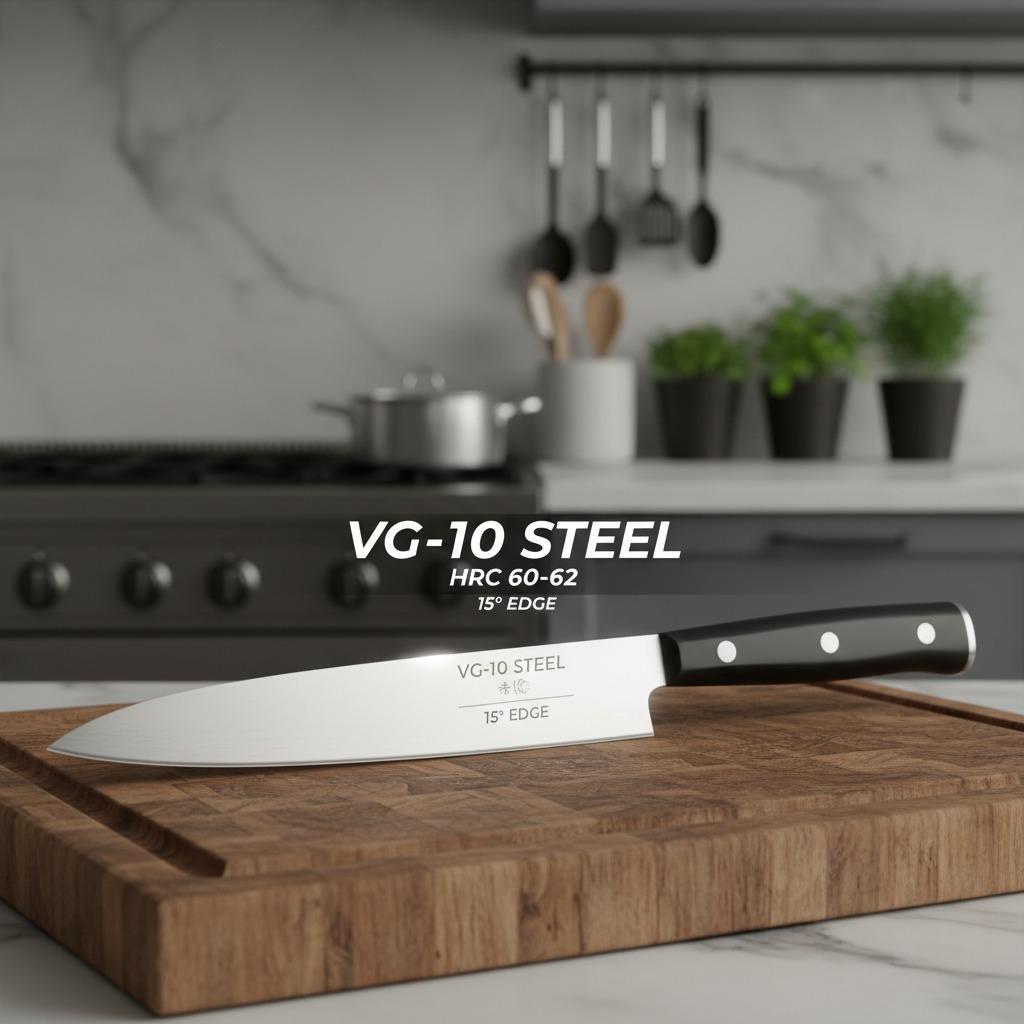

Starting with HRC: How to Read Professional Knife Specifications
Knife listings often contain a short line of technical details: HRC 60, stainless steel, 15 degrees per side, full tang, flat grind, or similar terms. These specifications are useful, but only when you know what they mean in daily kitchen use. A higher number or more technical steel name does not automatically make a knife better for every cook.
This guide explains the core specifications behind professional kitchen knives, starting with HRC hardness. Use it to compare chef knives, santoku knives, utility knives, slicing knives, and other kitchen blades with a clearer understanding of performance, care, and trade-offs.
Key Takeaways
- HRC measures blade hardness, not overall knife quality.
- Harder knives usually hold an edge longer but may need more careful use.
- Edge angle, steel type, grind, and balance can matter as much as hardness.
- The best specification depends on your cutting style, sharpening habits, and ingredients.
What Does HRC Mean on a Knife?
HRC stands for Rockwell C Hardness. It is a hardness scale used to describe how resistant a steel is to permanent indentation. In simple terms, it helps estimate how hard the blade steel is after heat treatment.
For kitchen knives, HRC is often discussed because it affects edge behavior. A harder blade can usually support a thinner, sharper edge and keep that edge longer during normal slicing. A softer blade may dull sooner, but it can be tougher, more forgiving, and easier to sharpen.
HRC is not a complete performance score. Two knives with the same HRC can cut very differently depending on blade geometry, steel composition, heat treatment quality, thickness behind the edge, and how the knife is maintained. Treat HRC as one important clue, not the whole answer.
Common HRC Ranges and Real Kitchen Use
Knife hardness ranges vary by maker and model, but the following table gives a practical way to interpret common HRC numbers when comparing kitchen knives.
| HRC Range | Typical Feel | Strengths | Trade-Offs | Best Use Cases |
|---|---|---|---|---|
| 54-57 HRC | Tough and forgiving | Easy sharpening, good impact resistance | May need more frequent honing or sharpening | Busy home kitchens, heavy prep, users who value durability |
| 58-60 HRC | Balanced all-purpose range | Good edge retention with manageable maintenance | Still requires correct cutting surface and care | Everyday chef knives, utility knives, mixed ingredients |
| 60-63 HRC | Harder, more precise | Longer edge life, supports fine cutting edges | Less tolerant of twisting, prying, or hard impacts | Precision slicing, vegetables, boneless proteins |
| 63+ HRC | Very hard and specialized | Excellent edge potential in the right design | Sharpening can take more skill; chipping risk can rise if misused | Experienced users, fine slicing, careful maintenance routines |
Hardness Versus Toughness: The Main Trade-Off
The easiest mistake is to assume that higher HRC always means a better knife. Hardness and toughness are related, but they are not the same. Hardness describes resistance to indentation and wear. Toughness describes resistance to cracking, chipping, or breaking under stress.
In kitchen terms, a hard knife may keep a fine edge during repeated slicing, but it should not be used like a cleaver unless it was designed for that job. Avoid twisting a hard, thin blade through dense foods, striking bones, or cutting frozen items. A tougher, slightly softer knife may be more suitable for rough prep work, shared kitchens, or users who prefer quick maintenance over maximum edge retention.
Before buying, think about your actual cutting habits. If you often process squash, chicken joints, or dense ingredients, prioritize blade shape, thickness, and toughness. If you mostly slice vegetables, herbs, fruit, and boneless meat, a harder, thinner knife may feel more efficient.
Steel Type: Stainless, Carbon, and Maintenance
Steel type tells you how the blade may behave beyond hardness. The original knife specification examples mention stainless steels such as VG-10 and X50CrMoV15, and carbon steels such as Aogami Super and White #1. These names can be helpful, but do not judge by steel name alone. Heat treatment, blade geometry, and production consistency also matter.
- Stainless steel: Usually chosen for easier care and better corrosion resistance. It is practical for home cooks, restaurants, and shared kitchens where knives may not be dried immediately.
- Carbon steel: Often valued for sharpening response and edge feel, but it can discolor and may rust if left wet or acidic residue remains on the blade.
- Powder or specialty steels: These may offer strong edge retention, but buyers should ask about sharpening difficulty, intended use, and care requirements.
If a listing names the steel but gives no care guidance, ask the seller how the knife should be cleaned, dried, sharpened, and stored. That information is more useful than a steel name by itself.
Edge Angle: Why Degrees Matter
Edge angle describes how acute the sharpened cutting edge is. Many Japanese-style kitchen knives are associated with around 15 degrees per side, while many Western-style knives are associated with wider angles such as 20 to 22 degrees per side. These are general patterns, not universal rules.
A lower edge angle can feel sharper and pass through food with less resistance. The trade-off is that a fine edge usually needs more careful use. A wider edge angle may not feel as delicate, but it can be more stable for harder tasks.
When comparing specifications, check whether the angle is listed per side or as an included angle. For example, 15 degrees per side equals a 30-degree included edge. This matters when selecting sharpening stones, guided sharpeners, or professional sharpening services.
Grind, Geometry, Balance, and Weight
Two knives can share the same HRC and steel type but cut very differently because of geometry. The grind is the way the blade tapers from the spine to the edge. A thin blade behind the edge usually slices more easily, while a thicker blade may feel stronger but wedge in dense foods.
Common grind terms include flat grind, hollow grind, and convex grind. Each can work well when matched to the right blade style and use. Instead of asking only, “What grind is it?” also ask, “How does it perform in the foods I cut most?”
Balance and weight affect comfort. A heavier knife can feel stable for repetitive chopping, while a lighter knife may reduce fatigue during fine prep. Balance near the handle can feel nimble; forward balance can add cutting momentum. Whenever possible, hold the knife or compare measurements with a knife you already use comfortably.
Buying Checklist for Reading Knife Specifications
Use this checklist before choosing a professional kitchen knife or comparing several models:
- Match the HRC range to your cutting tasks and tolerance for careful use.
- Confirm the steel type and ask what maintenance it requires.
- Check whether the edge angle is per side or included.
- Consider blade thickness, grind, and intended ingredients, not just sharpness claims.
- Look at handle shape, weight, and balance for comfort during long prep sessions.
- Ask how the knife should be sharpened and whether special tools are recommended.
- Use the right board: wood or suitable plastic is safer for edges than glass, stone, or ceramic surfaces.
Care Tips That Protect the Specifications You Paid For
A knife’s listed hardness and edge angle only matter if the blade is treated correctly. Wash knives by hand, dry them soon after cleaning, and store them in a block, sheath, rack, or drawer insert that protects the edge. Avoid dishwashers unless the maker specifically says otherwise, because heat, detergent, and movement can damage edges and handles.
Use honing and sharpening appropriately. Honing can realign some edges between sharpening sessions, but it does not replace sharpening when the edge is worn. Harder or more wear-resistant steels may require suitable stones or sharpening systems. If you are unsure, ask the supplier or a professional sharpener before removing too much steel.
FAQ
Is a higher HRC knife always sharper?
No. HRC affects how well a blade may hold an edge, but sharpness also depends on edge angle, sharpening quality, and blade geometry.
What HRC is best for a home chef knife?
Many home cooks prefer a balanced range around the high 50s to low 60s HRC, depending on how carefully they use and maintain the knife.
Can I use a hard knife for bones or frozen food?
Do not use a thin, hard kitchen knife for bones, frozen food, or prying unless the knife is specifically designed for that purpose. Use a cleaver or appropriate tool instead.
What specification should I check after HRC?
Check steel type, edge angle, grind, blade thickness, handle comfort, and care requirements. Together, these details give a more accurate picture than hardness alone.
How should I compare knives online?
Compare the stated HRC, steel, edge angle, blade size, weight, and care instructions. If details are missing, ask the seller before buying rather than assuming performance from one specification.
