




How Do You Choose a Reliable Tailor Scissors Manufacturer?
A reliable tailor scissors manufacturer should be able to produce scissors that cut the intended fabrics cleanly, feel controlled during repeated use, remain consistent across bulk orders, and support the buyer's branding, packaging, and supply requirements.
For B2B buyers, choosing a factory should therefore involve more than asking:
“What is your price for 8-inch tailor scissors?”
A stronger sourcing question is:
Can this manufacturer consistently produce the cutting performance, handle design, finish, branding, packaging, and quality level required by our market?
That matters because tailor scissors are precision hand tools.Small differences in:
- blade alignment,
- pivot tension,
- grinding,
- handle geometry,
- weight balance,
- surface finishing,
can noticeably change the user experience.
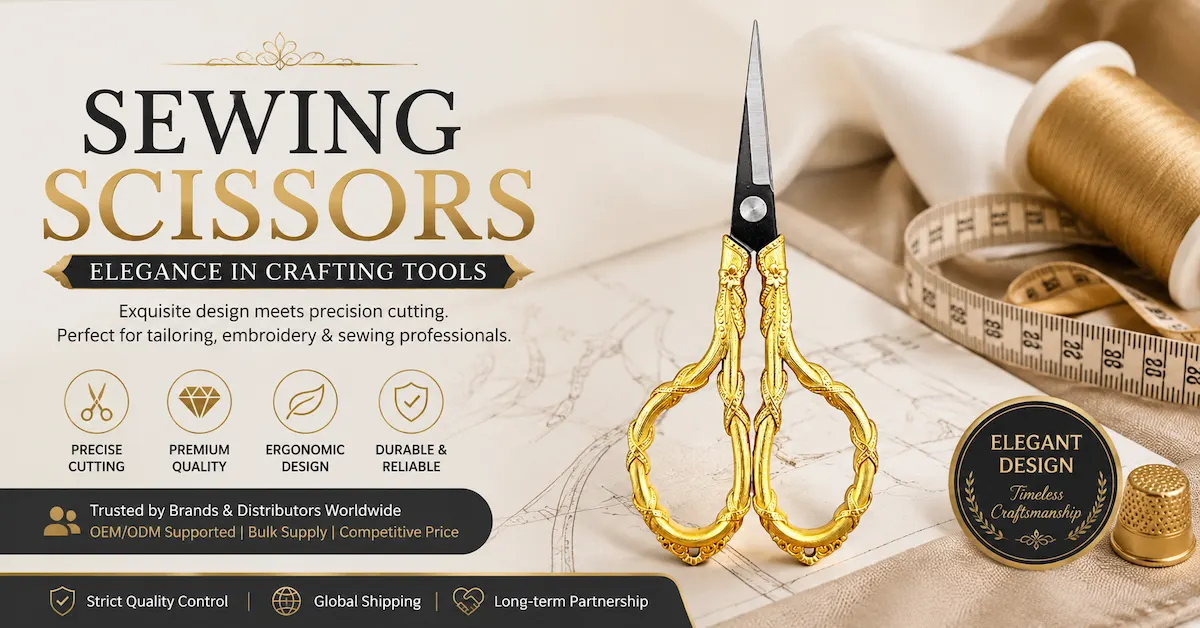
BONET currently maintains a dedicated tailor-scissors category containing OEM tailor scissors, OEM sewing scissors, professional sewing scissors, ergonomic sewing scissors, decorative handle designs, and other fabric-cutting styles.
Who Typically Searches for a Tailor Scissors Manufacturer?
The primary search intent behind tailor scissors manufacturer is commercial investigation and supplier selection.
Typical buyers include:
- Sewing tool brands
- Garment-accessory distributors
- Textile wholesalers
- Craft retailers
- Tailoring equipment suppliers
- E-commerce brands
- Private-label companies
- Promotional product buyers
- Sewing kit manufacturers
Different buyers need different products.
Garment and Sewing Tool Distributors
They usually prioritize:
- Reliable cutting performance
- Multiple sizes
- Consistent bulk supply
- Competitive product tiers
- Stable repeat orders
Private Label Brands
They are more likely to require:
- Custom handle colors
- Logo application
- Blade finishes
- Retail packaging
- Exclusive designs
- Product-line consistency
Craft and Sewing Retailers
Retailers may focus more on:
- Attractive appearance
- Comfortable handling
- Clear product positioning
- Shelf-ready packaging
Professional Sewing Markets
Professional customers are usually more sensitive to:
- Blade alignment
- Cutting control
- Handle comfort
- Pivot adjustment
- Long-term performance
Understanding the customer group should come before selecting a model.
Tailor Scissors vs Regular Household Scissors
Tailor scissors and household scissors may look similar, but their intended use is different.
| Factor | Tailor Scissors | Household Scissors |
|---|---|---|
| Main application | Fabric and sewing work | General household cutting |
| Blade design | Usually longer and fabric-oriented | General-purpose |
| Cutting priority | Smooth,controlled fabric cutting | Versatility |
| Handle | Often designed for sustained cutting | Everyday comfort |
| Buyer type | Sewing brands, garment suppliers | General retailers |
| OEM opportunity | High | High |
| Product positioning | Professional / specialized | Mass-market |
For B2B buyers, this distinction matters because a general household-scissors design should not automatically be marketed as a professional tailor shear without appropriate performance evaluation.
What Types of Tailor Scissors Can a Manufacturer Offer?
BONET's current tailor-scissors range shows several commercial product directions.
OEM Tailor Scissors
Suitable for:
- Private-label sewing brands
- Garment accessory distributors
- Wholesale programs
These products can be developed around the buyer's required appearance, packaging, and market positioning.
Professional Sewing Scissors
Suitable for customers who prioritize:
- Controlled fabric cutting
- Professional appearance
- Comfortable handling
BONET's tailor category includes products described with stainless-steel blades and ergonomic decorative handles.
Ergonomic Sewing Scissors
These models focus more strongly on:
- Grip design
- Handle geometry
- User comfort
They can be useful for premium or professional sewing-tool ranges.
Decorative and Designer Sewing Scissors
BONET's current range also includes Victorian-inspired, bamboo-inspired, rainbow-wing, and other appearance-focused styles.
These are more suitable for:
- Craft stores
- Gift-oriented products
- Sewing enthusiasts
- Differentiated private-label collections
The right manufacturer should help buyers choose the appropriate product architecture instead of recommending one model for every channel.
What Specifications Should Buyers Confirm?
Do not request a quote using only the keyword “tailor scissors.”
Prepare a clear specification.
| Specification | What to Confirm |
|---|---|
| Application | Fabric type and intended use |
| Product size | Overall size / blade length |
| Blade material | Required material specification |
| Blade profile | Shape and tip |
| Handle | Material, geometry,color |
| Pivot | Fixed or adjustable requirements |
| Finish | Polished, matte or other option |
| Logo | Method and location |
| Packaging | Card, blister, box or bulk |
| Quantity | Per SKU |
| Target market | Destination country/region |
| Inspection | Required QC standards |
This allows several manufacturers to quote the same product requirement, making price comparison meaningful.
Blade Material Is Important, but It Is Not the Whole Story
Material is one of the first factors buyers ask about.
BONET's tailor-scissors content currently includes models described with stainless-steel blades as well as titanium-finished styles.
However, buyers should not evaluate tailor scissors based only on material names.
Final cutting performance can also depend on:
- Blade geometry
- Grinding
- Heat treatment
- Edge finishing
- Blade alignment
- Pivot adjustment
- Final assembly
Two scissors made from similar steel may perform differently if the manufacturing processes are different.
How Manufacturing Processes Affect Tailor Scissors
A serious tailor scissors manufacturer should be able to explain how the product moves from raw material to finished cutting tool.
BONET's manufacturing page lists a sequence including stamping, blade straight adjustment, heat treatment, rough grinding, water grinding, polishing, injection molding, assembly/setting, quality checks, final cleaning, corrosion protection, and packing.
View BONET Manufacturing Process
Stamping
Blade components are formed according to the required design.
Straight Adjustment
Blade straightness matters because poor geometry can affect cutting contact.
Heat Treatment
BONET states that hardening, tempering, and annealing processes may be used to improve durability and edge performance.
Grinding
Rough grinding prepares the blade, while finer grinding processes help refine the cutting edge.
Polishing
Surface finishing affects both appearance and blade refinement.
Handle Production
BONET lists injection molding for ergonomic and durable scissors handles.
Assembly
The pivot, blade contact, and handle relationship must work as one system.
Quality Inspection
Final inspection should verify function, appearance, assembly, and consistency before packing.
Blade Alignment and Pivot Tension Should Be Sample-Tested
One of the most common sourcing mistakes is evaluating scissors only by photographs.
Buyers should physically test:
Blade Alignment
Poor blade contact can cause:
- Fabric slipping
- Incomplete cutting
- Snagging
- Uneven cutting resistance
Pivot Movement
The joint should feel:
- Smooth
- Stable
- Controlled
If the pivot is too loose, blade contact may become inconsistent.
If it is too tight, users may experience unnecessary cutting resistance.
Cutting Performance
Test with materials relevant to the actual market, rather than testing only paper.
For a garment-tool buyer, that may mean evaluating representative:
- Woven fabrics
- Lightweight textiles
- Sewing materials
The approved test method should match the product's intended positioning.
Handle Ergonomics Matter for Professional Users
Tailors, sewing professionals, and craft users may perform repeated cutting motions, making handle design commercially important.
Buyers should evaluate:
- Finger-hole dimensions
- Handle angle
- Grip surface
- Overall balance
- Weight distribution
- Left/right-hand suitability where required
BONET's existing tailor-scissors content highlights ergonomic handles on several models, including professional and decorative sewing-scissors designs.
For private-label brands, handle design is also one of the strongest visual differentiation opportunities.
A Practical Tailor Scissors Quality-Control Checklist
Instead of asking whether a supplier offers “high quality,” turn quality into inspection items.
| QC Item | Buyer Check |
|---|---|
| Blade material | Matches agreed specification |
| Blade straightness | No unacceptable deformation |
| Blade alignment | Consistent contact |
| Cutting test | Matches intended fabric use |
| Pivot | Stable and smooth |
| Handle | Secure and comfortable |
| Surface finish | Matches approved sample |
| Logo | Correct position and quality |
| Color | Matches approved reference |
| Packaging | Correct SKU and artwork |
| Quantity | Matches purchase order |
| Repeat order | Matches approved standard |
This structure also makes supplier disputes easier to resolve.
What Should Buyers Ask About Factory Capability?
A strong factory audit should go beyond attractive machinery photographs.
Ask:
- Which processes are completed in-house?
- Which processes are outsourced?
- How are blades inspected during production?
- How is grinding consistency controlled?
- How is pivot tension checked?
- How are approved colors maintained?
- How are repeat orders matched against previous production?
- How are defective units handled?
BONET's About page states that its Yangjiang manufacturing facility covers 5,000 square meters and lists ISO 9001, BSCI, and Sedex among its certifications. Buyers requiring those credentials should still request current documents, scope, and validity for their supplier qualification process.
Tailor Scissors Manufacturer vs Trading Supplier
Both sourcing models can work, but they solve different needs.
| Buyer Requirement | Direct Manufacturer | Trading Supplier |
|---|---|---|
| Technical communication | More direct | May involve intermediary |
| Product customization | Usually easier to coordinate | Depends on factory network |
| Manufacturing visibility | Higher potential | Varies |
| Multi-category sourcing | More focused | Often broader |
| Tooling coordination | Direct | Indirect |
| Repeat-order control | Easier to trace | Depends on supply chain |
For a highly customized tailor-scissors project, direct factory communication is often valuable because small blade, pivot, or handle changes may require technical discussion.
OEM Tailor Scissors for Private Label Brands
OEM capability is an important conversion point for buyers searching for a tailor scissors manufacturer.
BONET's OEM/ODM page states that its services include production by drawing or sample, material customization, custom colors, logo printing or laser engraving, packaging customization, quality inspection support, sample development, structural optimization, and mass-production support.
Explore BONET OEM/ODM Services
Basic OEM
Suitable for buyers requiring:
- Existing model
- Brand logo
- Custom packaging
Appearance Customization
Can involve:
- Handle colors
- Surface treatment
- Branded retail presentation
Product Configuration
Depending on feasibility:
- Product size
- Handle structure
- Blade configuration
- Packaging assortment
ODM Development
For buyers developing a new product line, BONET states that it can support concept development, sample development, structural optimization, material recommendations, packaging development, feasibility assessment, and mass-production implementation.
How Does an OEM Tailor Scissors Project Work?
BONET describes a six-stage OEM/ODM process.
Step 1: Requirement Communication
Provide:
- Product reference
- Target customers
- Intended fabric/application
- Quantity
- Branding
- Packaging
Step 2: Design and Sampling
Confirm:
- Structure
- Appearance
- Logo
- Packaging
Step 3: Quotation and Confirmation
Review:
- Cost
- MOQ
- Specifications
- Lead time
- Project schedule
Step 4: Mass Production
Production begins after specifications are confirmed.
Step 5: Quality Inspection
Inspect:
- Appearance
- Function
- Assembly
- Packaging
- Overall consistency
Step 6: Packaging and Delivery
Products are packed according to the agreed requirements.
What Affects Tailor Scissors Pricing?
A meaningful B2B quotation depends on the specification.
Price drivers can include:
- Blade material
- Product size
- Grinding requirements
- Handle design
- Surface finish
- Pivot construction
- Number of colors
- Logo process
- Packaging
- Order quantity
- New tooling
- Testing or inspection requirements
Therefore:
Never compare two quotations unless the specifications are equivalent.
A cheaper pair of scissors using a different blade construction or packaging method is not necessarily a lower-cost sourcing option.
What About MOQ and Lead Time?
There is no useful universal MOQ for all tailor scissors.
MOQ may change depending on:
- Existing vs custom product
- Handle color
- Surface finish
- Logo
- Packaging
- Number of SKUs
- New tooling
Lead time can also vary according to:
- Sampling
- Revisions
- Material preparation
- Packaging artwork
- Order quantity
- Production scheduling
BONET's OEM process explicitly places MOQ and lead-time review in the quotation and confirmation stage rather than presenting one fixed number for every project.
This is the correct approach for serious OEM sourcing.
How to Send a High-Conversion Tailor Scissors RFQ
Do not send:
“Please send your best tailor scissors price.”
Send something closer to:
We are a sewing-tools distributor developing a private-label tailor scissors range for retail and garment customers. We need two sizes, black ergonomic handles, our logo, custom hanging-card packaging, and an initial volume of X units per SKU. Please recommend suitable existing models and advise sample, MOQ, customization, packaging, and lead-time requirements.
A good RFQ should contain:
| RFQ Detail | What to Send |
|---|---|
| Buyer type | Distributor / brand / retailer |
| Application | Fabric cutting / sewing |
| Model | Reference image or BONET model |
| Size | Required size(s) |
| Quantity | Units per SKU |
| Blade requirement | Material/application |
| Handle | Shape and color |
| Logo | Method/location |
| Packaging | Retail or bulk |
| Market | Destination region |
| Delivery | Required schedule |
This allows a manufacturer to respond with a real commercial proposal rather than a generic catalog.
Common Mistakes When Sourcing Tailor Scissors
Choosing by Price Alone
A low unit price can hide differences in:
- Blade processing
- Handle quality
- Inspection
- Packaging
Testing Only One Sample
Bulk consistency matters more than one ideal sample.
Using Paper as the Only Cutting Test
Tailor scissors should be evaluated against intended textile applications.
Ignoring Handle Comfort
A product can cut well but still receive poor user feedback if the grip is uncomfortable.
Customizing Too Much Too Early
New buyers may reduce development risk by starting with an existing proven model before moving into deeper structural customization.
Not Locking a Golden Sample
The final approved sample should become the reference for:
- Production
- QC
- Repeat orders
Why Consider BONET as a Tailor Scissors Manufacturer?
BONET maintains a dedicated tailor-scissors category that includes OEM, professional, ergonomic, decorative, and specialized sewing-scissors directions.
Its manufacturing information covers processes from stamping and heat treatment to grinding, handle production, assembly, inspection, cleaning, corrosion protection, and customized packing.
Its OEM/ODM service also supports product customization, samples, branding, packaging, and mass production for global brands, wholesalers, retailers, and distributors.
For a serious sourcing inquiry, send BONET:
- Target market
- Buyer/channel type
- Tailor scissors style
- Size requirements
- Quantity per SKU
- Handle requirements
- Logo
- Packaging
- Required sample
- Delivery window
Request a Tailor Scissors Quote From BONET
FAQ
What is a tailor scissors manufacturer?
A tailor scissors manufacturer produces fabric-cutting and sewing scissors for professional, retail, wholesale, or private-label customers and may also support customization, packaging, and bulk production.
What is the difference between tailor scissors and sewing scissors?
The terms often overlap. Tailor scissors or tailor shears usually emphasize professional fabric cutting, while sewing scissors can cover a broader range of sewing and craft tools.
What materials are commonly used for tailor scissors?
Stainless steel is commonly used for blades, while some models may use special finishes or coatings. The exact material and finish should be confirmed for each product.
How should buyers test tailor scissors?
Test blade alignment, cutting performance on representative fabrics, pivot movement, handle comfort, assembly quality, and surface finishing.
Can a tailor scissors manufacturer customize handle colors?
Yes, depending on the model and production requirements. BONET's OEM services include color customization.
Can I put my own logo on tailor scissors?
OEM suppliers may support logo printing, engraving, or other branding methods depending on the product surface and design.
Can BONET develop tailor scissors from my drawing or sample?
BONET states that its OEM services support production by drawing or sample, while ODM services include sample development and structural optimization.
What is the MOQ for custom tailor scissors?
MOQ depends on the model, customization, colors, packaging, tooling, and order structure. Buyers should request MOQ for the exact product specification.
How long does custom tailor scissors production take?
Lead time varies according to sampling, revisions, materials, customization, packaging, order volume, and production scheduling.
What should I send to receive an accurate quotation?
Send product type, intended use, size, quantity, handle requirements, blade requirements, branding, packaging, target market, reference images, and required delivery schedule.
Conclusion
Choosing the right tailor scissors manufacturer requires more than comparing catalog photos and unit prices.
Professional B2B buyers should evaluate:
- Fabric-cutting performance
- Blade geometry and alignment
- Pivot control
- Handle ergonomics
- Manufacturing processes
- Quality inspection
- Product range
- OEM/ODM capability
- Packaging
- MOQ and lead time
- Repeat-order consistency
For sewing brands, garment-tool distributors, retailers, and private-label buyers, these factors determine whether a supplier can support one trial order or build a reliable long-term product program.
BONET combines a dedicated tailor-scissors range with manufacturing and OEM/ODM capabilities for global B2B customers.If you already have a reference model, required size, quantity, branding concept, or packaging design, include those details in your first inquiry to receive a more useful project evaluation.
