




This playbook targets buyers searching for private label kitchen scissors manufacturer support. It covers custom kitchen scissors, OEM kitchen scissors manufacturer selection, kitchen scissors supplier checks, custom logo kitchen scissors, kitchen scissors custom packaging, stainless steel kitchen scissors evidence, and kitchen scissors manufacturer China sourcing decisions.
Private label buyers usually begin with a mood board: a color family, a target shelf price, a few products they admire, and a launch window. That is a good beginning, but it is not yet a manufacturable brief. A kitchen tool has edges, joints, finishes, tolerances, and a package that has to protect it. A retail team also has a less visible job: making the whole range feel like one brand when several materials and production routes are involved.
This guide follows the decisions that make that work easier. It explains how to choose between private label, OEM, and ODM; how to select products from a real portfolio; how to specify a custom logo kitchen scissors program; how to connect packaging design to logistics; and how to review samples and quality evidence. BONET HOUSEWARE is used as a practical reference because its public OEM/ODM page describes support for kitchen knives, kitchen tools, cutting boards, kitchen gadgets, multifunctional kitchen scissors, and scissors, plus material, color, logo, packaging, sampling, and production services.
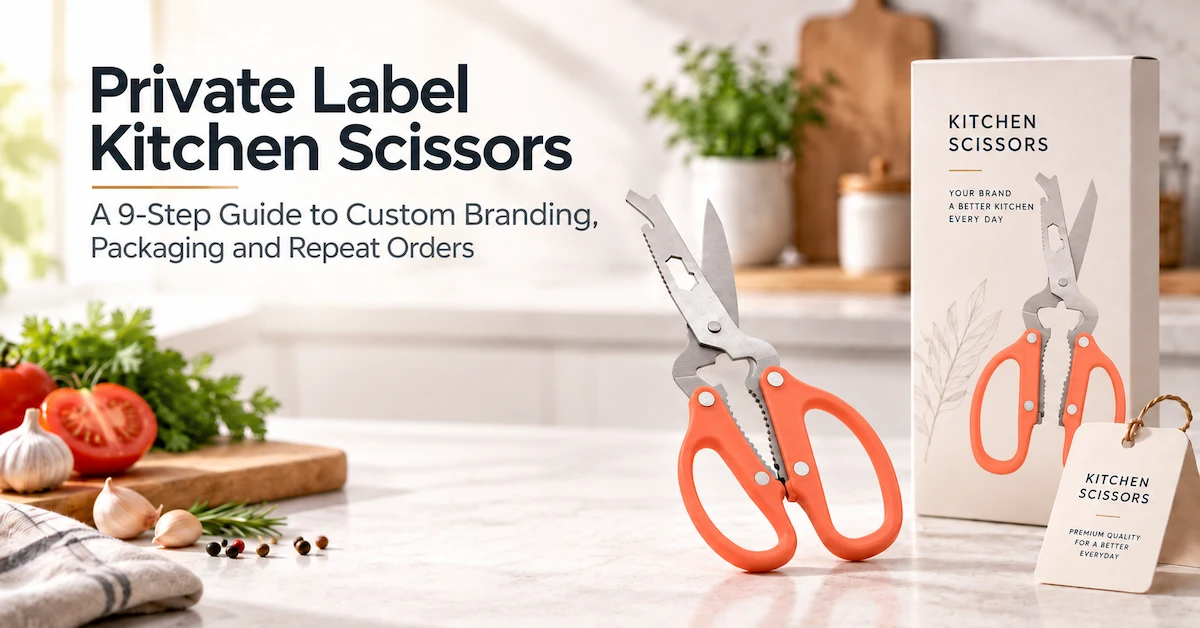
The examples in this article reflect BONET HOUSEWARE's published service descriptions. MOQ, pricing, material grades, tests, sample timing, production timing, and shipping arrangements remain project-specific and should be confirmed in writing.
1. Define What “Private Label” Means for This Launch
Private label is often used as if it were a single manufacturing method. In practice, it describes a commercial route: an existing or jointly developed product is sold under the buyer's brand. One program may contain several levels of customization. A stock utensil might need only a logo and a new sleeve. A kitchen scissors set may need a different handle color, an insert, and a box structure. A new multifunction gadget may require an ODM conversation about feasibility before anyone can quote it responsibly.
Write the route next to every SKU in your request for quotation. “Private label” tells the factory who owns the market presentation; it does not say whether the factory is reproducing a finished drawing, adapting an existing platform, or helping to develop a new mechanism. That one line prevents different teams from pricing different assumptions.
| Route | Where the project starts | Typical private label decisions | What to document |
|---|---|---|---|
| Private label | An existing product platform or a close catalog reference | Color, logo, surface finish, assortment, retail presentation, and carton marks | Selected reference SKU, permitted changes, artwork revision, pack specification |
| OEM | Your drawing, sample, or complete specification | Exact dimensions, materials, construction, finish, branding method, and acceptance criteria | Controlled drawing, sample ID, bill of materials, inspection checklist |
| ODM | A consumer problem, product concept, or performance target | Structure, ergonomics, materials, feasibility, sample iterations, and packaging development | Design brief, open decisions, prototype notes, approval gates |
A private label kitchen scissors program can combine all three routes. A brand may start with a general-purpose model, add a branded multifunction version, and develop a magnetic-storage SKU for a premium channel. The best partner is not the one that calls every item “OEM.” It is the one that can explain what remains fixed, what changes, and what must be sampled again for each scissors model.
2. Match the Product Category to the Factory's Actual Work
Kitchen scissors are a focused category, but the manufacturing questions still change by model. A general-purpose pair is judged by blade alignment, pivot feel, grip and everyday cutting. A multifunction model adds feature access and claim evidence. A magnetic-storage model adds a sheath, retention behavior and a storage surface. A private label range may contain all three, so the supplier must show which construction and process controls apply to each SKU. A broad catalog is helpful, but it is not proof that one process fits every scissors model.
Ask for the nearest product example and the process map behind it. BONET product pages provide useful references for general-purpose kitchen scissors, multifunction kitchen scissors, multi-purpose kitchen shears, and magnetic kitchen scissors. Use those pages as a starting point, then ask which construction details are truly comparable to the private label SKU.
The same question applies when comparing a custom kitchen scissors manufacturer with a trading company. Who controls stamping, straight adjustment, heat treatment, grinding, polishing, handle molding, assembly, cleaning, inspection, and packing for the selected SKU? If some work is coordinated elsewhere, which company owns the specification and corrective action? You do not need a long equipment list. You need a clear answer tied to your scissors program.
| Private-label direction | BONET product reference | Brand decision | Evidence to request |
|---|---|---|---|
| Everyday kitchen scissors | S52034 kitchen scissors | Use a simple logo, practical grip and compact pack for everyday retail. | Cutting result, pivot feel, handle color and packed sample. |
| Multifunction private label model | SKI090 multifunction scissors | Turn each feature into a named consumer benefit instead of a vague count. | Function matrix, claim wording and feature photography. |
| Multi-purpose kitchen shears | SKI022 multi-purpose shears | Balance handle construction, access to features and cleaning communication. | Approved appearance, function checks and care statement. |
| Magnetic-storage private label SKU | G2011 magnetic scissors | Build the storage experience into the brand story and pack. | Sheath fit, surface retention, removal test and retail presentation. |
A useful category-fit check
- Construction: Can the supplier name the components, joining method, and surfaces that need protection?
- Process: Can it identify the relevant stamping, adjustment, heat-treatment, grinding, polishing, injection, cleaning, assembly, or packing stages?
- Use: Can the team describe what the consumer does with the item and what must not fail?
- Range: Can the same color, logo, and pack logic be translated across materials without pretending that every SKU is identical?
3. Build a Brief That a Private Label Kitchen Scissors Manufacturer Can Quote
Quotations become comparable when the input is comparable. Put one row per SKU in your RFQ and attach the latest drawing, reference photo, or sample notes. If a field is undecided, write “open for recommendation.” An invisible decision is not flexibility; it is a future mismatch.
At minimum, include the following:
- Product identity: working name, intended use, target customer, sales channel, and destination market.
- Finished dimensions: overall size, critical thicknesses, moving clearances, and any pack-fit limits.
- Materials and finish: preferred material direction, surface treatment, color reference, and areas that must remain uncoated.
- Function: what the tool must do in real use, including opening, cutting, gripping, scraping, or folding actions.
- Branding: logo artwork, method preference, location, maximum size, color, and the visual result you will approve.
- Packaging: pack format, insert, label language, barcode, warning text, carton marks, and channel constraints.
- Quality: reference sample, critical dimensions, appearance limits, functional checks, and who performs the inspection.
- Commercial context: trial quantity, expected reorder logic, requested launch window, delivery destination, and terms to quote.
A disciplined brief also tells an OEM kitchen scissors manufacturer what not to assume. Do you want the logo to be a quiet mark on the handle, a high-contrast print on the card, or a durable engraving on metal? Is the reference sample controlling the shape only, or shape and finish? Is the box a gift presentation, a shelf pack, or a shipping-friendly e-commerce pack? These questions feel small until several teams work on the order.
4. Treat Product Development as a Series of Decisions
Good kitchen scissors product development does not hide uncertainty. It gives uncertainty a place to go. Start with a requirement review, list missing information, and agree which questions need a recommendation. Then move through structure, materials, logo, color, and packaging in an order that allows each decision to be tested.
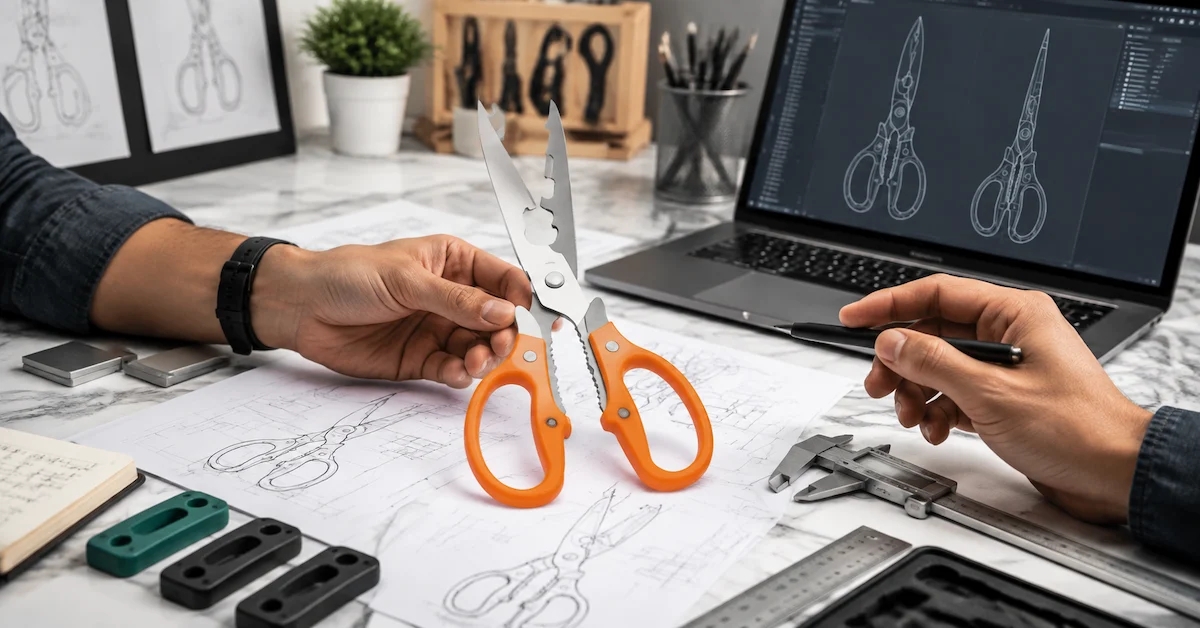
When a prototype arrives, review it in layers. First check the job it must perform. Then check dimensions, assembly, balance, and moving parts. After that, review surface appearance, color, logo placement, and pack fit. A sample can look excellent on a white table and still feel unstable in a wet hand or rub against the inside of its box. Write those observations beside a photograph and a ruler. Give every correction an owner and a closure date.
BONET describes ODM support in terms of concept development, structural optimization, sample development, material recommendation, feasibility assessment, packaging development, surface-treatment advice, and mass-production support. Those are useful conversation headings. They are not a promise that every option applies to every product. The practical test is whether the proposed change can be explained, sampled, and carried into a controlled production file.
5. Plan Custom Logo Kitchen Scissors Around the Product Surface
Logo placement is a product decision, not a last-minute decoration. A mark on a broad board has a different visual scale from a mark on a narrow handle. A printed logo can read clearly on a package card but disappear on a textured silicone surface. Laser engraving can suit a metal area, while printing may be more appropriate for a colored molded part. The right method depends on the substrate, surface treatment, handling, cleaning expectations, and the visual language of the range.
For a custom logo kitchen scissors brief, describe the result rather than naming only a technique. A brand team can also compare the product direction against BONET pages for general-purpose kitchen scissors, multifunction scissors, and magnetic kitchen scissors before approving a logo surface. State the intended size, position, orientation, color reference, contrast, and what counts as unacceptable drift. Attach a vector artwork file and label its revision. If the mark is meant to align across a collection, show a side-by-side layout so the factory can review scale on each SKU.
| Branding decision | Questions for the supplier | Evidence to approve |
|---|---|---|
| Location | Will the logo sit on the handle, blade guard, tool head, board, insert, or outer box? | Marked drawing and a photo of the sample from the buyer's viewing angle |
| Method | Is printing, laser engraving, molded relief, label, or a combination practical for this surface? | Method sample on the actual material or a clearly equivalent surface |
| Appearance | What contrast, color, edge definition, and finish are expected? | Approved artwork revision and a visual comparison under agreed lighting |
| Durability context | What cleaning, rubbing, folding, or contact occurs in normal use and in the pack? | Product-specific check plan; avoid copying an unrelated claim |
Keep the logo conversation connected to the assortment. A private label kitchen scissors manufacturer may use the same brand mark across stainless steel, silicone, plastic, wood, and bamboo, but the mark should not be forced to look mechanically identical. Consistency comes from proportion, placement logic, and color discipline. The actual print or engraving result still needs to respect the material.
6. Make Kitchen Scissors Custom Packaging Part of the Product
Packaging has three jobs: protect the product, explain it, and move through the chosen channel. Those jobs can conflict. A gift box may present beautifully but add volume. A slim peg pack may fit a retail hook but leave a pointed edge exposed. An e-commerce parcel needs a different protection strategy from a shelf-ready carton. Discuss the route to market before the package artwork is final.
When requesting kitchen scissors custom packaging, specify the format instead of asking for “retail packaging.” BONET's public service page lists color boxes, gift boxes, retail packaging, barcode labels, and export carton solutions. The project file should add the details that make those options inspectable: board grade or material direction, insert construction, print panels, label language, barcode version, pack quantity, carton marks, and how the product is protected at the sharp or moving points.
Packaging questions that prevent late changes
- Does the product need a guard, tray, sleeve, insert, or tie to prevent movement?
- Does the retail panel have enough space for the brand story, instructions, warnings, barcode, and required language?
- Will the chosen pack fit the intended shelf, peg, parcel, or gift channel?
- Can the outer carton identify the SKU, color, pack quantity, and revision without opening it?
- Which artwork file is approved, and which earlier version must be retired?
A new pack should be checked with the actual product, not an empty carton. Place the approved sample inside, close the pack, and look for pressure marks, loose movement, exposed points, and awkward removal. Then inspect a packed unit after ordinary handling. The exact transport test depends on the channel and market; it should be agreed for the project rather than borrowed from a different item.
7. Review Quality in Observable Terms
“Premium quality” is a positioning phrase, not an inspection criterion. Convert it into things a buyer, factory, or third-party inspector can see, measure, or operate. For a knife, that might include blade alignment, handle fit, edge protection, surface appearance, and pack contents. For scissors, the pivot, opening action, cutting performance, handle assembly, and protective presentation may matter. For a utensil, inspect the connection between the tool head and handle, the surface, the logo, and the way it sits in the insert.
Use one approved sample or one controlled drawing as the reference. Separate critical, major, and minor defects before production. Record what happens when a defect is found: hold, rework, replacement, or written disposition. The exact acceptance levels and tests should follow the item, material, destination market, and customer requirement.
BONET's published manufacturing description includes stamping, straight adjustment, heat treatment, rough grinding, water grinding, polishing, injection molding, ultrasonic cleaning, setting and assembly, quality checks, final cleaning, and packing. Not every SKU follows every stage. Ask the proposed OEM kitchen scissors supplier to mark the stages that apply to your product and identify the control point at each one.
There is also an important evidence boundary. Yangjiang Master Scissor & Knife Manufacture Co., Ltd. holds an ISO 9001:2015 certificate whose stated scope is the production and sale of scissors. That wording should remain within the certificate scope. It is useful evidence when evaluating a scissors program, but it should not be stretched into a blanket certification claim for every kitchen scissors category.
8. Choose a Kitchen Scissors Manufacturer China Partner with a Traceable Process
Buyers searching for a kitchen scissors manufacturer China often compare catalog breadth and headline price first. A more durable comparison looks at how information travels. Can the supplier identify the product revision, sample ID, artwork, packaging file, inspection basis, and shipping assumption? Can the team explain which process is internal, which is coordinated, and where a change is recorded?
Communication discipline is especially important across time zones. After a call, send a short recap with the SKU, decision, open question, responsible person, and next file. When several colors or packs are under review, use a simple decision log. A file name such as “blue handle final” is not enough; use a revision number and archive the superseded file.
Also check what the quotation does not say. Development, tooling, sample treatment, accessories, labels, inserts, cartons, inspection, freight assumptions, and destination documents can sit outside a unit price. Ask the supplier to list included, excluded, provisional, and separately priced items. This does not make a project bureaucratic. It makes the first order easier to repeat.
9. Use a Stage-Gate Workflow Before the First Retail Order
A stage-gate workflow gives a private label program a calm rhythm. Each gate answers one question and leaves a record for the next team. BONET's public OEM/ODM page describes a six-step collaboration process; the expanded version below adds the buyer's documents and decision points.
| Stage | Buyer provides | Manufacturer returns | Gate before moving on |
|---|---|---|---|
| 1. Requirement review | Use case, target market, SKU list, drawing or sample, materials, quantity, pack idea, timing | Questions, feasibility observations, missing-data list | One shared brief with open items visible |
| 2. Product definition | Priority order for function, appearance, cost, and channel | Recommended structure, material direction, finish, logo path, development route | Specification approved for sampling |
| 3. Sample and artwork | Logo files, color references, packaging artwork, review criteria | Sample or prototype with recorded construction and pack details | Corrections closed; reference sample identified |
| 4. Commercial confirmation | Order quantity, destination, pack quantity, delivery priorities | Project-specific price, MOQ, timing, tooling, and packing assumptions | Order terms aligned to the approved revision |
| 5. Pre-production alignment | Final approvals and required documents | Production references, control points, approved packaging files | Release to production |
| 6. Production and inspection | Agreed inspection or reporting needs | Goods, in-process controls, final checks, corrective-action record where needed | Shipment disposition recorded |
| 7. Packing and delivery | Shipping marks, booking data, document requirements | Packed order and agreed shipping support | Records retained for the next order |
The commercial numbers in this workflow must remain live. MOQ, sample timing, production lead time, tooling cost, and shipping date vary with product construction, material, packaging, quantity, and the factory's current plan. A responsible ODM kitchen scissors manufacturer will confirm them against the actual brief rather than quote a universal promise.
10. Build a Range That Is Easy to Reorder
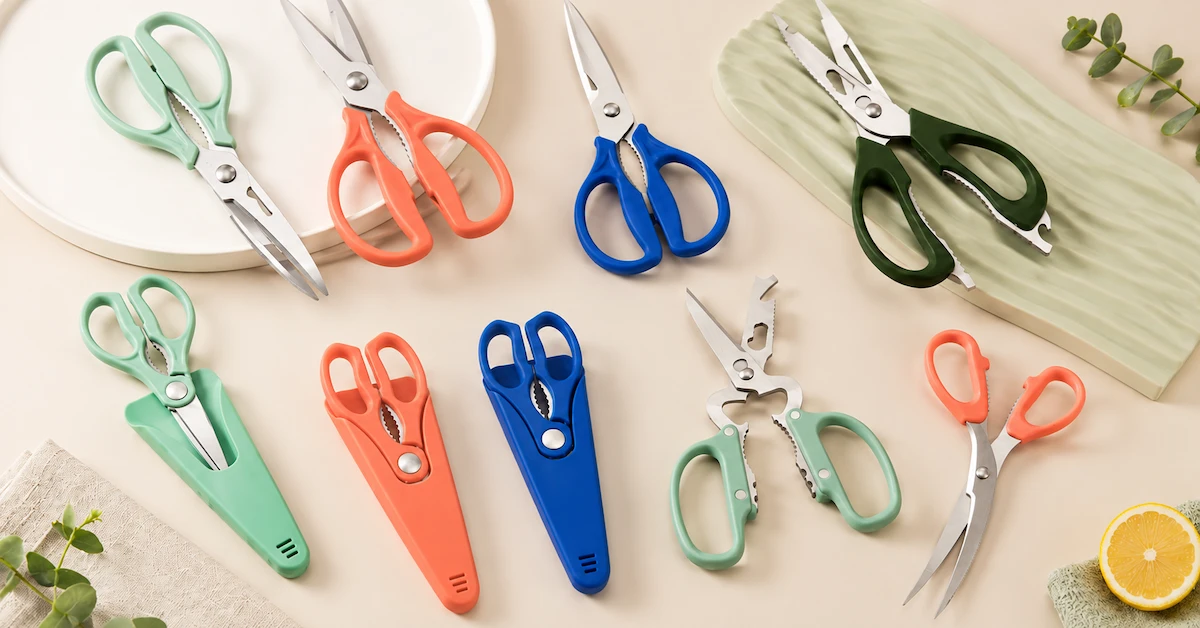
Private label success is often decided after the launch. A retailer may reorder the best-selling utensil, add a new color, or combine a kitchen scissors set with a board. If the original sample, logo artwork, packaging dieline, and inspection notes are scattered across email, the second order becomes a new interpretation.
Create a range bible with one short page per SKU. Include a product photo, revision, dimensions, material direction, finish, logo location, color reference, pack contents, carton quantity, and approved sample ID. Add a small “do not change” list for details that protect function or brand recognition. When a new color or accessory is proposed, issue a new revision instead of editing an old file in place.
Look for sensible common elements across the range: a handle color family, a consistent logo scale, a shared insert logic, or a carton-mark system. Do not sacrifice product protection for visual sameness. A board, a peeler, a pair of scissors, and a utensil set may need different pack structures even when they share one brand.
Five Mistakes That Weaken a Private Label Program
Quoting before the item is defined
An early budget is useful as a direction. It is not a locked commercial term. Change the material, dimensions, logo method, pack, quantity, or destination and the figure may move. Mark early figures as provisional and request a fresh quotation against the approved version.
Approving the look but not the use
A beautiful sample can still be unstable, difficult to clean, uncomfortable, or awkward to pack. Test the product as the consumer will use it. For a set, check every component and the way each component interacts with the insert and box.
Leaving the destination market until the end
Market and channel details can change labels, language, warnings, barcodes, package dimensions, documents, and testing needs. Share the destination at the start. Match any regulatory or food-contact requirement to the actual product, material, and market.
Changing several variables without a new reference
If color, structure, logo, and pack all change at once, nobody knows which sample is the reference. Record each revision and identify the sample that replaces the previous one. This matters even more when a project pauses for several weeks.
Using one generic checklist for every category
Shared principles are helpful, but product risks differ. A general-purpose scissors, shears, magnetic scissors, and multifunction scissors should not have the same inspection sheet. Build the checks from intended use, construction, manufacturing path, known failure modes, and retail environment.
Buyer FAQ
What should I send to a private label kitchen scissors manufacturer first?
Send the product name and use, target market, drawing or reference sample, dimensions, preferred materials and finish, logo artwork, packaging concept, estimated quantity, target timing, and any required documents. Mark undecided items as open for recommendation. A clear brief produces a more comparable response.
Can BONET handle a mixed range of general-purpose scissors, multifunction scissors, magnetic scissors, and retail scissor sets?
BONET HOUSEWARE presents those categories in its public portfolio and describes OEM/ODM support across kitchen knives, kitchen tools, cutting boards, kitchen gadgets, multifunctional kitchen scissors, and scissors. Whether one partner is right for the full range depends on each SKU's construction and requirements. Review category fit item by item, then assess the benefit of shared branding and packaging coordination.
What is the difference between an OEM sample and an ODM prototype?
An OEM sample normally demonstrates how an agreed specification will be reproduced. An ODM prototype may still test structure, material, ergonomics, appearance, or feasibility. Both should end with a controlled reference and written decisions before production.
How do I compare logo and packaging quotations?
Put each quotation beside the same product revision, artwork, material, finish, pack format, quantity, and inspection assumptions. Ask whether logo setup, samples, inserts, labels, cartons, and artwork changes are included or separate. A low line item can be misleading when its assumptions are different.
What is a typical MOQ or lead time for private label kitchen scissors?
There is no responsible universal number. A catalog utensil with a printed sleeve, a new molded handle, and a multi-piece kitchen scissors set in a gift box do not share one MOQ or calendar. Material, tooling, pack, quantity, and the live production plan all matter. Request written project-specific figures.
Can BONET support custom colors, logos, and packaging?
The public OEM/ODM page lists material and color customization, logo printing, laser engraving, packaging customization, color boxes, gift boxes, retail packaging, barcode labels, and export carton solutions. The method, artwork limits, color result, pack construction, cost, and timing should be confirmed for the selected SKU.
Final Checklist Before You Approve the Supplier
- The supplier has relevant experience with the exact category and construction.
- The quotation identifies the specification and artwork revision.
- Materials, dimensions, finish, color, logo, and packaging are documented.
- The sample review covers function, assembly, appearance, branding, protection, and pack contents.
- Quality requirements are observable and tied to one approved reference.
- Destination-market requirements are discussed before packaging approval.
- MOQ, price, tooling, sample timing, production timing, and shipping terms are confirmed for the project.
- Changes are recorded, and the production release points to one controlled file set.
- The brand team can explain the route from brief to sample, production, inspection, and delivery.
- The decision reflects total project risk, not unit price alone.
Turn Your Brand Idea into a Controlled Private Label Kitchen Scissors Range
Selecting a private label kitchen scissors manufacturer is an exercise in making the invisible work visible. Define the product and market. Choose the right route for each SKU. Connect logo and packaging decisions to the actual surface and channel. Approve observable details, keep the revision record, and ask for evidence that the production path fits the item.
To start a practical discussion with BONET HOUSEWARE, prepare your product drawing or reference image, target market, expected quantity, material preferences, logo files, packaging idea, and requested timing. The team can review whether a private label, OEM, or ODM route is the most sensible starting point for the range.
