




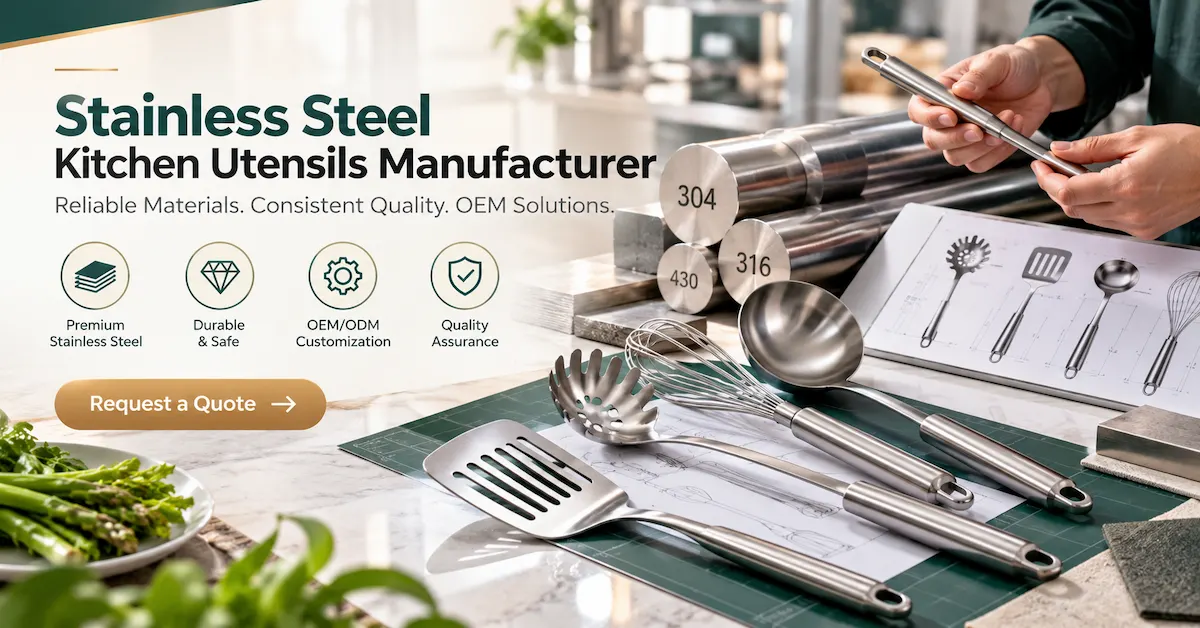
Quick Answer: What Should Buyers Verify First?
A suitable stainless steel kitchen utensils manufacturer should identify the alloy used in each metal component; show how blanks, edges, joints and finishes are controlled; provide evidence relevant to the intended food-contact market; and agree on an inspection plan for approved samples and repeat orders. Confirm the product's actual bill of materials before discussing whether a finish, grade or performance claim is acceptable.
Five documents make that conversation concrete: an approved drawing, a component-level material specification, a finish and functional acceptance plan, a retail-pack specification, and an order-specific quotation. Additional test reports should be selected according to product risk and destination requirements.
1. What Counts as a Stainless Steel Kitchen Utensil?
In everyday purchasing language, stainless steel kitchen utensils include ladles, serving spoons, turners, whisks, tongs, pasta servers, strainers, graters and related cooking or preparation tools. Yet a supplier's product category often mixes fully metallic tools, metal-and-polymer assemblies, and tools with only a stainless steel blade or reinforcement. These are not interchangeable specifications.
Take a pair of food tongs. The contact tips may be silicone while the arm or spring is stainless steel. A peeler can have a stainless cutting edge and a molded plastic handle. A serving spoon may have a one-piece formed stainless head and handle, or two metal pieces joined together. Each construction places different demands on corrosion testing, cleaning, assembly integrity and documentation.
For this article, “stainless steel kitchen utensils” refers to the category in which stainless steel performs a defined structural, functional or food-contact role. It does not mean every part of every product is stainless. Ask the manufacturer for a part-by-part drawing and bill of materials before publishing “all stainless steel” or “single-piece stainless steel” in your catalog.
A practical first step is to browse the BONET utensil category and identify the exact reference, then ask which metal parts are present in the production configuration. That category includes nonmetallic and mixed-material tools, so the category label by itself cannot establish steel content.
2. Match the Utensil Specification to the Customer's Work
Different buyers need different evidence. A supermarket developing entry-level serving tools will watch finish variation, packaging presentation and repeat price. A cookware brand will test whether a spatula or tong is appropriate for the cookware surfaces it sells. A hospitality distributor may prioritize repeated cleaning, handle stability and the ability to replenish individual tools after heavy use.
Define the real kitchen task before specifying a grade. For a soup ladle, the buyer may need a balanced reach, adequate bowl depth and comfortable transfer of hot liquid. For a whisk, spring geometry and secure wire anchorage matter. For a pasta server, slot dimensions, drain behavior and the comfort of the handle deserve testing. For a grater, tooth formation, user protection and consistent cutting action take priority over surface shine.
Ask product managers to document representative foods, utensils, cookware, washing agents, cleaning frequency and storage conditions. Those details influence material selection and service claims. They also stop the supplier from quoting the same general-purpose tool for applications that carry different risks.
A useful specification names the intended user and explicitly excludes unsuitable uses. A typical household serving tong should not automatically be sold for direct-flame exposure, industrial food processing or unusual chemical cleaning without supporting design evidence. Clearly defined use reduces returns because the customer promise becomes realistic.
3. Stainless Steel Grades: 304 vs 430 vs 420 vs 316
The term “stainless steel” is a family name, not a finished material specification. The grade, condition, surface processing and component design matter together. The following comparison gives purchasing teams a starting framework. It is general engineering context—not a list of grades currently offered for every BONET utensil.
| Grade family | Common role to evaluate | Strength or limitation | Buyer verification |
|---|---|---|---|
| 304 austenitic | General kitchen contact surfaces, formed spoons, ladles and bowls | Broadly useful corrosion resistance; actual performance depends on finish and exposure | Mill certificate, component identity, finish and intended-use review |
| 316 austenitic | More demanding corrosion environments when justified | Molybdenum-bearing grade can improve resistance in some chloride exposures, but costs more | Document why additional performance is needed; verify the supplied alloy |
| 430 ferritic | Certain formed or decorative stainless components | Different corrosion and forming profile from 304; magnetic behavior is common | Application suitability, surface performance and approved grade |
| 420 martensitic | Cutting parts such as peeler or scissor blades, where grade and heat treatment suit the design | Can be heat treated for cutting applications; do not infer the hardness or corrosion result without tests | Blade specification, processing state, finished cutting and corrosion evidence |
For standard ladles, turners and serving tools, 304 is a common comparison point, but it is not automatically mandatory or superior for every geometry. For sharp components, a grade chosen for heat-treatment capability may be more relevant. Some quotes also mention 201 stainless steel: ask about chemistry, target corrosion conditions, price assumptions and whether the finished part meets the application rather than approving a substitute by name.
Do not use the magnet test as a grade certificate. Some nonmagnetic austenitic grades can show magnetic response after cold working, while magnetic grades may still be suitable for certain products. Grade verification should rely on material documentation and, where justified, appropriate laboratory or instrument testing. Likewise, a bright finish does not prove corrosion resistance, and “18/8” marketing shorthand is not a complete product specification.
4. How to Verify the Steel Actually Used in Production
Begin with the drawing or bill of materials: assign a grade to each steel component and record the corresponding supplier material reference. The quoted steel should be traceable to the material received for manufacturing. That means a sensible link between the purchase record, batch or heat identification, incoming certificate and the produced component lot.
A material certificate may help confirm the declared chemistry, but the buyer must check that it belongs to the supplied lot and covers the ordered grade. Depending on risk, portable X-ray fluorescence (XRF) or laboratory chemistry analysis may help resolve alloy substitution questions. XRF is not a complete substitute for every test: it does not determine all light elements accurately and it cannot establish hardness, heat treatment, welded-joint strength or suitability for food contact.
For a mixed-material tool, create a component matrix. Identify stainless head, spring, shaft, rivet, weld filler where applicable, plastic grip, silicone tip and any coating. Then ask which materials actually touch food during intended use. A metal core that is fully protected within a handle and an exposed stainless serving surface create different documentation needs.
Set a change-control rule in the order: the supplier must seek written approval before changing grade, raw-material source where agreed, thickness, welding consumable, coating or handle composition. A substitution that looks visually equivalent can still change corrosion behavior, flexibility, price or the meaning of a food-contact report.
5. Forming, Stamping and Dimensional Stability
Metal kitchen utensils are frequently made from sheet, strip, wire or tube that is stamped, bent, drawn, trimmed or otherwise formed into the required shape. The route depends on the product. For a spoon, a smooth bowl and consistent wall section matter; for a turner, the blade geometry controls stiffness and how easily it slides under food. A slotted server adds a perforation process and more exposed edges.
As part of a supplier review, ask which tooling creates the working surface and how the first article is compared with the approved drawing. Key characteristics can include overall length, working-head width, curvature, material thickness, slot width, handle straightness and the stability of the finished product on a countertop. Not every dimension needs a tight tolerance; focus on those that affect use, assembly and packaging.
Thinner material can reduce unit weight and steel cost but may also increase flex and deformation. A thicker material may improve rigidity while making a tool heavier, less comfortable or more expensive. Buyers should not reward the thinnest quotation without sampling the actual load and working motion. Measure stiffness or deflection with an agreed fixture and repeatable load rather than a vague “heavy-duty” claim.
The supplier should clarify whether it forms the relevant components directly, uses an approved partner or purchases semifinished parts. Outsourcing a step is not necessarily unacceptable; missing responsibility for variation is the problem. A complete project plan identifies who owns the tool, the inspection record, rework and final product acceptance.
6. Edge Safety, Perforations and Food-Contact Geometry
One of the most visible failures in a stainless steel serving utensil is a sharp or rough edge that should have been smooth. Inspect the rim of a spoon, the tip of a turner, the edges of slots and the perimeter of a hanging hole. A burr can remain after blanking or punching even when the main face looks polished. A fingertip check may identify a concern, but inspectors should use a defined method and safe tools where needed.
For slotted tools, verify that holes are shaped and deburred on both sides. For a grater, sharpness is intentional at the cutting feature; safety requires protecting users from unintended contact points without blunting the intended teeth. Do not use one universal “no sharp edge” criterion for products that legitimately contain a cutting blade. Define dangerous unintended edges separately from functional cutting edges.
Surface continuity also matters for cleaning. A narrow crevice where a head meets a shaft can retain food. An overlapping joint that feels secure may still be difficult to wash. Examine the assembled article after a representative food-use cycle, including the spaces around seams, rivets and handle inserts. Compare the result with the cleaning instructions intended for the retail pack.
For premium kitchenware, a consistent satin or brushed finish can make an attractive retail range. But the appearance should not conceal rough weld areas, scratches or trapped residues. Specify both the look and the allowable surface condition, using retained samples viewed under consistent lighting.
7. Weld Quality, Rivets, Handles and the Weakest Point
The joint between the working head and handle is often more important than the stainless steel grade alone. A ladle may use a welded shaft, a tong can have a spring or hinge, and a mixed-metal tool may use rivets or mechanical retention. Before buying, identify how the parts are connected, which load paths pass through the connection and how the supplier detects an incomplete or inconsistent assembly.
For a welded component, inspect alignment, weld continuity, discoloration, cracks, rough transition areas and cleaning accessibility. Not every cosmetic color change means the weld is defective, but visible defects should trigger a technical review. A smooth outer surface does not alone prove internal joint strength. Ask for a fit-for-purpose bending, pull or cyclic-use method where the joint is a critical characteristic.
For riveted and screwed assemblies, test for looseness, unwanted rotation, protruding fasteners and changes after cleaning. For spring tongs, check opening force and tip alignment over repeated operation. For composite handles, evaluate expansion differences, trapped moisture, insecure inserts and the durability of the grip. The buyer should decide whether a loose handle is classified as a critical or major defect before the inspection company visits.
Document the test fixture, applied force, number of cycles or other method, and acceptance criteria with the supplier. These are project-specific acceptance values, not generic universal limits. The best way to control an assembly is to connect the agreed design to a repeatable test that both the factory and receiving team can perform.
8. Brushed, Mirror and Satin Finishes: What Should Be Inspected?
A brushed stainless finish can support a practical, professional aesthetic; a high-polish finish may suit premium gift packaging. Either can fail commercially when scratch orientation, gloss or joint finishing varies among pieces. Ask for a physical finish reference and clearly state whether the finish needs to match across an entire tool set.
Compare samples under one lighting condition and with the protective film removed. Inspect the sides, underside, hanging loop and interior corners, not just the front face used for marketing photography. A process may polish the flat head beautifully while leaving the handle attachment area rough. Scratches accumulated during assembly or shipment may have no connection to the initial polishing quality.
Cleaning and passivation are related but different activities. Removing grinding residue, oils and embedded iron contamination may be appropriate before final packaging. If a passivation treatment is specified, agree on the procedure and corresponding evidence. ASTM A967/A967M is a recognized reference for chemical passivation treatments of stainless steel parts, but citing the standard does not prove that BONET has performed a particular process on every utensil, nor does it establish suitability for every kitchen application.
Never describe a utensil as “rust-proof” simply because it is polished or called stainless. An appropriate claim should follow from the actual material, processing, use conditions, cleaning instructions and test results. If a decorative coating is proposed, add a separate review of coating adhesion, durability and whether it will contact food.
9. Design a Corrosion Test That Matches Real Use
A corrosion test should answer a specific purchasing question: what must the product tolerate in the hands of its intended user? Conditions can include wet food, salt, acidic ingredients, detergent residues, repeated washing and moist storage. The same grade can show different outcomes after rough grinding, improper cleaning or damaging handling. For that reason, test the finished product in the agreed condition where practical.
Ask the laboratory or qualified engineer to propose a method relevant to the destination market and product claims. Document the test medium, concentration where applicable, temperature, duration, drying method and assessment criteria. A salt-spray exposure can be useful for certain comparative or process checks, but it is not a universal simulation of a household dishwasher and should not be presented as proof of lifetime corrosion resistance.
Pay special attention to weld-adjacent areas, cut edges, crevices and any dissimilar-metal contacts. Visual checks after conditioning should record localized staining, pitting, remaining contamination and changes to function. The goal is not to produce an impressive number of hours; it is to create an acceptance rule relevant to actual ownership conditions.
For sellers who wish to claim “dishwasher safe,” inspect the complete assembly—not just the steel part. Handles, rivets, adhesives, decorative markings and packaging instructions all matter. A recommendation to hand wash may be more suitable for some designs, but that too should be consistent with the actual materials and consumer expectations.
10. Food-Contact Requirements: Grade Is Not a Compliance Certificate
Food-contact compliance is not established by calling an alloy “304,” “316” or “food-grade stainless steel.” The applicable review depends on the destination jurisdiction, intended food contact, surface condition, coatings, weld materials and any polymer components. A trustworthy manufacturer should be able to identify what is supplied and help the buyer arrange the required evidence; regulatory interpretation and testing should involve qualified specialists.
For the European Union, Regulation (EC) No 1935/2004 establishes a general framework for materials and articles intended to contact food. Regulation (EC) No 2023/2006 addresses good manufacturing practice for food-contact materials. EU-specific measures apply to certain material types, while national rules may address others, including metal-related requirements. Ask the relevant specialist which requirements apply to the complete article and destination rather than assuming a single EU certificate covers every stainless product.
For the United States, the regulatory analysis for substances intended to contact food should reflect the materials, their intended use and applicable authorization or other regulatory basis. The phrase “FDA approved stainless steel utensil” should not appear in marketing unless the precise meaning has been verified by competent counsel or a specialist. FDA-related paperwork for a polymer component does not automatically demonstrate the status of an attached metal or coating.
Request a dossier naming the product and revision; actual metal and nonmetal components; manufacturing treatments relevant to contact surfaces; intended foods and temperature conditions; test or supporting evidence; and any limitations. Check that reports identify the tested sample and that a change in steel grade, plating, pigment, coating or supplier is reviewed for its effect on the earlier evidence.
11. Real BONET Products: What the Published Specifications Actually Show
BONET HOUSEWARE CO., LTD. identifies itself as a kitchenware and cutting-tool supplier based in Yangjiang, Guangdong, China. The website includes stainless metal components within a broader catalog of mixed-material tools. These live product pages give buyers a useful starting point, but they must be read with attention to the product fields rather than product-description slogans.
| Model and product | Published dimension | Listed components | What to verify |
|---|---|---|---|
| U101 – Kitchen utensil set | 26.4 × 5.5 × 6 cm | 420 stainless steel; nylon | Which tools and contact surfaces are metal; the precise set contents; component drawings |
| U103 – 2-in-1 spatula/tong concept | 27.5 × 8 × 4 cm | 420 stainless steel; nylon in structured fields | Text also mentions silicone; reconcile actual contact-tip composition with the approved BOM |
| M054 – 3-in-1 peeler | Multiple L/M/S variants listed | 420 stainless steel; PP | Blade grade, task-specific cutting performance, grip and packing contents |
The U101 and U103 pages both specify 420 stainless steel and nylon in their material fields. Therefore, neither should automatically be marketed as a 304 stainless steel utensil or as an all-metal tool. U103 is a particularly important reminder: its narrative description refers to silicone while the structured “Plastic Material” field names nylon. Ask for the signed bill of materials and physically approved sample to resolve the inconsistency before the claim enters your retail copy.
The M054 peeler is adjacent to the main serving-utensil category rather than a direct substitute for a ladle or spoon. Its inclusion illustrates why the chosen grade should follow the function: a sharpened cutting component calls for different tests from a smooth serving surface. Do not extrapolate M054 blade properties to other models.
BONET publicly describes support for materials, logo work, packaging, design review and sampling on its OEM/ODM page. Whether a specific stainless steel grade, finish, weld construction or tooling change is available must still be confirmed for each requested model and quantity.
Compare Actual Models Before Requesting Tooling Changes
Start with U101 or U103 product references and explain the steel component, working task, destination market and proposed changes. Ask BONET which options are current production and which require a new technical review.
12. Use Four Sample-Approval Gates Instead of One Visual Sign-Off
The first prototype often proves only that the shape is attractive. A retail purchase order needs more. A useful sampling program separates appearance, material identity, functional performance and packed-unit readiness so a visually appealing prototype does not silently become a final production approval.
Gate 1: confirm construction
Request the drawing, version, component material matrix and target finish. Identify prototype substitutions before testing. If the supplier used another alloy or joining method to make a quick sample, record that fact; do not approve the mass-production specification on the strength of a nonrepresentative prototype.
Gate 2: verify function
Put the product through representative kitchen motions. For a tong, evaluate tip alignment, grip and repeated open-close action. For a serving spoon, assess the supported load, pouring and balance. For a peeler, use an agreed range of vegetables and check cutting function and user safety. Record the conditions so two reviewers can reproduce them.
Gate 3: approve finish and evidence
Compare surface treatment, burr quality, joint area, cleaning outcome and any planned corrosion or food-contact testing. Reject vague sign-off language such as “passed factory test” without a linked method, acceptance rule and actual result. Decide whether a test belongs to a component, finished article or production lot.
Gate 4: approve the exact retail pack
Check artwork, barcode, instructions, protective sleeves, configuration count and carton labels. A utensil that passes use tests can still arrive scratched, unlabeled or incorrectly assembled in a kit. Retain two labeled golden samples, one with the buyer and one with the manufacturer, along with the final signed revision.
For substantial design changes or new tooling, discuss a pilot run using representative production methods. Treat the pilot as a separate approval event. Every new material, handle, weld or packing revision should be checked against the relevant previous approvals, not silently folded into the next production order.
13. Quality Control Plan for a Stainless Steel Utensil Factory
Factory QC works best when each process has a defined question. “We inspect everything” does not explain which defects are prevented, how results are recorded, or who can stop a line. A stronger plan follows the product from incoming metal to finished retail unit and distinguishes safety-relevant defects from ordinary cosmetic variation.
| Stage | Critical check | Suggested record | Escalation trigger |
|---|---|---|---|
| Incoming metal | Approved grade, thickness, source and incoming surface | Lot identity and material certificate | Material mismatch or unexplained source change |
| Forming | Head geometry, deformation, slots and dimensional controls | First-piece and periodic dimensional records | Drift affecting use or downstream assembly |
| Trimming/finishing | Unintended sharp edges, burrs, scratches, finish variation | Visual reference and inspection log | Safety-related edge defect or systemic surface issue |
| Joining | Weld alignment, handle security, rivet or spring function | Functional and joint-specific test records | Loose component, visible crack or failed agreed load test |
| Cleaning | Process residue, trapped contaminants, drying | Process checklist or cleanliness evidence | Residue or unacceptable contact-surface condition |
| Final pack | Correct model, artwork, contents, protection and carton count | Pack checklist and shipment inspection | Wrong SKU, missing protection or misleading claim |
Set tolerances and tests for the selected product; the table deliberately contains no invented steel thickness, weld strength, load threshold or AQL limit. A buyer can use an agreed inspection sampling plan, such as one based on an appropriate published sampling standard, but the standard, lot definition and acceptance quality limits must be mutually specified before shipment.
Also ask how defects are isolated and corrected. A repeated burr problem calls for review of stamping, tool wear and deburring settings, not just removal of a few bad samples. If a weld fails, assess upstream preparation, equipment setup and inspection coverage rather than only adding a final check.
The BONET manufacturing page lists stamping, polishing, injection, assembly, cleaning, quality checks and packing among its processes. The page also features blade-related heat treatment and grinding steps; do not assume those operations apply to every stainless kitchen utensil. Request a model-specific process flow and quality plan.
14. OEM and Private Label: Control the Metal Before the Logo
For retailers and kitchenware brands, customization can cover geometry, handle color, metal finish, marking and packaging. BONET describes production from drawings or samples, material customization, logo printing and laser engraving, structural optimization and design support. These services provide a starting framework, but capability and commercial terms must be matched to the particular SKU.
Ask whether your proposed modification changes the part's manufacturability. A narrower handle can alter grip; a longer shaft may increase bending; a new hanging hole can add an edge to deburr; a laser mark in a high-contact area can influence cleaning or surface appearance. Treat these as design changes requiring review rather than styling decisions only.
Specify the location, dimensions and approval method for any logo. Determine whether it is placed on exposed metal or a polymer grip. Check legibility after cleaning and protection during shipping. For food-contact components, validate that surface decoration is appropriate for the intended use and does not introduce unsupported claims.
If a newly developed design requires dedicated tooling, document ownership, maintenance, access, storage and what happens at the end of the commercial relationship. Explain which intellectual-property rights are actually granted. Adding a private-label logo to a supplier's existing utensil does not by itself make the underlying design exclusive.
To avoid expensive sampling cycles, send one unified brief rather than separate emails containing changing dimensions and colors. Make one person responsible for artwork revision, one for technical product approval and one for the purchase order. A disciplined approval system is often more valuable than a promise of unlimited customization.
15. Compare Quotes by Material, Workmanship, MOQ and Risk
The cheapest quoted utensil may use a different alloy, thinner blank, simpler joint, less finishing or cheaper protection. None of those cost choices is automatically wrong; the problem appears when suppliers price different products under the same name. Insist that every quotation identify the approved material, component construction, finish, pack format and inspection responsibilities.
Ask for the minimum order quantity separately by model, material, finish, color and decoration. A single total order figure can hide component-specific minimums, especially when a coordinated set contains several differently formed heads and multiple packaging versions. Request pricing for your realistic opening order and expected repeat volume, not only a theoretical full-container price.
Separate nonrecurring costs—such as new tooling, test work, approved artwork and prototype development—from recurring unit cost. Then compare delivered cost per sellable unit after packaging, inspection, freight, duty and expected wastage. A product with a slightly higher unit price may be commercially preferable when surface protection, better repeatability or lower rejection risk changes the result.
For illustration only, not a BONET quotation, imagine an initial order of 2,000 utensils that contains four finishes. If the supplier's minimum applies to each finish, the apparent 2,000-unit order might not qualify when divided into four 500-unit lines. This is why a buyer must ask for MOQ by variation. The actual MOQ, price and tooling requirements should come from a project-specific BONET response.
Ask whether the estimated lead time starts after deposit, after final sample approval or after materials are ready. Include time for artwork, any required test report, production, final inspection, repairs and dispatch. A seller's on-time shipment forecast is not the same as a guaranteed warehouse arrival date.
16. Packaging and Repeat Orders: Protect the Surface You Paid For
Stainless metal finishes can be damaged by the shipping process even when they leave the factory in acceptable condition. Loose tools may rub against one another; a hard accessory can mark a polished head; an incorrect blister or hanging hole can stress a handle. Ask for a packed sample representing the real retail configuration and the planned shipping route.
Agree on protective sleeves, partitions, carton quantity, gross weight, dimensions and label placement. For gift sets, check that every component is secured and the pack accurately names its contents. For e-commerce shipments, review the consumer parcel as well as the master carton. A retail-ready package is one that survives distribution while communicating the correct specifications.
Provide instructions that reflect the validated use conditions, including any cleaning limitations. Do not print “dishwasher safe,” “rust-proof,” “100% 304 steel” or “food-safe” because a competitor uses those words. Link the approved claim to the relevant material and finished-product evidence and retain the artwork version in the order record.
For repeat orders, create a SKU master sheet: drawing revision, material and source controls, finish reference, packaging artwork, golden sample, inspection plan and approved supplier changes. If the factory proposes a substitute alloy, coating, rivet, grip resin or packing material, require documented comparison and approval before production.
Ask the supplier to keep lot and shipping records sufficient to investigate complaints. When a defect appears in one color or order, a useful traceability system lets the buyer define the affected production rather than withdrawing every similar item without evidence.
17. How to Evaluate a Stainless Steel Kitchen Utensils Manufacturer
A factory visit or video audit should be product-specific. Ask the supplier to walk through one selected utensil and show how it receives material, forms the part, finishes edges, joins components, cleans, checks and packs it. A video of unrelated knife grinding equipment does not prove the welding quality of a serving spoon.
Investigate which operations are done on site and which use approved subcontractors. The buyer does not necessarily need a factory to own every machine, but should know who controls the process, signs the inspection record and remedies defects. Request the responsible contact for engineering questions, sample approval, material substitutions and export documentation.
BONET is a relevant inquiry option because its website publicly covers kitchen tools and OEM/ODM services and identifies an established manufacturing workflow. However, online descriptions are not independent verification of every line, grade, certificate, capacity or batch result. A serious buyer should still request current evidence for the exact SKU, agree a factory or sample audit where justified and confirm responsibilities in the order.
A strong technical response should include three honest categories: what is currently standard, what can be modified with limited changes and what requires development or additional testing. That distinction allows both sides to match design ambition to budget and schedule without promising capabilities before feasibility has been confirmed.
For a wider comparison of general stainless products, the BONET article on stainless steel houseware inspection covers bowls, colanders and mixed sets. For a project centered on new tooling, see its custom kitchen utensil development guide. This article deliberately goes deeper into steel identity, joints, finishing and food-contact evidence for metal utensils.
18. Copy This Technical RFQ for BONET HOUSEWARE
The fastest way to get a meaningful supplier reply is to give the factory a specification it can either accept, qualify or challenge. Send the same format to all candidate manufacturers so a pricing comparison does not hide changes in grade, thickness, weld construction, packaging or scope.
Project: Stainless steel kitchen utensils for our retail, wholesale or foodservice program.
Target products: List the exact ladle, turner, tong, whisk, server or relevant BONET model references; state intended foods and kitchen tasks.
Destination market: Country or region, distribution channel, labeling language and known food-contact requirements.
Materials: Requested metal grade for each exposed or structural component; polymer or silicone parts; proposed substitutions and their approval route.
Construction: Overall dimensions, thickness where relevant, forming route, edges, slots, welded or mechanical joints and handle details.
Surface: Brushed, mirror or satin finish reference; acceptable scratches; cleaning, passivation or coating details where applicable.
Testing: Function, joint strength, corrosion/cleaning and food-contact evidence required for this project; proposed methods and acceptance rules.
Branding: Logo position, decoration method, requested colors, individual or set packaging, barcode and instruction artwork.
Commercial: Quantity by SKU and variant, trial order, expected repeat volume, MOQ by variation, tooling fees, sample cost and quotation validity.
Shipment: Target dispatch and arrival dates, packed dimensions, carton quantity, delivery basis and planned inspection milestone.
Requested reply: Mark each requirement as standard, feasible with a change, or not yet confirmed; attach sample plan, available evidence and itemized quote.
Turn This Checklist Into a Clear OEM Quotation
Choose a BONET product reference or provide a drawing, then request a component-level material answer, sample plan and quotation for your exact target market.
19. Frequently Asked Questions About Stainless Steel Kitchen Utensil Manufacturing
Which stainless steel is best for kitchen utensils, 304 or 430?
There is no single answer for every utensil. Compare the intended environment, forming requirements, finish and expected cleaning conditions. Grade 304 is a common benchmark for general contact surfaces, while 430 may suit certain components after application-specific evaluation. The accepted grade must be documented in the purchase specification and verified in production.
Why does BONET list 420 stainless steel on some kitchen tools?
U101 and U103 currently list 420 stainless steel in the metal field, and the M054 peeler also lists 420 for its blade. These are published catalog facts, not evidence that all BONET utensils use 420. Ask what each component does and why that grade is selected; cutting parts and smooth serving surfaces may need different engineering trade-offs.
Can a magnet distinguish 304 from 430 stainless steel?
No reliable finished-product grade identification should rest on a magnet alone. Material condition and processing influence magnetic response. Review lot-specific documentation and obtain appropriate identity testing where the risk of material substitution justifies it.
Are all “stainless steel” kitchen utensils fully stainless steel?
No. Many models combine stainless elements with nylon, silicone, PP or other materials. Look at the component-level bill of materials. The presence of a steel shaft or blade does not justify an “all stainless steel” product description.
Does a polished finish prove corrosion resistance?
No. Grade, processing, surface condition, residues and actual exposure all matter. A polished sample can still have problems near welds, cut edges or crevices. Define corrosion expectations and request relevant finished-product evidence before writing claims.
What should buyers check on welded utensil handles?
Review weld continuity, alignment, cracking, rough edges and cleanability. Then agree on a suitable functional or mechanical evaluation for the joint under expected use. Do not infer strength from the appearance of a single weld photograph.
Is ASTM A967 a mandatory standard for every stainless utensil?
No. It is a technical reference for chemical passivation treatments and associated checks. Whether such a process is appropriate or required for a particular component depends on the specification, manufacturing route and intended application. Do not confuse optional process standards with market-specific food-contact requirements.
Does 304 stainless steel automatically satisfy EU food-contact requirements?
No. EU food-contact compliance depends on the finished article, intended use and applicable general and material-specific or national rules. Evaluate nonmetal components, coatings, joints and supporting evidence as appropriate. Consult a specialist for the destination market.
How should an importer test a stainless steel ladle or turner sample?
Check the approved dimensions and alloy specification, inspect edges and joints, test balance and working behavior with representative tasks, review cleaning and corrosion expectations, and inspect the retail-packed sample. Record the method, observations and acceptance decision by sample revision.
Can BONET add custom logos to stainless steel utensils?
BONET's OEM/ODM page describes logo printing and laser engraving as general services. Feasibility and marking method depend on the exact model, contact surfaces, material and volume. Request a physical approved mark sample and confirm any food-contact implications before production.
What is the MOQ for a custom stainless steel kitchen utensil order?
MOQ is product and configuration specific. Ask separately about existing tools, custom grades, new tooling, decorative finishes, logo variations and retail packaging. BONET's website does not establish one universal minimum for every proposed stainless utensil, so request a project-specific quotation.
How can importers prevent quality drift in repeat orders?
Keep controlled drawings, material grade and lot documentation, golden samples, test methods, finish references, packaging revisions and explicit change approval. Audit a new batch against those same records instead of relying on the phrase “same quality as before.”
Why Choose a Stainless Steel Kitchen Utensils Manufacturer for OEM Projects?
Working with a reliable stainless steel kitchen utensils manufacturer helps kitchenware brands, importers, and distributors establish clearer material specifications, quality inspection procedures, and production requirements. Before placing bulk orders, buyers should confirm stainless steel grades, surface finishes, product dimensions, and relevant food-contact documentation.
When evaluating a stainless steel kitchen utensils manufacturer, buyers should also review sample approval procedures, OEM customization options, packaging requirements, and consistency between production batches. BONET HOUSEWARE provides kitchenware product references and customization services to support project-specific sourcing discussions.
Conclusion
The strongest purchasing decision starts with the actual steel component, not the marketing label. Verify alloy identity, inspect formed edges and joints, agree on surface and corrosion expectations, confirm the applicable food-contact evidence and approve both the functional utensil and its retail packaging. Then carry those requirements into the inspection plan for the next production batch.
For a project-specific discussion, explore BONET's U101 kitchen utensil reference, its custom kitchenware services and the contact page. Provide your intended use, target market, preferred steel grades and inspection needs so BONET can explain current options, necessary development and realistic commercial terms.
